
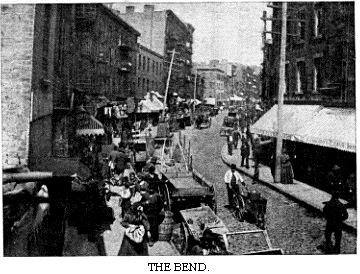
The first tenement houses were converted from the Knickerbocker houses of old New York. The rooms in the house were subdivided so that more than one family could live in the residence (Riis 5-6). Many of the tenements were on the Lower East Side, which was already a notorious place. Before the development of the tenements, various industries were located there, and turned the lake known as �the collect� into a wasteland. The lake was eventually covered with earth, and the industries left the area. Various people grabbed up the real estate in the area, and starting building 2 �-story wood frame houses on their lots (Anbinder 14-15). This was the beginning of the era of the New York City tenements, infamous ever since for their inhuman living conditions.
The main reason why the tenements were built in the first place was not only the demand for housing, but also greed. The landlords stood to make more of a profit if they developed their buildings into tenement houses filled to the brim with renters (Anbinder 18). The first New York building built as a tenement house came into being in 1833 as a four-story building housing four families.
After 1833, the number of tenement houses grew and grew, and the size of the buildings also grew. The wood houses, which were in very bad shape, were generally 2-3 stories high. The brick tenements could be built higher, some rising as high as five or six stories. The number of brick houses was larger than the number of wood houses by 1855, and thus more people could fit into the area, making the Lower East Side very crowded � even more crowded than the worst slums of London (Anbinder 73-75).