OTTO VON BISMARCK
THE IRON CHANCELLOR OF THE SECOND GERMAN EMPIRE
Otto von Bismarck, born on April 1, 1815 at Schönhausen, is considered the founder of the German Empire. For nearly three decades he shaped the fortunes of Germany, from 1862 to 1873 as prime minister of Prussia and from 1871 to 1890 as Germany’s first Chancellor. On the occasion of the 100th anniversary of his death on July 30, 1898, German News remembers the great German statesman.
After reading law at the
Universities of Göttingen and Berlin, Otto von Bismarck entered Prussian
service and became a judicial administrator at Aachen. Bismarck gained
prominence in 1851 when he was chosen to represent Prussia in the Federal
diet. In 1859 he was sent as ambassador to Russia, from where he was
recalled in March 1862 to become ambassador to France.
This victory instigated
the kingdoms of Bavaria, Württemberg, Baden and Hesse to join the North
German Alliance, an alliance of
Prussia and 17 northern
German states created by Bismarck in 1866, which led to the declaration of
the German Empire (Deutsches Reich) in 1870 and the
proclamation of King
William I of Prussia as German Emperor in Versailles in 1871. The imperial
constitution was declared in April 1871. Bismarck was
appointed imperial chancellor. The chancellor of the Reich was not responsible to parliament but to the Emperor. The Reichstag, the imperial parliament, was convened by uni versal, equal, direct and secret elections. Next to the Emperor,it was the second most important institution. However, its political influence was limited to the area of legislation. It exerted only a very small influence over the formation of governments and government policy. Characteristic of the Reich was the government over the parties" and the restriction of the peoples representation to a position in which it was only able to express a non-binding opinion on important political questions. The system was described at the time as a chancellor dictatorship". It was Bismarck as Imperial Chancellor who decided upon policy outlines and who proposed the appointment and dismissal of state secretaries who were in turn responsible for the administration of theministries of the Reich.
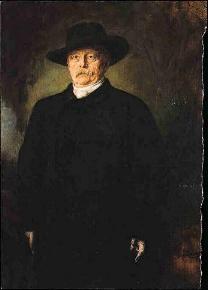
His greatest achievements, however, were the administrative reforms, developing a common currency, a central bank, and a single code of commercial and civil law for Germany. Bismarck also became the first statesman in Europe to devise a comprehensive scheme of social security to counter the Social Democrats, offering workers insurance against accident, sickness and old age. In foreign affairs, he, as a master of alliances and counter-alliances, presided over the Congress of Berlin (1872) and this seemed to symbolise his paramount position as mediator between the then great powers such as Russia, Austria, France, Great Britain. An alliance with Austria-Hungary (1879) marked a new period of conservatism in Bismarck’s foreign policy.
But by 1890 his policies began to come under attack. On March 18, 1890 two years after Emperor William II accession, Bismarck was forced to resign. His last years were devoted to composing his memoirs. But even today he is always be one of the greatest statesmen of Germany - Rexx 08.01.02
DESERT FOX - THE AFRIKAN KORPS
FIELD MARSHAL ROMMEL
Rommel, Erwin (1891-1944), German field marshal, renowned for his African desert victories during World War II. Born in Heidenheim, he joined the German army in 1910. After winning awards for bravery in World War I, he taught in military academies. In the German push to the English Channel in 1940 Rommel headed the victorious 7th Tank Division. He was made a lieutenant general the following year and placed in command of the Afrika Korps in North Africa.
By 1944, Erwin Rommel had a lifetime of military experience behind him. He was awarded the Pour le Mérite, Germany's highest decoration for bravery, for capturing 9,000 enemy soldiers during World War I. During the invasion of France of 1940, Rommel commanded the notorious Ghost Division--the German 7th Panzer Division. Pushing every man and machine to its limit, Rommel's forces advanced 350 miles in six weeks (an unheard of distance for tanks during that time).
Rommel was a popular, although unconventional military leader. Rommel's method of command was also unique. While other officers directed battles from a strategy room located far from the field of battle, Rommel chose to lead from the front. Rommel felt it was important for the commander to always be near his troops. When the troops had to build a bridge or when a supply convoy was in trouble, Rommel was known to lend a hand.
Rommel earned worldwide recognition for his leadership of the Afrika Corps during the North African desert campaign. From 1942 to 1943, Rommel was at the top of the Allies most wanted list. His ability to show up, when and where his opponents least expected, earned Rommel the nickname "the Desert Fox." Initial successes in the desert campaign, however, were followed by crushing defeats at the hands of better equipped Allied forces. The Allies marched victoriously through North Africa in May 1943. From there the Allies landed in Italy and by early 1944 were marching steadfastly toward Rome.
In 1944, the western front was the only arena that had yet to receive a full Allied frontal assault. Hitler charged Rommel with defense of the western front. He began by touring the western coastal defenses from the North to the Mediterranean Seas. He was discouraged by what he saw. The defenses were widely scattered and none could withstand an Allied offensive attack. The infantry defending the coasts were in worse condition. They included POWs and German soldiers exhausted from fighting the Russians. They were poorly organized, poorly trained, and lacked artillery; in some cases they even lacked the physical strength to endure intense military action.
Although the situation was bleak, Rommel set to work to bring order to the western front. The mere appearance of Germany's national hero had a positive effect on troop morale. Rommel organized the troops and put them to work fortifying western coastal defenses - the Atlantic Wall. He made daily inspections of the progress on the Wall. Rommel functioned as an architect, personally designing many of the obstacles for the Atlantic Wall. Minefields, concrete and steel obstructions, and artillery posts sprung up at a startling rate.
While construction continued on the Atlantic Wall, the German leadership debated strategy for the defense of the coast. Rommel, aware of the strength of the Allied forces, contended the Allies must not be allowed to establish a beachhead on the coast. They must be thrown back into the sea. Rommel proposed that all available men and material be positioned as close to the coast as possible. Field Marshal Gerd von Rundstedt, Rommel's immediate superior, argued that sufficient forces must be kept on the coast, but a large contingent of forces should be kept in reserve, away from the field of battle so that a piercing counterattack could be launched.
In the end a compromise was reached, giving Rommel command of the army, but also placing a small reserve of troops far from the battlefield. Rommel, however, did not have complete control over all of the German armed forces. Unlike the Allies, who in Eisenhower had a commander with absolute control over the army, the navy, and the air force, Rommel only controlled the army. The German navy and Luftwaffe functioned under separate and autonomous command. Effective organization was further hindered by Hitler's insistence that all orders be approved by him, thus making the formation of a single-minded defense plan for the coast impossible.
On June 6th, 1944, the construction and planning of German defenses in France came to an end as the Allies launched Operation Overlord. Due to the inclement weather, Rommel thought that an attack would not be launched. He used the opportunity to travel to Germany to celebrate his wife's birthday. Upon hearing of the attack, Rommel rushed back to the Normandy coast, arriving at 10:00 p.m. The initial Allied attack had been a bruising one. Although Rommel's Atlantic Wall inflicted casualties on the Allied forces, the sheer number of men and material participating in the invasion and the supremacy of the Allied air force far outweighed the effectiveness of the coastal fortifications. On D-Day, the Allies were able to put over 8,000 planes in the air, compared to Germany's three.
Rommel commanded the German forces tirelessly, traveling to the front, and inspecting and encouraging the troops. But the Germans suffered from lack of supplies and the continual onslaught of Allied air power. Without sufficient manpower, Rommel was unable to launch an effective counterattack. By mid-July German losses topped 100,000, yet only 6,000 replacement troops had arrived.
Realizing the war was lost, Rommel went to Hitler to bring the severity of the situation to his attention. Rommel proposed re-establishing a defensive line on the Seine, to secure the German borders from Allied attack. Hitler rejected the idea--France was to be defended to the last man. Shocked by the Führer's lack of understanding of the situation, Rommel discussed with other German officials the possibility of opening secret negotiations for peace with the Allied leaders. On July 17th, 1944, the possibility of such negotiations taking place evaporated when Rommel was seriously injured in an attack by an Allied plane. The injuries effectively ended his involvement in the Normandy invasion.
There had been frequent rumblings of plots to remove Hitler from power. In 1944, the conspirators made overtures to Rommel to gauge his interest in the plot. Rommel and Hitler were once close friends, but since the defeat in North Africa and Hitler's "victory or death" proclamation, Rommel viewed Hitler as a madman who would destroy Germany. Although he would have no part in an assassination attempt against Hitler, Rommel did say that he would consider being the leader of Germany after Hitler's removal from power.
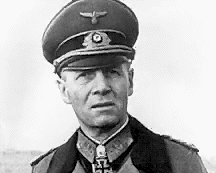
Rommel was recovering from his injuries when the assassination plot was launched. Under torture, one of the conspirators mentioned Rommel's name, implicating him in the plot. As friends and fellow officers were arrested as conspirators, Rommel realized the end was near. On October 14th, 1944, two generals came to Rommel's house and gave him an ultimatum. Either take his own life and be buried with full honors or stand trial and put the future of his wife and son in jeopardy. Rommel said good-bye to his family, went with the two men, and swallowed poison. He was buried with full honors.
-Rexx 08.01.02