 |
|
|
|
|
|
|
|
|
|
|
|
|
|
|
|
|
|
|
|
Amphilophus Labiatus |
|
|
|
Red Devil |
|
|
|
 |
|
|
|
Size: In the wild, this species rarely grows past 9", yet captive specimens ruitinely reach 10-12", with males usually growing larger than females. |
|
|
|
Origin: Lake Nicaragua and surrounding crater lakes. |
|
|
|
Temperament: This is a very territorial species. Cohabitation of multiple Labiatus and with other species is possible, but only in very large aquariums. In tanks over 300 gallons there are usually no problems |
|
|
|
Minimun Tank Size: Because of their large size a 75 gallon is recommended for a single Red Devil. A 55g is suitable for a grow out tank, and may possibly house a small female through adulthood. |
|
|
|
Availability: Red Devils are common at any LFS, but most of these fish have Amphilophus citrinellus genes somewhere in thier background. For a 100% Labiatus, buy F0, F1, or F2 from a trusted source. |
|
|
|
May Be Confused With: Amphilophus citrinellus and other similar Amphilophus species. |
|
|
|
|
|
The common Red Devil Cichlid, sold at every Pet Shop in North America, is in most cases a hybrid with Citrinellus genes in its background. Many people fail to recognize the differences between Amphilophus labiatus and Amphilophus citrinellus, and will let the 2 species hybridize together. This can even happen at the breeding facilities. Never let the 2 species hybridize in your aquarium.
The Labiatus is most commonly found in nature as a grey and black striped fish, but like so many other Central American species this one is characterised by polymorphism and up to 10% of the population morphs into red, yellow, orange, white, or pink after they are several inches long. These brightly colored Labiatus are the morph that sells the best and because of this the duller striped Labiatus are virtually never exported from Nicaragua. The rarity of the normal grey Labiatus makes it the most sought after color morph in the hobby even though they are less attractive. It is thought that the bright color morphs are an adaptation to allow the fish to breed in deeper water that is usually murkier. In this eviroment the small fry cannot see their parents unless the parents are a very bright color (Yellow, Red, Orange).
I have several yellow and orange Labiatus in my collection. Many are kept together in a 500g aquarium. None show very much aggression to each other or to their tankmates. I can even house them with much small fish which are never bothered. They are fed a varied diet of Hikari pellets, fresh sea food, live worms, live crayfish, and leafy vegetables.
|
|
|
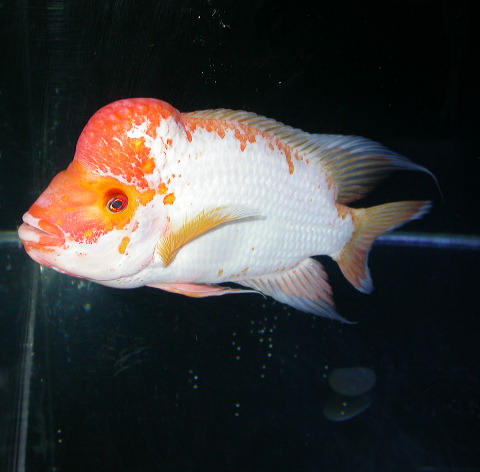
| The picture below was gratiously donated by Drew, co-administrator of www.cichlidmadness.com. This fish appears to be a very old male Labiatum of the "White Marble Variante" as shown in the aqualog book. |
|
|
|
 |
|