 |
|
|
|
|
|
|
|
|
|
|
|
|
|
|
|
|
|
|
|
|
|
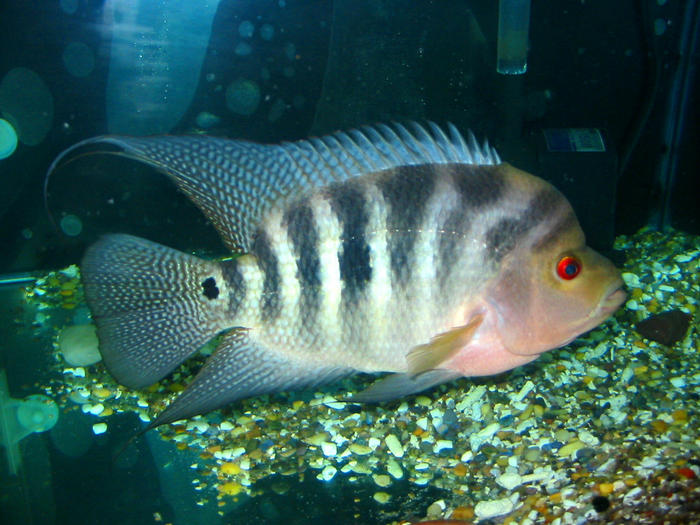
Amphilophus Citrinellus - Normal |
|
|
|
Striped Midas, Barred Midas, Grey Midas |
|
|
|
 |
|
|
|
Size: The reported maximum size of this fish in the wild is 10". Although old captive specimens have been known to reach 14"+ on many occasions. |
|
|
|
Origin: The Citrinellus is native to the eastern slope of Nicaragua and Costa Rica. |
|
|
|
Temperament: Extremely aggressive under most circumstances. Young fish can usually be kept in a group in a large tank with minimal problems. Though, as they mature most individuals will become very aggressive to the point where they would have no problems killing other fish. Do not try to intoduce 2 adults into a small tank together without a divider, as it will in most cases end with one of the fish's death. |
|
|
|
Minimum Tank Size: A 55g will be suitable for a small female, but a very big male may need a tank as large as 90-125g+ |
|
|
|
Availability: The availability of this color form varies. In the past this variante has been overabundant. In the recent past it has been extremely scarce. Currently it is available from a few breeders and is highly saught after, although that will change once people realize that the Striped Midas is just a less attractive form of the common Citrinellum!
|
|
|
|
May Be Confused With: Suppliers often have trouble differentiating between the fish of the "Midas Complex" and its not unheard of for Zaliosum, Citrinellus, Labiatus, Hogaboomorum, and others to be confused with each other, |
|
|
|
|
|
|
|
Other Information and My Experiances
The normal morph Midas is a fish I was after for a long time. I was finally able to get a small group around over a year ago. The Grey/Barred Midas are now 5-9" TL. These fish came from Rio San Juan, Costa Rica. Midas are not often found in rivers with a swift flow, but this one is particularily sluggish. It is quite interesting to see the differences between this race (which is somewhat more elongated and has flashier lips) and the more common Nicaraguan. I'm hoping to breed the Midas, but they have shown no spawning behaviour so far. For a long time the male was very shy and hardly ever came out to eat. I had to lure him out with nightcrawlers for 3 months. But thankfully he has now began accepting floating pellets, which is a big relief. Currently he is in a 500g with many other cichlids and is putting on a lot of weight. |
|
|
| The Nicaraguan race is usually yellowish with dark black stripes. The individuals of the Costa Rican race however are usually either solid grey, or grey on grey striped, often have a pinkish chest, and also often showing a more pointed snout.. Below is a superb example of a Costa Rican Midas that is owned by Michael Yang. |
|
|
|
 |
|