

View My Guestbook
Sign My Guestbook


|
|
| As we look at our present day situation as far as automobiles go, their future does not look very bright. Even if we do not run out of oil the current transportation system will soon become so overcrowded that no one will be driving anywhere in a hurry. Take Los Angeles for example, which has the highest population density per square mile of any us city. With an urbanized area density of 5,800 residents per square mile, LA has a freeway system that is at least one-third too small to accommodate travel demands. The reason for this is very simple higher population densities mean more cars per square mile, more travel per square mile and thus, more traffic congestion, not to mention air pollution. The amount of travel time spent in rush hour traffic has slowly increased since 1982, resulting in over 2/3 of rush hour travel time spent sitting in traffic for most commuters. The national average is 34 hours a year, up approximately 30% over five years. At the same time there is considerable concern about highway impacts, especially air pollution, and the fear of future petroleum supply shortages. So far the most popular solution to this growing problem has been to simply build more roads. This is a temporary solution, which cannot continue forever, and only results in more air pollution and higher taxes. |
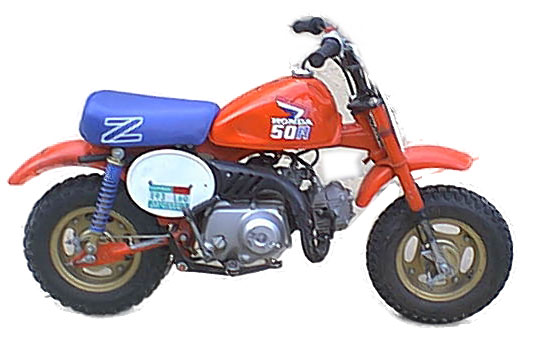
| For my final report I decided to measure the gas mileage of a small Honda 50cc motorcycle that I could compare it to economy cars and try to prove a concept that I think could greatly reduce the traffic problems that are plaguing our cities. First off let me tell you a little more about my bike and the experiment. |
|
|
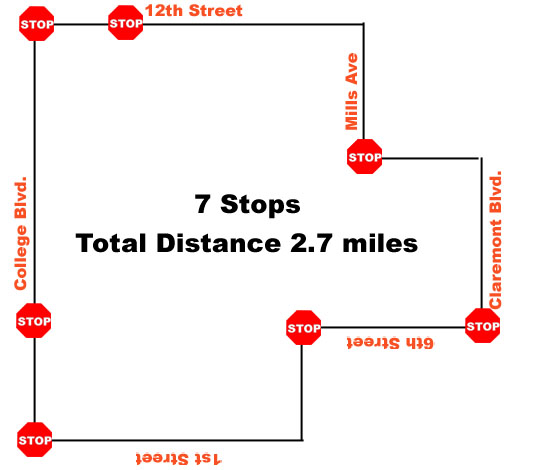
| The bike was built in 1986, cost $600, and has a top speed of 35 mph. It was designed for kids from ages 4-6 and is very easy to drive. For my experiment, what I did is measure out the distance of a lap around the college with my car and then drove around and around for about 2 hours and counted the number I laps I did. |
|
|
| There were 7 stops along the 2.7 mile lap. Before I started I filled my gas tank to the very top so when I was done I just went to the gas station and filled my tank to the top again to see how much gas I had used to go my distance. From this I was able to calculate the miles per gallon, which turned out to be 95. You heard me right 95 miles from one gallon of regular gas. The most efficient economy cars only get about 35 miles per gallon in the city. If you go out on the road later today take a look around at how many people are driving by themselves. Surveys have shown that about 75 percent of people drive alone to work every day. In the same amount of space that a car takes up on a road I figure that at the very least 9 bikes can be driven with ample space to maneuver around. With this in mind I am going to calculate how many bikes can fit in the same amount of space that one mile of cars can fit in. |
| An average car (driving safely) takes about 35 feet of space in one lane of highway. |
| 35ft divided by 5280 ft/miles = about 150 cars per mile of highway |
| so 9 motorcycles per car times 150 cars = 1350 motorcycles in one mile of freeway |
| Right now it is legal for me to ride my bike in any bike lane, but think of the possibilities if these bikes were allowed on the street. A normal 1-lane road would be able to handle more drivers than a 5-lane freeway. Traffic would practically be eliminated and commute times would be significantly reduced. And the best thing is that no new roads or freeways would have to be built. Bicycle lanes and the far right side of the street could be designated the motorcycle lane, new lines could be drawn, bikes and cars could both drive on the existing roadways. If the U.S. Department of Transportation figures I found are correct, the amount funded for highway construction in California in 1999 was more than $1 billion. The money we would save could be used on more important things like schools and environmental cleanup. |
| Also the current problems like the oil shortages and air pollution would be solved because people who choose to drive motorcycles would be using about 1/3 as much fuel to travel the same distance (that's not even counting the fuel that would be saved because of the shorter commute times.) Also the problem of parking space would be solved. I ride my bike to class everyday and can lock it between two bikes on the bike rack, if we were to park the bikes in a parking lot you could probably fit about 12 motorcycles in one parking spot. This is another way that time would be saved. And let me remind you the engine on my motorcycle was designed and built in 1986, I'm sure that more efficient and powerful compact engines have been built since then. |
| Now I know that there is an issue of safety when riding motorcycles, but I really do not believe it is a big issue if you consider the performance of the motorcycle. It can only go 35 mph, and from this speed can come to a complete stop in about 12 feet of space. People can go faster than this on ten speed bicycles, and a fall at this speed usually results in only minor scrapes and bruises. People would of course wear helmets and a thick jacket would provide ample protection in case of an accident. |
| I truthfully believe that these motorcycles can be the answer to all our problems. The idea may seem a little silly, but if you consider the facts, the possibilities become all to clear. Now I realize that Joe the big shot executive who lives in the gated community in Beverly Hills isn't likely to ride a miniature motorcycle to work. But there are those of us who would like to have the opportunity to save fuel, cut pollution, and yes, leave the roads a little less crowded. |
| If you want to support this idea please sign my guestbook and tell your friends about this site. |
| View My Guestbook Sign My Guestbook |