|
LN-
|
Thanks for agreeing to talk with us, Brian.
|
|
BB-
|
My pleasure.
|
|
LN-
|
Perhaps you'd like to just sort of discuss where you see the
Indy Racing League going in terms of technology.
|
|
BB-
|
In a general sense, or about engines specifically?
|
|
LN-
|
Whichever you prefer.
|
|
BB-
|
Wow, that's a lot of ground. I guess to begin with I'd have
to restate the IRL's commitment to keeping costs down. That's
really fundamental to the direction we see for ourselves, and we
believe it's what our fans want to see, as well.
|
|
LN-
|
So technology-wise, you're saying that you're basically a
cost-driven organization?
|
|
BB-
|
Yeah, that's probably right. If we can get the same job done
in terms of performance with a $90k motor instead of a $250k
motor, that's obviously the direction we'd like to take. Of
course, we've had to move slower in that direction than perhaps
we'd prefer, but the current package provides a good
intermediate step.
|
|
LN-
|
Could you expand on that?
|
|
BB-
|
Sure. We started, largely out of necessity, with 2.65 liter
turbocharged Fords, and if memory serves they were good for
around 850 horsepower. They were also quite expensive. Mr.
George rightly suggested that 650 to 700 horse would be
completely adequate for our needs, both in terms of speeds on
the sorts of tracks we run and for the skills of our drivers.
Our current 3.5 liter naturally aspirated engine meets our needs
at the moment, but even with League mandated pricing at $90k
per, they're quite a bit more expensive than we'd like to see.
Running the kind of revs necessary to get that output out of a
3.5 liter takes some expensive technology.
|
|
LN-
|
So what do you see as being an ideal solution?
|
|
BB-
|
There's an old drag racer's line that says something about
the only substitute for cubic inches being cubic money.
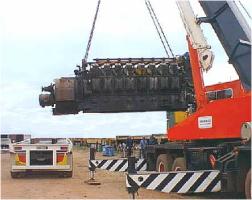
Eventually, we'd like to see a seventeen or eighteen liter engine spec,
limited down around 1800 rpm. That'd give the little guys a real
chance, just like in the old days. Anybody could have a
truckload of sand delivered and be casting blocks within a few
hours from League-approved wooden bucks provided by one of our
approved manufacturers. We'd mandate the buck rental price at
around $20, and one set should last for years as long as they
don't get left out in the rain by one of the really low-buck
outfits. All in all, a team should be able to get a complete
engine together for well under a thousand dollars, maybe less if
they make their own rope gaskets.
|
|
LN-
|
That would make a significant difference to some struggling
teams.
|
|
BB-
|
It's not just about cost. That sort of specification is much
more noise efficient, as well.
|
|
LN-
|
Noise efficient? I'm not familiar with that term.
|
|
BB-
|
It's a simple principle. All engines, from the lowliest
tin-can Honda to the most powerful, umm, what's that big
powerful American car again?
|
|
LN-
|
Cadillac?
|
|
BB-
|
Yeah, to the most powerful Cadillac, are capable of
producing almost infinite horsepower. Even the teeniest
weedwacker could make enough power to push a locomotive through
the highest mountains in Indiana. The problem is, an engine
making place-
|
|
LN-
|
A factory?
|
|
BB-
|
Yeah, a factory, is a very noisy place. Lots of equipment,
lots of machines, they're really noisy inside. Anyway, as the
engine is being made all of this noise gets packed up real tight
inside, really screwed down in there. The noise is kind of like
cholesterol and clogs up the engine, slowing it down and keeping
it from making the power it could.
|
|
LN-
|
This is fascinating.
|
|
BB-
|
Isn't it, though? Anyway, the key to getting more power from
an engine is to help more of that noise get out. It's like when
you get a hole in your muffler, and suddenly you've got all of
this extra power- that's because you're letting more noise
escape from the engine. That's why glass-packs work so well; I
put them on all of my cars.
|
|
LN-
|
I think I follow you now.
|
|
BB-
|
I know, it's kind of hard to get your head around at first.
Like I said, you've got to let the noise escape. That's one of
the problems with CART's engine spec. They're a nice engine, but
even turning those really high revs and using all of that
expensive technology the cars themselves only end up around ten
mph faster than ours. The problem's that turbo- it traps all of
the noise inside and slows them down. That's why they're so
quiet, too.
|
|
LN-
|
That makes sense, sort of.
|
|
BB-
|
Stay with me, now. An eighteen liter, sandcast block making
650 horsepower at 1800 rpm is going to make an absolutely
ungodly sound, a noise completely unknown in human experience.
And it's gonna be loud, incredibly loud, insurance claim loud.
It'll be noise efficiency incarnate. We might even try a two-stroke.
|
|
LN-
|
This is really exciting.
|
|
BB-
|
For the chassis-
|
|
LN-
|
We're out of time.
|
|
BB-
|
I know. For the chassis, we'll-
|
|
LN-
|
Would you like to come back and talk about chassis?
|
|
BB-
|
Uh, OK.
|
|
LN-
|
Thanks again for your time, Brian.
|
|
BB-
|
It's been my pleasure.
|