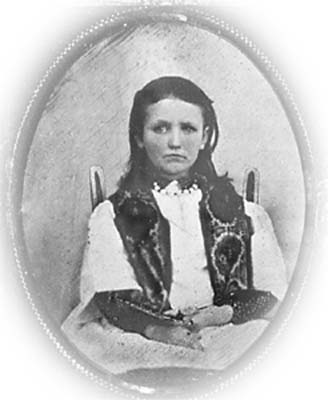
"Life's History of One of Our Pioneers" (Hannah Tranquilla McNaughton Gattis)
by Mrs. C.E. Haywood, THE BRADY STANDARD, Tuesday, July 13, 1926.
A LONELY MOTHER
As my thoughts often wander back to childhood, I think if I should write of those days, perhaps some reader would enjoy it. The suns and moons of over 70 summers have passed, yet memory often calls be back to that terrible war, called the Civil War or the "rebellion".
Many were the happy homes that were in grief-- fathers and brothers, with the widows, sons, were to take a part and honor their country. My noble and loving brother was to go-- my mother's oldest child. Our grief to see him go was great. In the march to his first battle, e're he had fired a gun, his life was taken by a bursting bomb shell. My other brother was seven years old, so I was his chum and we were together in work and play. My dear grandma, who lived some 35 miles away, was sick, and wanted me to come. My aunt's husband was in the war, and only a servant girl and two small children were with my grandma, yet I loved her so much, I was willing to go to help care for her. I hated to leave my mother, but she had Father and two sisters older than myself with brother.
An old man, and neighbor of Grandma's came to go with me. To ride horseback was a delight to me, and I rode my favorite mare, Polly. Times were getting dreadful all through Tennessee. The Northern armies were holding possession of the country where they could get supplies to live on the citizen's stock and fowls. A regiment of Union soldiers was stationed near my aunt's home. We could often hear them shooting the chickens and pigs. They killed the cows and calves, to supply their needs. Not far from Aunt's she had put in a piece of cloth to weave for our use, at a neighbor's that lived off the public road. One evening we heard the soldiers were cutting out of the looms every piece of cloth they found. After dark, Aunt took me and the servant and went to see if they had got hers. I remember how we feared meeting the scouting soldiers. We found the cloth in the loom all right, and never met a "Yank." Aunt cut her cloth out herself, and then had to keep it hid. Sometimes we would hear of a skirmish fight near Fayetteville, when the Confederate army companies called "bush whackers" would be coming in , and there were those who had little mercy for a "Yank."
When I had been some time with my aunt, another aunt came and took me to her home, some forty miles over in Alabama. They lived on a public road that ran from Salem, Tennessee, to Scottsboro, Alabama. Near Salem there was in camp a Northern army, and after I had gone with this other aunt, we heard the "Yanks" were leaving for Scottsboro. They had done about all the damage, only to gather up all mules and horses they could find. Soon they began passing, leading the stolen horses. One day we saw a bunch of them turn into a dim road that led to the pasture where my uncle's horses were. Soon we could see them coming with all of uncle's horses and mules, and with them my pretty Polly mare. I cried, for I knew I would never see her again. They cut out what they didn't want, and that bunch went on. The next squad that stopped went in my aunt's kitchen, got some knives and went to the barn and killed the fattened hogs, and put them in a wagon and took them off. My poor old feeble uncle couldn't say a word.
The army was passing for a week. Early one morning, Aunt sent Cousin Alice and myself to bring in wood. When we stepped out some bullets went whizzing over us, and we saw some "Yanks" turning loose mules and horses-- they were running for their lives. My old uncle came out, saw the men, and knew them to be bush whackers, for they were gathering up the horses the soldiers had turned loose. He begged them not to do that way any more, and if they wanted to do so, to not hide near a home to kill some man. When they took off the horses we thought they wouldn't come back. In a little while we saw a lone soldier coming, leading two horses. Those bush whackers had come and hid near the house and began shooting. As we looked, a bullet hit the man and he fell from his horse, and we heard his groans. These men ran down and took his guns and belt of cartridges and two horses, and went to the bushes with them. Dear Aunt said to us children, "Come and go with me to the man, he is some mother's son." We three children went with Aunt. I can never forget the man's pitiful groans, for he was shot through the body. A cold rain was falling, Aunt sent us in the house for some quilts. We put one by the poor man and got him on it, and then covered him over. Uncle had come to us, and he saw some more soldiers coming and beckoned for them, but they saw the man on the ground and started back. Uncle begged them to come and carry the dying man in the house, and told them we would do all we could for him. These soldiers handed Cousin Alice and me their guns and ordered us to keep close to them, they spoke very gruffly to us, and we obeyed. They jerked up the dying man and carried him in and said they would send some one next day. They never did. My aunt sat by the man and asked him his name, and of his home and people. He said his name was Thomas Baker, his home was in Star County, Ohio, and that his mother was a widow and he her only son. Soon he was dead. There were none but old and crippled men in the country, but Aunt sent for them and the neighbors came and sat up that night, and the men next day made a coffin for him of undressed pine, and Aunt put him in a sheet and pillow, and he was placed on chairs. Snow and ice was everywhere. No comrade was sent from the army. After two nights had passed, his body was taken to Beach Grove cemetery and he was buried in January 1862. In 1882, my children were in school near the cemetery and some men came and took up the remains, which were placed in a soldier's cemetery, we do not know where.