![]() |
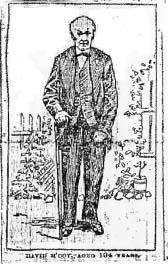
San Bernardino Has the Oldest Pensioner of the United States. He Helped Kill Tecumseh David McCoy has passed his hundredth birthday in May 1890 - Hale and Hearty at One Hundred and Four Save For a Touch of Le Grippe - He Tells the Story of an Eventful Life. According the Joseph Medft of the Chicago Tribune, _________ is not attainable in California due to the prevalence of lime in the drinking water. It is an indisputable fact, however, and constantly being proved in California has produced and contains some of the oldest people in America. Among all whose history has appeared in the columns of the Examiner perhaps as interesting a character is David McCoy, the oldest living pensioner of the war of 1812_________?county as his residence. The venerable centegenerian's last seven years of life have produced little if any, perceptible change in the man, aside from he fact that |
|||
|
he is somewhat feeble and spends more of his time in his room. He pleasantly attributes his present weakness not to age, but to a "heavy" cold, or what the doctors nowadays call the grip, which attacked him two years ago.
Think of a man 102 years of age having le grippe, and that, too, in such severe form that no one expected him to recover. But recover he did, and, barring the slight feebleness referred to, David McCoy is as well and hearty as most men are at seventy. "So you want to know the story of my life?" he remarked as the Examiner correspondent seated himself in the little room which most of the time of this patriarch is spent. "Well, there isn't anything of importance in that. Ask me any questions you have and I will be pleased to answer them." And there that man who has lived through more than a century of history and witnessed the birth and marvelous growth of a new republic, told the story of his life's career. It was like a voice from a dead past which has become almost tradition and it was spoken in a slow, plodding, methodical way, which gave an insight to the character of this man. He makes me comfortable, then sits in his chair with head down, as if in meditation and talks as if to himself. "I was born in Burke County, North Carolina, on the 2nd day of May, 1790, a year after General Washington was inaugurated. My father, Hugh McCoy, was a Scotchman and fought in the British army in the war for independence. He was not a military man, but was conscripted into the British army while on business for his father in one of the seaport towns of Scotland. He was sent to New York and placed in Lord Howe's army, and I have heard it said that he was one of General Howe's best soldiers. Well, he was wounded in an engagement and was taken by his commanding officer to John Franklin's house in New Jersey. Mr. Franklin was a good patriot, but the British compelled him to take care of my father until he recovered, when he refused to re-enlist in the invading army and he sought and won the hand of his benefactor's daughter, Miss Jemima Franklin. Soon after marriage they removed to North Carolina to live, and six children were born to them, three sons and three daughters. |
||||
| "I was the fourth child, and when I was four years old my father concluded to go to Scotland to look up some property which he supposed belonged to him. Ships were very uncertain in those days, and we never heard from my father again. The country was new and my mother's means were limited, and with six children to support, we were not indulged in many luxuries. I remember that I did not have a pair of shoes until I was twelve years old. That was when I rode the family horse to carry corn to an old mill near by to have it ground into meal for the family board. Such a thing as a hat I did not have until I was big enough to set traps for musk rats and exchange the skins for one. My uncle was a hatter, and I was very proud when I had captured sufficient rats to pay him for a plain fur cap.
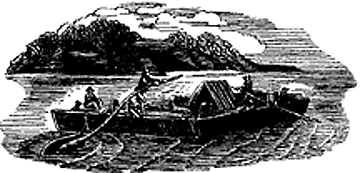
"I never went to school a great deal, and cannot boast of a liberal education, but I remember perfectly well mu companions at the first school I attended. One of them was Washington Irving, the historian, who was a boy of somewhat ___habits and ___but very quick to learn, and with a fondness for books. My cousin, Irving McDowell, also went to school with me "I have lived out of doors a great deal and I think that is one of the causes of my long life. In 1812 I hired out to go on a river expedition with a cargo of lumber and produce to New Orleans, journeying down the Kentucky, thence down the Ohio to the Mississippi. The journey was made homeward, a distance of 1,000 miles on foot. The lonely traveler carried his blankets and when night overtook him camped beneath some trees, with the twinkling stars and silvery moon as silent watchers of his slumber. I used to wonder as I sat down to rest near some attractive spot if I should ever live to see those great fertile valleys peopled with towns, cities and productive farms. But the transformation that has taken place has been swifter and more wonderful than I ever dreamed. "Then the war with Great Britain came on. In 1812 I had removed to Clay county, Kentucky, and was engaged in the production of saltpeter. There was at that time considerable anxiety about the state of affairs with England, but many people did not give it much thought, thinking matters would soon be righted. I was a strong Republican and favored prosecuting the war. One day the news came that Congress wanted volunteers to go to Canada to help General Harrison take Fort Malden. Not waiting for a second invitation I made preparations to go. Taking my rifle and mounting my horse I rode to Canada __I enlisted in General Isaac Shelby's____of Harrison's army. Shortly afterward the battle of the Thames river was fought ___Proctor, the British General, and his Indian ally, Tecumseh, were defeated. "I cannot tell you much about the position of the different armies. I only know that I was there to fight British and Indians and I shot at them. There was a great deal of rejoicing and shouting when Tecumseh was killed. A few minutes after his death I went over and looked at his body. The soldiers had taken his scalp and cut away pieces of skin from his legs between the thighs and knees for trophies, and the great Chief was not pleasant to look at. His face was hideously daubed with warpaint and he wore a necklace of teeth of wild animals, a headgear of eagle feathers and was dressed in the usual buckskin costume prevalent among chiefs of that day. After the battle the volunteer troops were discharged and I returned to Kentucky. I bore my own expenses and the Government rewarded me by paying me $1 a day and 60 acres of land, for which I received a warrant in 18??. "I was married in 1815 to Miss Lucintha Davis, a granddaughter of Martin Smith, the man who gave me my first employment, and we removed to Indiana, where we lived until 1821. "At the time when gold was discovered in California I went to Lewis county, Missouri, and entered 160 acres of land near Canton. That portion of the country settled up very rapidly, and established there had called it Bunker Hill. The petition was granted and I was appointed Postmaster. The post office still exists. It was while living there that I received my warrant for the 160 acres of land in payment for services in the war of 1812. "I came to California in 1862, coming overland in wagons drawn by horses. It took us four months to make the trip. There was considerable trouble with Indians at the time, but we were fortunately unmolested. However, we reached a fort about two hours after it had been attacked by a band of Indians and two white men killed, and we reunited there to assist in guarding the fort until re-enforcements could be secured. |
||
| "On August 4, 1863, I reached Marysville and soon after settled on a farm on the Sacramento river to Sutter County, where I lived three years, when I removed to this place. In 1871 my wife and I returned to our old home in Bunker Hill, Mo. where most of our children were living. Here, in 1877, my good wife died. She had been a noble and faithful companion to me for sixty-two years and her death was a great blow to me. Since that time I have lived here with my daughter, Mrs. Morris, and I will ;ass the remainder of my days in the Golden state."
During his life, Mr. McCoy has associated with and saw many prominent men, the Crittendens of Kentucky, Henry Clay, William H. Harrison, Washington Irving, Andrew Jackson and others. On the morning of his 100th birthday he penned the following message to his friends: May the 2nd, 1890. I am 100 years old this day, born in Bourke county, North Carolina, May the 2nd, 1790. ________________David McCoy
|
|||||||||||||||||||||||||||||||||||||