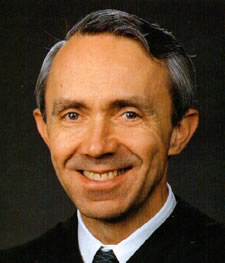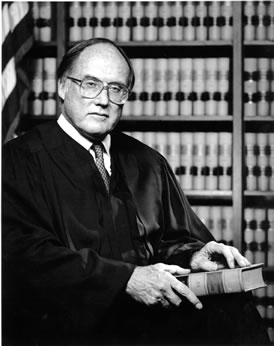
Chief Justice William H Rehnquist
Therefore, the Chief Justice wrote, the program does not offend the Establishment Clause of the First Amendment, which mandates a separation of church and state.
The U.S. Supreme Court Moves Education to the Right
By Robert E. Martin
With a pair of stunning rulings on June 27th, the U.S. Supreme Court laid
the groundwork for a US educational system that would conform to
politically conservative ideology.
With the same configuration that decided the controversial 2000
Presidential election, a Court sharply divided along political lines ruled
that public money can be applied to religious-school tuition.
The ruling not only gave a major boost to voucher initiatives nationwide,
but also had profound implications for how the doctrine of separation of
church and state should be applied in educational systems.
In the second case the Court found, as Justice Clarence Thomas wrote:
"Students who participate in competitive extracurricular activities
voluntarily subject themselves to many of the same intrusions on their
privacy as do athletes,". In short finding that random drug testing could
be imposed as a pre-condition for participation in a wide range of
extracurricular school activities and did not constitute "unreasonable"
search and seizure under the Fourth Amendment.
The Supreme Court declared in the voucher ruling that it can be
constitutional for public money to underwrite tuition at religious schools.
The justices voted 5 to 4, to uphold Cleveland's school-voucher program
and, by extension, similar programs across the country. Such programs are
valid as long as parents can choose among a range of secular and religious
schools, the majority said.
|
Chief Justice William H Rehnquist |
"In sum, the Ohio program is entirely neutral with
respect to religion," Chief Justice William H. Rehnquist wrote for
the court. "It provides benefits directly to a wide spectrum of
individuals, defined only by financial need and residence in a particular
school district. It permits such individuals to exercise genuine choice
among options public and private, secular and religious."
Therefore, the Chief Justice wrote, the program does not offend the Establishment Clause of the First Amendment, which mandates a separation of church and state.
|
Writing a separate concurrence, Justice Clarence Thomas said programs like
Cleveland's could be beacons of hope to impoverished inner-city children.
Quoting Frederick Douglas, Justice Thomas wrote: "Education means
emancipation. It means light and liberty. It means the uplifting of the
soul of man into the glorious light of truth, the light by which men can
only be made free."
But Justice John Paul Stevens called today's ruling, which overturned a
finding by the United States Court of Appeals for the Sixth Circuit, in
Cincinnati, "profoundly misguided." He wrote, "Whenever we remove a brick
from the wall that was designed to separate religion and government, we
increase the risk of religious strife and weaken the foundation of our
democracy."
Another dissenter, Justice David H. Souter, said that if there were ever a
good excuse to skirt the Establishment Clause, it might be found in
Cleveland, whose public schools have had a woeful performance and where
thousands of parents have used vouchers to send their children to private
schools. "But there is no excuse," Justice Souter said. "Constitutional
limitations are placed on government to preserve constitutional values in
hard cases, like these."
Spirited public debate over voucher systems is certain to continue. Now,
the arena may shift to the nation's legislative chambers. Joining Chief
Justice Rehnquist and Justice Thomas in the majority were Justices Sandra
Day O'Connor, Antonin Scalia and Anthony M. Kennedy.  Joining Justices
Stevens and Souter in dissent were Justices Ruth Bader Ginsburg and Stephen
G. Breyer.
As the tone of the opinions indicated, the continuing debate about
school-voucher programs involves issues that are not only constitutional
but deeply personal as well. The debate touches not only upon separation of
church and state but on how to best educate America's children.
President Bush and many political conservatives support vouchers, and
today's ruling was a resounding victory for them. Opponents of voucher
programs say they weaken already struggling public schools by draining tax
money from them.
The ruling today went against a 1973 ruling by a more liberal Supreme Court
that struck down a New York tuition-assistance program. The decision is
known as the Nyquist ruling, after Ewald B. Nyquist, who was the New York
State education commissioner from 1970 to 1977.
On Feb. 20, supporters of the Cleveland voucher system called it "a limited
program targeted to the most needy, the poorest of the poor, who would not
otherwise have a choice," in the words of Judith L. French, an Ohio
assistant attorney general. Nearly 4,000 of Cleveland's 57,000
elementary-age public school pupils take part. The vouchers are worth up to
$2,250.
| Justice Souter signaled his skepticism at the time. "At
the end of the day, a massive amount of money went to the religious
schools in Nyquist, and a massive amount of money goes to the religious
schools here," he said. "That's the sticking point." But
the majority reasoned today that the preponderance of religious schools
taking part in the program did not result from the program's intent but
rather is a phenomenon common to many American cities.
As important as this ruling was, it may not be the Supreme Court's final word on the issue. On a few issues of transcendent importance, the Supreme Court has reversed its own rulings, most notably in the 1954 ruling in Brown v. Board of Education, in which the court declared segregated schools unconstitutional, thus voiding an 1896 ruling that upheld the "separate but equal" principle. |
Justice Souter |
"I hope that a future court will reconsider today's dramatic departure from
basic Establishment Clause principle," Justice Souter wrote at the end of
his dissent.
The Conservative Viewpoint
According to conservatives, the school voucher issue is not about religion,
even if that's what the agenda looks like.  It's about control.  Control of
the educational system in this country.
Conservatives feels that liberals are playing the separation of religion
card as it pushes a lot of buttons and gets attention, but that the issue
is really about losing power and control of the system.
Holding to their 'free enterprise' argument, conservatives feel this is
really about turning education around, creating some competition for the
public schools, and allowing parents to decide how they will educate their
children.
As long as all religious schools are given the same ability to accept
vouchers, conservatives ask how can this be unconstitutional, especially
given that schools aren't even provided for in the Constitution.
In other words, the government has no constitutional responsibility to
educate children (or anybody else), but seeing as it has set a
long-established precedent for doing so, why not make it truly equal (which
is addressed in the Constitution) and allow people to use the government
dollars (their dollars) as they see fit?
>From the conservative perspective, public education will have to step up to
the plate and start doing what it hasn't done for many years...teach
students, not subjects.
The Liberal Viewpoint
Opponents to vouchers feel that the problem isn't with freedom of religion
as guaranteed in the constitution, as that is a fundamental right of
expression.  Their concern is about funding parochial and personal
enterprises, agendas & purposes with public money, which is designated for
the public school system.
Liberals assert that the issue is not whether private or charter schools
can exist, simply that you can't use public money to promote a narrow
educational agenda.
Unfortunately, schools are the last bastion that a variety of
philosophical, political, and religious viewpoints can be projected, as
they certainly do not exist in the Right Wing controlled media nor the
corporate controlled government anymore.
The biggest flaw in the thinking of voucher supporters, however, is the
fact that public schools have had to service portions of the population
that private schools can readily reject.  This creates a competitive
playing field that is anything but equal.
If religious, private, and charters schools were required to accept ALL
elements of the population that public schools do, or pick & choose as
private schools do, then much of this debate would evaporate.