An Interview With Interim Saginaw City Manager
BILL BAILEY
|
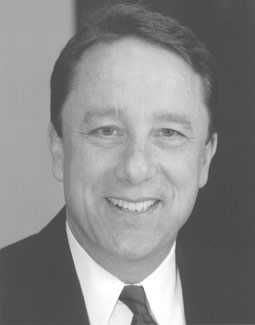
Interim
Saginaw City Manager Bill Bailey |
After about twenty-five years of service in Saginaw City
government, William Bailey was recently appointed interim City Manager.
With the retirement of current City Manager Reed Phillips, Bailey is
stepping in, temporarily, while the City Council conducts what may be a
nation-wide search for Phillips' replacement.
In his years of service to Saginaw, Bailey has worked in many of the
city's facilities, including the Saginaw Children's Zoo and the Civic
Center, but he has become best known the past several years as the
city's Communications Director. That post evolved into his most recent
position as an Assistant to the City Manager.
Unlike other cities such as Flint, that has an elected full time
mayor with strong mayoral powers, Saginaw elects city council members
who then vote among themselves for a mayor. None are full-time city
staff with nine-to-five office hours. Therefore, it is the City Manager
in Saginaw who is sort of the C.E.O. of local government, making
administrative decisions for the day-to-day operation of city services. |
Still, many decisions, like the final city budget, are voted on by the
council, working from a suggested budget drawn up by the administrative
staff and recommended by the city manager. The city manager also advises
the council during their regular meetings, while also helping answer the
many questions that are usually heard from city residents.
Anyone who has been following Saginaw's struggles to balance its budget
while still providing essential services, is aware of the challenges facing
Bailey, the city staff, Mayor Wilmer Ham and the Council. Bailey recently
agreed to this wide-ranging interview exclusively for Review Magazine.
Review: What is a nice guy like you doing in the City Manager's chair? Can
you describe how a young lad from Bay City ended up with a career in city
government? Where did your interest in politics come from?
Bailey: My passion for politics, which is indeed a "blood sport, started as
a "roadie" for the George McGovern campaign in 1972. I worked the West Side
of the state planting road signs, making advance arrangements for campaign
stops. From this high-wire work I covered some politics as a journalist
early in my career.
Review: When did you first realize that you might be an interim City
Manager and what were some of your thoughts about that possibility?
Bailey: I've been the number two guy in the organization for many years and
it came as no shock to serve as an interim manager. Frankly, I view the
time as an opportunity to break political inertia and make some otherwise
difficult changes.
Review: When do you expect the city will complete their search for a new
City Manager? Could it take as long as a year?
Bailey: The Council will likely hire an experienced headhunter to conduct a
national search for a new city manager. I'm hopeful, however, they don't
overlook the local talent. It's my guess that a new manager will be in the
hot seat by November. I plan to help for a few weeks, but other challenges
are calling.
Review: Do you have a personal opinion or advice for the City Council
about whether there should be a nation-wide search for applicants or simply
look locally or from within current management as they did with past
managers Joyce Parker and Reed Phillips?
Bailey: The last three city managers came from the experienced ranks of the
city staff. My biggest piece of advice is that city management is sometimes
a gypsy field and the carpetbagger factor can be high. Council should not
be overly impressed by slick-talking managers. We don't need a Messiah; we
need a solid, trustworthy person that can do the difficult work. Fancy talk
and PR are good, but working on land assembly, issues of poverty, setting
the stage for job development and investment is the most important vision
we can foster. We need a government that understands market forces and uses
all the economic development tools to set the stage for reinvestment,
blight fighting, and casting Saginaw in the best light possible.
Review: Any idea whether your management style will be very similar or
different from how the job was carried out by past managers Phillips, Joyce
Parker or Marv Baldwin?
Bailey: I'm far more aggressive than past managers. As a small business
owner, I know what it's like to make paydays, negotiate and operate
efficiently. I also am a student of total quality managements, process
mapping and modern management skills that need to be increasingly applied
to government. From cutting the red tape, to one-stop-shopping for
services, government must be proactive, productive and measured. We will
pass a tax cap lifting measure only when we are perceived as being
politically stable, efficient and credible.
Review: As someone who once supervised the Saginaw Children's Zoo, what do
you think of the success and growth of the Zoo, after being spun off from
city management and funding? Both it and the expansion of the Saginaw Art
Museum seem to be hopeful signs for the city. The Andersen Water Park and
Wave Pool are similarly going to be managed, along with some Recreation
programs, by the Saginaw YMCA. Are there many more programs, currently run
by the city that may be similarly privatized? Obviously the police and fire
departments and the water and refuse services will always be run by the
city, but the Japanese Tea House and Cultural Center is another service
that has been mentioned as a possible budget cut.
Bailey: In many ways government is lousy at running businesses. I think we
understand that we have successfully spun-off the zoo, recreation to the
YMCA, Civic center and some others. I plan to constantly comb through the
organization to find efficiencies and places where the private sector can
do a better job than local government running an operation. Someone once
said, "if there are three companies in the Yellow Pages doing a task, why
is government doing it?"
A good example is the recreation department being run by the YMCA. Programs
are growing and credibility is increasing, as the Y becomes a broker for
recreation services. The city needs to be more of a facilitator of services
than a direct service provider.
Review: One of Reed Phillips suggestions to the Council was to eliminate
Saginaw Government Television (SGTV, seen on Channel 15 for Charter
Communications cable customers in the city and the township). He made it
clear that he would rather the meetings weren't televised. Doesn't
Charter's contract provide funding for the station that would be lost to
the city if the channel was discontinued? What are the odds that there will
still be a station after next year's budget cuts?
Bailey: If I could sweep my magic wand I would stop televising council
meetings. The franchise agreement (with Charter) is silent and doesn't
require broadcasting of anything.
Review: With the recent or impending retirements of such senior staff as
Economic Development Specialist Joe Turner, Darwin Baranski from Parks and
Cemeteries, Planning and Zoning's Rod Dixon, and Ken Gamble, Tom Miller and
yourself from the Manager's Office, is it difficult to fill their
positions, if indeed the positions still remain?
Bailey: Saginaw's (city government) work force is half the size it was when
I started 25 years ago. The brain drain is huge and the financial
challenges are even bigger. Next year we are projecting a $4 million
shortfall and we are working now to help stop the flow. Given our Draconian
tax cap, flat-line revenues, the city general fund suffers while we see
great investment in the city and new growth along the riverfront.
Fortunately, we have crafted plans and systems that overreach
personalities. One of my challenges is to make certain the organization is
stable and steady upon my departure.
Review: Do budget limitations make it difficult for the city to attract
young people and even higher priced experienced administrators to fill
positions?
Bailey: The middle-class (and state and federal government) have abandoned
Saginaw and the city. With them went much of the good values, leadership
and money. The challenge today is to plan for bringing them back in the
future. One way I am championing is to assemble tracts of buildable land
where new subdivisions on larger lots can be built. If we have to clear the
land and plant corn, let's do it to bring back market-rate housing in
Saginaw. We as a region must also grow enough jobs to keep our children
here. This is an area Vision 2020 is working on and one we believe deeply
in.
Review: Looking ahead another year or two, do you think Saginaw is headed
for the problems that Flint has been going through, facing a possible
take-over by the state of Michigan due to financial problems?
Bailey: Unofficially I've heard that the state has about ten cities on the
"at risk" list for takeover. Frankly, I think the state must reinvest in
cities. They can't run all of the cities and we must realign many state
laws that prohibit urban growth. Laws like land-use, sprawl and the way
grants are issued are just some of the things the state can do to protect
the cities.
Review: On a lighter note, what do you do to relax and get away from the
pressures of managing the city? Are the rumors true that you are a Jethro
Tull fan?
Bailey: As the author of 15 books, I'm a fanatical reader. During the
summer there is nothing more relaxing for me than a good book, a sunny day
and a cold drink. I'm a Jethro Tull fan and collector, especially of
vintage bootleg concert videos. I also meditate, read about Eastern
philosophy and take long walks with my wife and springer spaniel.
Review: When you retire do you plan to continue working with your
publishing and media consulting? Do you plan to do more writing yourself?
Do you expect to be working full-time or are you going to be semi-retired
and playing golf?
Bailey: My retirement plans are personal at the moment. I plan to work and
some offers are being tendered. I'm merely interested in doing something
else for a few years before I really hang it up.
Review: Most citizens understand and appreciate our police and fire crews
for the services they provide. Who are some of the unsung heroes you could
draw attention to? What are some of the services provided by the city that
don't get the big headlines but make our quality of life better?
Bailey: There are many important jobs in the organization. From fixing
broken water mains in the winter, to snow plowing and all forms of outdoor
work, we have a great and dedicated staff. Police and Fire are often in the
news and are real heroes, but most of our staff are also heroes and grind
out the difficult, sometimes dangerous work on a daily basis.
Review: There have been ups and downs in the City's relationship with the
unions, especially during contract negotiations with the police and fire.
How would you characterize relations now? How have they reacted to the
budget limitations?
Bailey: I've tried extra hard to communicate to our union colleagues,
hoping to make them fully understanding of the long-term financial picture.
>From uncontrolled health costs to day-to-day increases in operation, the
city is in partnership with its staff and the community.
Review: There are, of course, still crimes and murders in the city, but is
seems that even the perception of violence in the city has lessened in the
past few years. Has there been a demonstrable reduction in crime? Do you
expect youth and gang violence to pick up in the summer? Is community
policing gone with the past police budget cuts?
Bailey: Crime is down about 30 percent in the past five years. Sadly most
crime is gang and drug related and often found in communities with high
poverty rates. I think we are doing a good job, but we need to engage the
eyes, ears and hearts of every citizen. Parents need to know what their
kids are doing. Parents need to work with the schools, get involved and
stop bad behavior early and often. Local government can't paint houses, put
out your trash or raise crime-free kids. It takes involved families. We are
making progress, but it's not fast enough for me.
Review: If you could wave your magic City Manager wand, and get one wish on
the job, what would it be? To have the tax cap loosened?
Bailey: I have many wishes and they start with church and citizen
involvement. If every church adopted parks, vacant lots to mow, a child in
need and fund-raised to demolish some houses, we would  have a great city.
Local government can't do it all, we need faith-based involvement to help
with practical problems of house painting, neighborhood clean-up, providing
mentoring programs and much more.
The tax cap is a noose around our necks. I wish the readers could
understand that even if every GM plant in the world moved to Saginaw, we
would not get one more dollar in property taxes. It is unfair to struggle
with this tax cap that is unknown anywhere else in the country.
Review: How can the city work more effectively with the County Commission
in reducing urban sprawl? What can the city do to work with the county to
refurbish and reinforce the strength of Saginaw's residential neighborhoods?
Bailey: Sprawl is a national problem and the answers will probably need to
come from the state. In fact, many states are requiring smart growth and
"build-in" policies. Even our recent Vision 2020 land-use plan, which was a
great effort, largely failed to address in-fill housing and cost of ongoing
sprawl to all of us.
 I believe that the reasonable person would agree that building at the
fringes of the infrastructure is costly and downright dumb. Each day the
state loses hundred of acres of fertile farmlands and natural areas to
sprawl---and at the expense of urban areas. Issues like the availability of
water may be the fundamental issues that bring land-use planning into focus.
Review: What can be done to end the duplication of service in the city and
the county?
Bailey: Consolidation of fragmented governmental services should be a
fundamental goal of public administrators and elected officials. Sadly,
fiefdoms and provincial thinking stops us from many economies of scale.
For example, in Saginaw County we have one unit of government for every
5,000 peoples, more than a couple dozen school districts, 17 police chiefs
and fire departments scattered all over.
Doesn't it make sense to find ways to consolidate some of these services?
In the end, it's all about politics. It all about old-style politicians
that want to protect their turf at the cost of services and on the back of
all taxpayers. I'm not sure my idea of a metro council has the right
timing; but it's certainly the right thing to do.
Review: Why can't Saginaw do more to get its share of state and federal
monies that are available. The feds have a lot of money out there and
Saginaw never seems to get its fair share of the pie.
Bailey: Saginaw does receive millions in block grants, grants for the
Shaheen project, riverfront development ($2.1M), downtown streetscape ($4M)
and others. Certainly we can do better.
 Our state and federal elected officials, some faced with term limits, have
delivered some "pork," but I think as they mature in office we'll see more
dollars for public improvements. There is no money tree and grants at all
levels have dried up.
In addition, most grants will help you build a facility, but there is  no
support to operate it---and that's the biggest challenge. I'd like to see
the city hire a lobbyist who would be charged with making certain we're in
the game and at the table when there are bits and pieces of grant money
available.
Review: The issue of lifting the tax cap is a big one, but how can this
effectively be put before the voters when 12-year tax abatements are given
to huge corporations and developers with all the burden being placed upon
residential homeowners?
Bailey: The Draconian tax cap limits city services. The tax cap has held
back a number of services and resulted in plenty of downsizing. Frankly,
rightsizing is good, but we are at the point where entire blocks of
services are at great risk.
 The next year, if the cap isn't lifted, will begin to impact the public in
tangible ways. Soon---and sadly, the public will feel the pain of reduced
city services. We've been creative enough to constantly realign services so
there hasn't been direct pain. But pain there will be when police only
respond to the most serious calls, special events are gone and recreation
services are reduced.
 Consider this my fair warning that unless we see the tax cap lifted you
will see dramatically reduced city services. This is why I'm calling for a
faith-based summit, a citizens summit and other creative initiatives to
engage non-government resources to mow vacant lots, paint houses, adopt
parks, volunteers clean-ups and so forth.