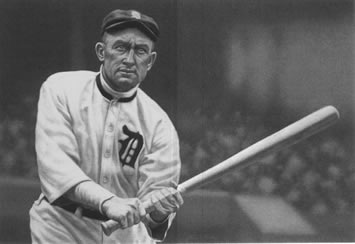
Such were the contradictions of arguably the greatest baseball player of all time.
The Georgia Peach
By Richard Curry
Part Two in a Series
|
Ty Cobb's batboy of years past once related how,
"During spring training, Ty would take a sack of old balls and all
the boys would line up so he could give them one. If he saw some little
fellow with tattered clothes who looked like his parents wouldn't be able
to buy him a baseball, Mr. Cobb would make sure to call him over, give him
a baseball, pat him on the head, and tell him to keep playing
baseball."
Such were the contradictions of arguably the greatest baseball player of all time.
|
Cobb struck out 357 times in his career, whereas Babe Ruth struck out
1,380. Maybe that's why Ty wasn't going for homers.
Augusta residents in 1911 saw a different side of Ty Cobb when he played a
football hero in a play called The College Widow.  He not only performed in
Augusta; he also toured seven nights a week with the production throughout
the East Coast as far north as Boston. Ty later noted in his autobiography,
"it proved to me that actors more than ball players had to be iron men."
Woodrow Wilson, then governor of New Jersey, was visiting his childhood
home in Augusta that year and went to see Cobb perform in the play. Cobb
visited Wilson in the White House three years later.
In 1912 three men attacked Cobb on his way to a Detroit railroad station.
His pistol jammed and Ty was cut in the shoulder by a knife. But not before
Ty caught one of the assailants and pistol-whipped him.
"I used the gun sight to rip and slash and tear him for about 10 minutes
until he had not face left," commented Cobb. "I left him there not
breathing in his own rotten blood."
The next day, Ty wore a makeshift blood-soaked bandage and got two doubles
and a triple. Two days later a man was found dead in an alley where Ty had
reported the incident. Similarly, Ty once pounded umpire Billy Evans silly
after a game.
Claire Hodgson, a Ziegfeld girl, was sleeping with both Ty and Babe Ruth at
roughly the same period. Years later Claire said, "Ty was the greatest, but
Babe was first in my heart." At the same time Babe was seeing Claire, he
was married to Helen. Later on Babe cheated on Claire. (Now that's a shock!)
Race Relations & Diplomacy
In 1909 Ty got mad at a black elevator operator for taking him to
the wrong floor. Ty beat the man and slapped him. A night watchman
intervened and hit Cobb a few times with a nightstick. Then Ty really got
mad. He pulled out a pocketknife and began slashing away at the guard. Ty
finished by kicking him upside the head. Cobb showed for the game the
following afternoon taped up like a mummy and got three hits, also making
two great catches in a double-header.
That same year Ty said, "There will never be a darky in the majors.
Darkies' place is in the stands or as clubhouse help."
In 1908, playing in Havana, Cobb was introduced to Negro League Star and
Hall of Famer, Pop Lloyd. He refused to shake his hand. Lloyd batted .500
to Ty's .375. Lloyd also tagged him out three times trying to steal second.
Ty never played against a black team again. The Tigers won four games and
lost eight in Cuba.
Four years later in 1912 a NY fan hollered at Cobb, "Your sister screws
niggers and your mother is a whore." Ty held his temper for awhile, but
finally lost it. He catapulted up 12 rows of seats, found the heckler,
battered his head at least a dozen times, knocked him down, and kicked the
man.
The fan had no hands.
When Ty was suspended, his teammates said they wouldn't play. The
replacements lost to the A's 24 to 2 on May 18, 1912.
Early in his career Ty refused $100,000 to jump to the new Federal League.
At the time he was making $9,000 a year. A year later the Federal League
folded.
Ty's wife got 20 cents worth of bad perch. Ty went directly to the store
and clobbered Howard Harding (the fish store owner's wife's brother).
Harding, who was black, had a meat cleaver in hand when Ty hit him at least
three times with his gun butt. He then took the youngster out into the
street and nearly beat him to death.
Homelife
Cobb's home was in Augusta, GA on 2425 William Street. He bought
this home just before he went to war so his family could have a nice home
if he didn't come back. His second floor "secret room", which was always
under lock & key, contained trophies, racks of guns, contracts, bank
papers, portraits of his father (not his mother), his very first bat,
autographed presidential photos, books on Napoleon, Havana cigars, baskets
of unanswered fan mail, and moonshine whiskey from his hometown.
There's a Tiger team photo with Cobb in it twice. He ran to the other side
during a time exposure. Now there's a little sense of humor in the man!
Cobb was accused of throwing a game with Tris Speaker. Ruth said, "This is
a lot of bull. I've never known a squarer man that Cobb. He's mean as hell,
but he's as clean as they come."
At age 27 Cobb moved to Augusta with his wife Charlie (Charlotte Marion
Lombard) and two kids, Ty, Jr. and Shirley in November of 1913.  Son
Herschel was born there in 1916. They moved to Atherton in Northern
California in 1932, but he held on to his Augusta home until 1945.
Ty's Atherton home at 48 Spencer Lane is still standing. The neighbors
remember him as a cantankerous man who launched empty beer bottles into
their yard. Ty later divorced Charlie and his next two wives.
The Augusta house is still located near the Augusta State University. It's
a two-story wooden home. Visitors during Ty's heyday included novelist
Theodore Dreiser, band leader John Phillip Sousa, golfer Bobby Jones,
baseball commissioner and bigot Kenesaw Landis, former coach Knute Rockne,
and Coca Cola executive Robert Woodruff.  In town Ty was briefly president
and owner of the Ty Cobb Tire Company. The company advertised, 'Square
Deal, Service First.'
On Sept. 17, 1928, Ty Cobb called reporters to his hotel room in Cleveland,
Ohio and announced his retirement from baseball. "I will be leaving
baseball with a lot of regrets and still with a light heart," he said.
"It's hard to pull away from a game to which one has given a quarter
century of his best manhood and which paved the road to lift me to a place
of prominence and affluence."
The Saginaw paper reported Ty as saying, "I'm baseball tired and want to
quit. I realize the best days are behind me. Before me baseball was a
virgin. When I was through, it was American."
Ty owned 15 hunting dogs at the Augusta home. The family also had a
Shetland pony, a Billy goat, pigeons, canary, and a show horse. Sounds like
Dr. Doolittle.
He loved classical music and was very strict with his children.  His
grandson Charlie was 7 years old when his famous grandfather died. Grandpa
Ty gave Charlie his American League All-Star game gold watch.
"Grandpa was very kind to us grandkids and took us out on his inboard
boat," said Charlie.
Loose Ends and Fly Balls
Ty left three quarters of his estate to his family.  Before he
passed away, Cobb commented that "The great trouble with baseball today is
that most of the players are in the game for the money, and that's it, not
for the love of it, the excitement of it, the thrill of it."
At age 69 Cobb punched out a heckler in a nightclub, shoved a businessman
into a fishpond, and was hauled off to jail for abusing a policeman.
The lady at the Augusta Historical Society told me in confidence: "I
shouldn't say this, but Ty's personal lawyer was disbarred and sent to
prison. And Ty's personal doctor was disbarred and asked to leave town."
One thing people have learned in Saginaw is never tell Richard Curry
anything in confidence.
Ty Cobb was elected into the Hall of Fame with 98.23% of the vote. He
outvoted Babe Ruth.  Ty was polled the number one selection for the
Cooperstown Hall of Fame with 222 first place votes from the 226 writers.
Only Tom Seaver later was higher in all-time H.O.F. voting at 98.84%.
In retirement Ty visited Shoeless Joe Jackson at his liquor store in
Illinois. When Ty walked in, Joe said, "I thought you would never speak to
me again." Ty replied, "No, you will always be my friend." He then walked
over and gave him a big hug. Hugging people earlier would have made Ty's
life a lot easier.
Ty was also a Detroit Tiger to the end. I found an eight-page letter Cobb
sent to Tiger manager Bill Norman in 1958 three years before Ty's death
advising Bill on how to improve his team.
Ty Cobb's final days in Atlanta's Emory University Hospital were spent with
his three surviving children and first wife, Charlie, who divorced him
after 39 years of marriage.
"There was never anyone else in my mom's life," Mrs. Thomas (Beverly)
McLaren related. "She was there at the hospital in his last days. He
recognized that he drove everyone very hard and was sorry for the
unhappiness that had gone on before."
The Cobb's other daughter, Mrs. Richard  (Shirley) Beckworth observed, "I
know he said more that once, 'There's only one Mrs. Ty Cobb'. If they get
it all settled at the end, that's fine. I never asked her about it. That
was a private thing between her and dad."
Shirley said that after her mother died, she came across letters written to
her mom by Cobb from Detroit and other places during his career. "They were
the most tender and sweetest letters I have read. What he wanted was
honesty from everybody, but mostly from his own family. Cobb never turned
his back on his family financially. He was interested in our well-being and
in developing our intellect."
Around 1957 Cobb decided to move back to Georgia and live out his final
years in the North Georgia hills of his youth. He lived in a white-columned
former governor's summer home in Mt. Airy, GA adjacent to Cornelia for
awhile.  Later he rented a small brick apartment in Cornelia, which became
his last residence.  He planned to build a home on 65 acres he owned atop
Chenocetah Mountain, just outside Cornelia, but his plans were never
realized.
Weeks before dying, Ty said, "If I had my life to live over again I'd do
things a little different. I would have had more friends."
Only three former ball players went to Ty's funeral: Ray Schalk, Mickey
Cochrane, and  Nap "out of the shower" Rucker.  Seldom mentioned, they were
all financially supported by Cobb when they hit upon hard times. Four
hundred people were at Ty's funeral. Most were local little leaguers.
Bill Terry, former New York Giants player & manager said upon hearing of
Cobb's death, "The best baseball player in the world has died." Then U.S.
Senator Herman Talmadge of Georgia observed, "Georgia and the nation have
lost not only one of baseball's immortals, but also a dedicated citizen
whose philanthropies were legion. The first Hill-Burton Act Hospital
constructed during my administration as Governor of George was made
possible through his generosity."
The Cobb movie with Tommy Lee Jones never showed Ty's moments of kindness
or the fact that he used his money to benefit his hometown and help in the
education of hundreds of deserving young adults.
Ty has a banner at his museum. It reads: "Ty Cobb - fierce, calculating,
feared, revered, famous, infamous, benevolent, and a gentleman."
That pretty much sums up the life of Ty Cobb, except that they did leave
out  'racist zealot'.
There is a stage play on Cobb's life in New York City at the Melting Pot
Theatre. Stages of Cobb's life - player in his prime; middle aged man with
business smarts; man stricken with cancer.
Theme: This was a man who let his self-confidence destroy his personal
relationships.