SHOWTIME & STORYTELLING:
When 'Reality TV' and Documentaries Blur into the Haze of Hollywood,
does Life Imitate Art when it Turns to Crap?
by Rachel Deahl
Review Film Critic
Although its fans are sometimes loathe admitting it, 'Reality TV' isn't
that different from the fictional fare we've been watching on the boob tube
hitherto, it simply trades on a different selling point.
Packaging itself under the image of an unadulterated peek at "real" human
interactions, reality TV is fun to watch not because it is real but because
we think it's real. Be it Survivor or Friends, both shows offer up
carefully orchestrated, entertaining stories about a group of people who
are more attractive than the average American, and that is, in large part,
what makes us tune in each week.
Trading on the ridiculous nature of this new brand of entertainment,
Showtime attempts to drum up laughs by exploring the pitfalls and pratfalls
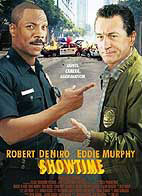
of making reality into reality TV. Pairing Robert DeNiro with Eddie Murphy,
Showtime unfortunately becomes the farcical cop show it sets out to poke
fun at.
|
Click for Official Site |
DeNiro stars as the gruff, "loose cannon" detective Mitch Preston. When one of his undercover drug busts goes awry, the cranky dick unleashes his aggression, and his gun, on a camera that's thrust into his face. The event sparks a mild media frenzy and inspires an ambitious TV producer (Rene Russo) to create a reality cop show with Mitch as its star.
Vehemently opposed to the idea, Mitch is forced into the project after the TV station threatens to sue for the episode with the broken camera. Of course every good detective needs a partner: enter Mr. Murphy. As Trey Sellars, Murphy plays a lowly beat cop with aspirations to be an actor. When a casting call goes out for the reality show, Sellars stages an audition and wins the role. Once on the job, and the show, Sellars puts his acting guns to work to the delight of audiences and the chagrin of his unimpressed new partner. While Murphy hams it up, DeNiro cuts it down. |
The running joke in Showtime is the idiocy of cop shows and reality TV.
Whether poking fun at Cops or T.J. Hooker (both of which are referenced in
the film), Showtime aims to reveal the artifice of police drama. The irony
is that in its own storyline, it employs the same cheesy dialog and action
that it mocks.
In Murphy's introductory scene, he launches into a trite monologue about
catching bad guys and finishing the case for his now wounded partner. The
speech feels so familiar that it's almost obvious what's going on. Sure
enough someone yells cut and it's revealed that Murphy's character is in
fact auditioning for a role.
Minutes later when DeNiro waltzes into the real chief's office and is given
the ultimatum that he has to star in the television show, the confrontation
feels uncomfortably akin to Murphy's silly audition.
This is the ongoing problem with Showtime: it repeatedly makes fun of
cliches and tropes that it then goes on to employ. Although it offers a few
genuinely funny moments, the feeling that you're laughing at Showtime as
often as you are with it is impossible to shake.
STORYTELLING
Divided into two parts, entitled "Fiction" and "Non-Fiction," Todd
Solondz's new film is laced with the same potent, shocking and
discomforting black comedy that made his two notable previous features so
hard to forget.
Solondz, who put himself on the map with Welcome to the Dollhouse, a
jarring, disturbingly hilarious tale about a Long Island middle schooler's
struggle to fit in, continued his bizarre exploration of suburban
dysfunction with his follow-up, Happiness, the director's funniest, most
disturbing and delightful work to date.
Happiness deconstructed a seemingly average American family to reveal a
crew of desperate husbands, mothers and fathers who also happen to be
sexual deviants and basket cases. A much more mature and complex feature
than his debut, Happiness established Solondz as one of the most promising
young American filmmakers to emerge from the last decade. It also showcased
his rare talent to combine the hilarious with the heartbreaking, to create
characters that are as repulsive as they are sympathetic.
Now, with Storytelling, Solondz adds another unique film about human
relations to his body of work. Though disappointingly fractured,
Storytelling possesses the hallmark bizarre-o humor that makes Solondz's
work so fascinating, even in failure.
The first segment of the film, "Fiction," is set at a prestigious liberal
arts college somewhere in America. Selma Blair stars as Vi, a naïve, and
fairly untalented student in a creative writing class. Taught by a
celebrated African American author, Mr. Scott (Robert Wisdom), the classes are
highlighted by Mr.
Scott's cold and calculating dismissal of his students' helplessly mediocre
work. For anyone who's ever taken a creative writing class, Solondz's
dead-on recreation of the experience is a delight.
From the dopey guy looking to say something nice about all the stories, to
the uptight preppy girl offended by what she doesn't understand, to the
talented writer whom mind-numbingly, and accurately deconstructs all the
work, the class scenes come vibrantly to life.
More than Solondz's uncanny ability to mimic the funnier aspects of these
kinds of classes, the director highlights the difficult nature of
pinpointing what it is that stories aim to do. As the students react with
hostility to what's foreign and disturbing and welcome the pat and trite,
Solondz gets in a good jab about the unfortunate tastes of the public.
Significantly longer and more disjointed, Solondz's second segment,
"Non-Fiction," examines a ne'er-do-well high schooler who becomes the
subject of a documentary filmmaker. Paul Giamanti turns in a solid
performance as a struggling artist looking to make something of his life
with a searing documentary about the horrors of high school.
As his subject, he chooses the shiftless Scooby Livingston (Mark Webber), a
high school senior living in an affluent suburb whose only ambition in life
is to be a talk show host.
Touching on issues of representation and the way in which a storyteller
relates to his subject matter, "Non-Fiction" is more fractured than its
preceding segment and doesn't offer the final wallop that "Fiction" does.
Best at highlighting racial and economic inequalities in our society, the
most poignant scenes in "Non-Fiction" involve the Livingston's maid,
Consuelo (Lupe Ontiveros). Whether shots of the elderly woman scrubbing the
pristine house in pain or the disturbing exchanges she shares with the
pint-sized member of the household, a 10 year-old young Republican named
Brady (Noah Fleiss), "Non-Fiction" drives home its most searing images in
these moments.