A Conversation with Tre Cool of
GREEN DAY
With "Warning," the latest album by Green Day, it may no longer be
fair to call the Bay Area group a punk band -- at least on a musical level.
Where the group's previous CD, 1997's "Nimrod," had a few frenetic rockers
like "Platypus (I Hate You)" and "Jinx" that were firmly in the punk rock
mold of Green Day's early CDs, the argument can be made that "Warning"
isn't a punk record at all.
|
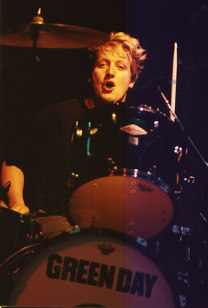
Tre Cool of
Green Day |
For one thing, none of the songs have the kind of breakneck
pace associated with punk. That's not to say that "Warning"
doesn't rock. But even the CD's friskier tunes, such as
"Castaway," "Fashion Victim" and "Church On
Sunday" only accelerate slightly beyond mid-tempo. Still such songs
hit pretty hard thanks to their fat guitar chords and Tre Cool's potent
drumming.
"Warning" also boasts more of a layered and expansive sound
than Green Day's other CDs. Acoustic guitar is a prominent ingredient on
several songs, including "Warning, and "Hold On," while
touches or keyboards color tracks like "Blood, Sex And Booze"
and "Church On Sunday." There's even a Tex-Mex horn part on
"Misery" and a roaring saxophone in "Jackass,"
In all "Warning," which is unfailingly catchy and boasts some
of the band's most crafted tunes, seems more rooted in the power pop of a
band like Cheap Trick than in the fast and furious sound that typifies
punk. |
But ask Cool to respond to the thought that punk may no longer be the best
word to describe his band, and you won't get much of an answer.
"I leave the labeling up to the press and the kids, too," Cool said,
turning aside the topic.
Actually, getting Cool to provide a straightforward in-depth answer on
most any topic isn't always easy.  Its not that Cool is uncooperative. In
fact, he's quite fun to talk with. But often it seems like he'd just as
soon make a joke as treat a subject seriously, although on occasion a
light-hearted response eventually gives way to a more insightful answer.
For instance, when asked what he thinks makes frontman Billie Joe
Armstrong special as a songwriter, here's how Cool responded. "Well he
takes this little purple pill every day, and it helps him write songs. It's
a songwriter's amino," Cool said, quickly segueing to a more serious
thought.
"I don't know what it is. Some people are just special like that, and he's
one of them. You can't really put a finger on it. You can put a finger in
it. Woah!"
| Fortunately, there were at least a few topics that engaged
Cool enough for him to provide some insight, beginning with a comparison
between the making of "Warning" and "Nimrod." As Green Day fans
know, the latter album represented something of a comeback for the band,
which was formed in 1989 in the Bay area city of Berkeley, California by Armstrong and bassist Mike
Dirnt (Cool joined in 1990).
After recording two CD's -- "39/Smooth" (1990) and "Kerplunk"
(1992) for the small Berkeley label Lookout Records, Green Day signed with
major label Reprise Records.
Their 1994 debut for Reprise, "Dookie," transformed Green Day
from being one of the many do-it-yourself punk bands scuffling along
behind their indy CDs and low-budget tours into a group that suddenly
dominated alternative rock airwaves. |
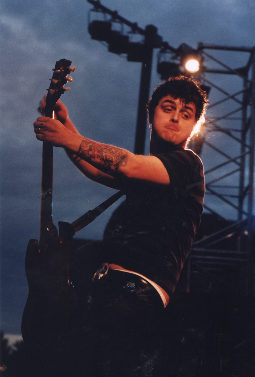
Billie Joe
Armstrong of Green Day |
"Dookie" produced hit singles in "Longview," "Basket Case" and "When I Come
Around" and sold eight million copies. Then came the inevitable backlash,
as fans who feel punk bands should always pursue a do-it-yourself ethic and
shun the corporate settings of a major label, accused Green Day of selling
out.
The band's next CD, "Insomniac," with its dark lyrics and agitated musical
tone, was partly a reflection of the frustration Green Day felt over seeing
some of their long-time fans turn on the group. The darker direction of
"Insomniac" didn't go over as well with radio or mainstream music fans.
While it went double platinum, that was nowhere close to matching the
success of "Dookie."
But "Nimrod" turned the tide. Combining fast-paced punkish rockers with
songs that revealed Armstrong's sharpened songwriting abilities and growing
talent at crafting hooky pop songs, "Nimrod" made a quick splash with the
single "Hitchin' A Ride."
Then another single, "Good Riddance (Time Of Your Life)" put "Nimrod" over
the top. A sweet acoustic ballad, "Good Riddance" became a multi-format
single that connected with a legion of fans that weren't previously
followers of the group and sent sales of "Nimrod" skyrocketing.
What's ironic about "Good Riddance" is that Armstrong wrote the tune as
something of a cynical kiss-off to a former girlfriend. But many fans put a
much warmer and more nostalgic interpretation to the song's "I hope you
have the time of your life" sentiments, and the tune came to be a theme
song for high school proms, graduations and other life-defining events.
Cool, though, has no problem with realizing that "Good Riddance" came to
take on such an unintended meaning.
"That's one thing about making music is you give it away after you record
it. But it's still a part of your life," Cool said. "It's a part of who you
are and where Billie was at that time in his life. So it doesn't change the
song at all. It's the same song and it has the same message for him. He
wrote it. So if it means something else to somebody else, that's good.
That's what music is all about. That's what makes music appealing. Because
some music I put on and you sort of get a feeling. You just sort of get a
warm fuzzy feeling out of it. You get pumped up and excited. Certain music
does that. That's the kind of music we try and make because it's not worth
making music that's not powerful."
Cool remembers the making of "Nimrod" as a long, work-intensive, but
enjoyable process. The band went into the project with some 40 songs and
spent a year writing and refining the material before zeroing in on the 18
songs that made the final cut for "Nimrod."
In an interview in the January 2001 issue of "Guitar Player" magazine,
Armstrong described "Nimrod" as a record where the group just pounded out
the songs; taking ideas and turning them into finished songs no matter what.
"We didn't just throw together 'Nimrod,'" Cool said, elaborating on the
subject. "We almost overdid some things. We had many ideas and we were open
to anything, from crazy jamming to a bunch of songs we did have. And we
worked on those songs hard, all the time, played them like a thousand times
before they hit tape. That's what you've got to do. When you write a song
you've got to familiarize yourself with it so you can play it in your
sleep. "
"Then it's all about catching a good performance on tape. Like a lot of
times, with 'Kerplunk' and 'Dookie' and stuff, like those songs we never
toured them. Now like I play them different than I recorded them a little
bit. I know if I would have played them more, I could have improved a
couple of things for me."
By contrast, Armstrong wrote songs for "Warning" only when inspiration
happened, and that enabled the songs to emerge more naturally and
spontaneously. One result of that approach, Cool said, was that the group
members had a good idea of how they wanted the finished recording to sound,
right down to the instrumentation that went on the songs.
"We kind of said on a lot of things, we'll put this on this and horns on
this or do this and see how it sounds," Cool said, elaborating on the
band's more experimental approach to refining the songs on "Nimrod."
"If it sounds good, let's do it. Let's put it on the record. But with
'Warning' it was more like OK, we're going to do this and put this
(instrument) here, and that's how it's going to sound like. If that's not
how it sounds, you better try to make it sound like that. It was more like
we knew what we were after (ahead of time)."