Jamaica Confidential: Resorts, Rastas, and Revolution
Jamaica is a land of beauty and contradiction.  Located south of
Cuba and nestled within the brilliant blue of the Caribbean, it is a land
of rich blue mountain forests and breathtaking coral reefs that has long
been a tourist destination for the rich & famous.  Sadly, it is also a land
of unspeakable poverty, riddled with political corruption, and one of the
most exploited countries in the Western World.
Recently, my wife and I spent one week in Jamaica at The Sunspree Resort in
Montego Bay and discovered two stark and different Jamaicas, one fueled by
the tourism industry that consists of exclusive guarded resorts nestled
against one another for miles on end in regions like Negril and Montego,
and the other a country of ramshackle shacks, crowded & littered city
streets, lush fertile farmland where ackee (an indigenous vegetable that
when cooked tastes better than scrambled eggs), Blue Mountain coffee (they
say if you drink a cup it will keep you awake for the rest of your life),
and ganja is raised by Rastafarians, the religious core of Jamaica, intent
upon leading their people to salvation from the corruption of 'Babylon'
culture.
The leading industries in Jamaica are tourism, bauxite mining (which has
left vast strip-mined areas potting this jewel of an island), and
agriculture.  The tourism industry boomed after World War II because
Jamaica offered peace, warmth, and a kind of freedom from the increasingly
restrictive climate, both artistically & sexually, of Europe & America.
The playwright Noel Coward built his retirement home, known as Firefly in
the hills of Jamaica, James Bond author Ian Fleming resided there, and the
'soul' of the Rolling Stones, Keith Richards, owns a home in Ocho Rios.
Much to my amazement, he is even listed in the Jamaican telephone directory.
Every morning when I awoke in Jamaica, I would revel in the lush fragrance
and color of this Garden of Eden, sucking in the parrot-feather-soft air,
rich with the scent of blooming frangipani and fermenting fallen mangoes
and a hundred plants and herb I'd never heard of before.
Yet embedded within this beauty, one can never forget the legacy of
Jamaica's past.  The first Jamaican settlers were a peaceful tribe called
Tainos, but were raided frequently by aggressive Caribes, reputed to be
cannibals.
The original 'Arawak' people of Jamaica were virtually wiped out when
Christopher Columbus and the Spainiards arrived upon the island. With their
weapons, the Spanish brigade set the stage for coming centuries of war,
slavery, and colonialism, including reigns by the British, French, Germans,
and Americans.  Eventually, this leads to revolt and burning of the sugar
plantations.
To my amazement, apart from the poverty of the country, the people of
Jamaica are remarkably well educated, speaking with a British lilt in their
accent with elocution that is better than that of many Americans.
Our first journey outside the barricades of the resort takes us to Negril,
a fantasyland of vast sandy beaches with building restrictions that
prohibit any structure from being higher than the palm trees.  It is here
that we meet 'Bongo', a Rastaman eager to sell us jewelry, drugs, and conch
shells.
In Jamaica, because of the poverty, natives regard tourists as their
'visitors', and as such, expect to conduct business with them constantly,
consistently refusing to take 'no' for an answer.
With Bongo a $20.00 purchase of fine lapis jewelry was enough to put him
at ease (by the way, this was an incredible bargain for the three sets of
necklaces & bracelets I bought for my wife) and after playing me some
original reggae he had recorded, Bongo was pleading with my wife to take
him back to the States on a visa so he could start his own Harley repair
shop.
Unfortunately, many of the problems with contemporary Jamaica and the
religious 'Rastafarians' that seek to redeem the island from political
bondage is more a result of 'recent' history.
The late reggae music icon Bob Marley often lamented the deterioration of
the Rasta scene. A sinister cocaine, freebase and heroin trafficking
network had spread from Negril into Kingston once Jamaican President Seaga
had been elected.
The reasons behind Seaga's victory were clear: he was the darling of
right-wing American corporate powers - the same people who were ushering
Reagan into office. Seaga pledged to keep Jamaica free of left-wing
adventurers and ideologues, and he made himself at the disposal of David
Rockefeller and the other architects of the Caribbean Basin Initiative.
Reagan wanted the island 'cleaned-up', and one of the things he insisted
was that the ganja trade be taken out of the hands of the poor and
eliminated as a 'cash crop'.  Consequently, this forced them to look for
other sources of income, so the ganja dealers turned to cocaine and heroin
to make a living.
Unfortunately, it is difficult for Americans to understand that 'ganja' or
'marijuana' is part of the Rastafarian sacrament, no different than
drinking wine at communion.  They believe it to be a gift from Jah (God)
that leads to a state of 'irie' or well-being; but the aftermath of these
policies is obvious everywhere you go in Jamaica.
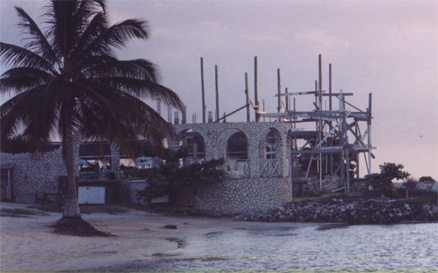
One cannot judge whether Jamaicans are wealthy or poor
by the look of their homes. Because the banks charge
Jamaicans 30% interest, most people use their own money
to build. When they run out, they stop building until
they can afford to complete their project.
In 1981 Reagan placed the Key West-headquartered U.S. military forces for
the entire Caribbean basin under the unified command of Rear Admiral Robert
McKenzie. Reagan was disturbed by the mounting influence of Cuba &
Nicaragua's revolutionary leftist governments in Jamaica under then Prime
Minister Michael Manley.
Capital, technology and management were shipped into the tropical basin by
multinationals anxious to avoid minimum wage laws and trade unions, and the
Jamaican people themselves saw little benefit.
Profits pouring out of Jamaica far exceed investments.  In fact, driving
anywhere on the highways around Jamaica is a nightmare.
These 'highways' are the equivalent of Michigan backroads and meander along
huge cliffs.   Five years ago the Japanese offered to rebuild the Jamaican
roads because so many Jamaicans purchase Japanese cars.  Japan gave Jamaica
$3 million to rebuild the highways and said it would be completed in three
years.  Today, two years past this deadline, the roads are a mess - with
single lanes of traffic resulting in a 50 mile trip taking up to 3 and a
half hours.
Again, much of this turmoil dates back to Reagan's Caribbean Basin
Initiative (CBI).  By the spring of 1982 Reagan put his version of this
concept before Congress, with support from Chase Manhattan Bank, Alcoa, and
Inter-Continental Hotels. It consisted of a cosmetic 12-year duty-free
arrangement for Jamaican imports (but 87 were already duty-free) except
footwear, textiles, rum, and sugar.
By 1983, the administration had killed the Congress-opposed
investor tax credits feature of the bill, and the paltry $350 million in
aid was a mere handout for a region in need of $580 million in emergency
funds.
The only relief of any consequence had been military subsidies.
Consequently, the entire CBI campaign had been a bribe to induce Jamaica
and the rest of the Caribbean to accredit the armed confrontation of
Grenada. It also provided a cover for $75 million in additional combat
funding for the war in El Salvador.
What Jamaica got for its support was more misery. Seaga's decision to allow
foreign imports into Jamaica killed the Jamaican economy. Smaller
businesses closed their doors. So by the mid-80s, the Jamaican economy was
in such bad shape that it could not pass the International Monetary Fund's
performance tests on its vast loans.
Seaga imposed a 43 percent devaluation of the Jamaican dollar.  Indeed, one
dollar in U.S. currency is equal to $42.00 Jamaican dollars today.  And
ironically, while gas was only 50 cents per gallon, the cost of a drink at
Rick's Café in Negril was $5.00.  (Of course, we must remember that today,
tourism is all Jamaica really has left!)
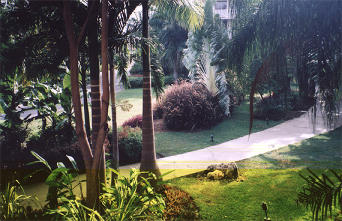
Of course, you would never know any of this living on the resorts.  The
13-mile Sunspree that we stayed at received a $13 million renovation in
1995 and occupied 12 acres on nearly half a mile of white-sand beach.  The
rooms were air-conditioned and furnished, and they even had satellite cable
TV. Spacious interlocking tropical- style freshwater swimming pools of
varying depths meandered throughout the resort, and if one never ventured
outside of the resort, one would never suspect there was trouble in
paradise.
Much to my amazement, one day we went sailing with Brenton, a pleasant
Jamaican that was happy to have a job doing nothing all day but taking
tourists snorkeling.
He explained to me that six miles away from our resort the night before, up
in the Blue Mountains by this watertower, the government had bulldozed
peoples' homes away and gunfire had been exchanged.  Of course, nothing
about this appeared in the Jamaican news or on the government television
station.
Still, there is much richness about Jamaica to behold.  Apart from the
value (due to its currency devaluation, Jamaica is a bargain where you can
live like a rock star at half the cost of other vacations) the country is
rich with marine life, coves that you can see clearly 50 feet to the
bottom, and a passionate people that do their best to make your stay
memorable.
Perhaps best of all, replete with all this beauty and such an intelligent
and innately gracious race of people, Jamaica puts you in touch with your
conscience.
Or as Nernelly, a Jamaican Bush Doctor puts it: "Some mon just deal wit'
information. An' some mon, him deal wit' the concept of truth. An' den some
mon deal wit' magic. Information flow aroun' ya, an' truth flow right at
ya. But magic, it flow t'rough ya."