LIKE A ROLLING STONE
By Greg Walton
Review Film Critic
Are you a true rock 'n roller?  Can you still play the first few notes of
Smoke on the Water?  Do you know the difference between Humble Pie and a
special on the Bill Knapps  desert menu?  If you're  one of the classic
rock faithful who believe real rock 'n roll died around 1975, then Almost
Famous  will hit a little closer to home.
The semi-autobiographical film by Cameron Crowe (Singles, Jerry Maguire)
hits the road with Stillwater, a fictional 70's supergroup with aspirations
of Zepplinesque stardom.  But Crowe, whose films could serve as sensitivity
training for the masculinely maladjusted, rises above the sex, drugs, and
backstage cliches.
Almost Famous searches the soul of music itself, questioning the highs and
lows of rock 'n roll dreams on both sides of the stage. William (Patrick
Fugit) comes from an unsettled but supportive family, headed by his
neurotic college prof mom (played with hit and miss gusto by Frances
McDormand). After inheriting his sister's record collection, William
becomes a sponge for music, and a chance meeting with legendary rock critic
Lester Bangs (Philip Seymour Hoffman) lands him his first writing
assignment: an interview with Stillwater.
The concert is his first introduction to the world backstage - a world of
pushy bouncers, dedicated groupies, and anti-journalistic attitudes.  The
members of Stillwater label William The Enemy  but carry him along from
show to show anyway...flattered by his fawning adoration of their rock n'
roll mystique.
When his assignment turns into a Rolling Stone cover story, William is sent
on tour with Stillwater and immersed head first into everything his mother
warned him about.  There's Penny Lane (Kate Hudson), the wisest of the
groupies, still naive enough to believe in love on the road.  Russell
Hammond (Billy Crudup), Stillwater's star guitarist who takes William under
his wing, but is just as quick to kick him out.  And then there's the music
itself, quickly buried under real world  baggage like managers, record
deals, and T-shirts.  Soon, William is two-days away his first deadline,
two thousand miles from home, and staring at an empty page.
Filmmaking, as the legendary director Stanley Kubrick once said, is much
closer to writing a song than, say, painting on canvas.  There is a sense
of rhythm, moments in time that rise and fall like the movements in a
symphony;  in the seven minutes-plus of Stairway to Heaven, Crowe could be
labeled as self-obsessed for making a film like Almost Famous.
After all, is his life as a 15 year-old journalist for Rolling Stone really
worth making into a movie?  Aren't there any famous historical figures left
in the world?  But, as the film relates in the time it would take to sit
through  Frampton Comes Alive, music is something that binds us all
together - makes new friends, heals old wounds, and interweaves itself with
the rhythm of our own lives.
Like Hi-Fidelity,  the other great record store nerd film this year,
Almost Famous becomes more meaningful depending on how much you bring to
it.  Crowe directs with an eye towards nostalgic awe.  Russell of
Stillwater is a guitar hero, even though the point of the film is that
he's far from it offstage.  Penny Lane is the selfless music fan she claims
to be, not a pathetic fame seeker grasping at straws.  And even William (as
Crowe's  alter ego) practically reeks of critical nobility, toiling under
Lester Bang's adage: 'Be honest and unmerciful'. Film reviewers couldn't
hope for a better plug than that.
Almost Famous isn't always honest.  It has its share of manipulative
screenwriter moments and lame comedic gags that scream Sell-out!  louder
than Milli-Vanilli.  But just as radio serves as our selective memory,
weeding out songs from the classic rock catalog, the film rides on a wave
of musical adulation.  Crowe's  life was like one big backstage pass - the
dream of every stereo-jock with half an opinion and a room full of double
LPs.
Almost Famous  is extremely adept at making its audience feel cool, letting
them peek behind the curtain and join in the fun they always knew was going
on back there.  It accomplishes the near impossible task of many a rock 'n
roll film of the past: dispelling the myths and worshipping them at the
same time.  Emphasized by Russell's answer to the question, what do you
love about music: "To  begin with...everything."
As the scene fades, the screen goes black.  But the music plays on long
past the point where most credits would roll.  Half the audience stands and
shuffles for the exit.  But the rest, the true rock 'n  rollers, remain in
their seats.
I think I even heard somebody yell out, Freebird!
Grade: A-
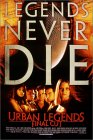
URBAN LEGEND 2 - FINAL CUT
     	Have you ever heard the one about the Hollywood producer who made
so much money off his cheap horror film that he decided to make a sequel?
He couldn't think up any original ideas so he took the movie-within-a movie
gag that worked so good in one of those Scream  movies.
"We'll set it at a film school," he said with his grinchy grin, "and hire
some no-name actors from zit cream commercials.  And maybe that Joey kid
from Blossom.  He probably needs the work.
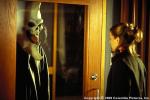
"But what kind of mask should our indestructible villain wear?", asked the
screenwriters.  "Somebody's already taken hockey and Halloween masks?"
"How about fencing?  Does anyone have fencing?."
"No, but -"
"Problem solved."
So the screenwriters worked night and day.
Actually maybe just one night.  And when it was done the producer looked at
it and said... "That's  the most worthless excuse for a horror movie I've
ever seen...we're gonna be rich!"
 I swear it's  all true.  My girlfriend's brother has a cousin who works
with a guy that went to school with the screenwriter's mother-in-law.   If
you don't  believe me, go see the movie.
I dare you.
Grade: D+