December 2005: Shoulder Surgery
In April 2005, during my run through Instone's Challenge, I partially tore the AC joint in my shoulder. I was treated with injections for the first 7 months of this injury. By December 2005, I could no longer raise my arm above my shoulder, and I could only lift about 5 pounds. It was finally determined that surgery would be necessary and an additional issue was discovered, known as "osteolysis of the distal clavicle", which in simplest terms is a form of arthritis of the shoulder characterized by the fraying of the clavicle bone. This page outlines the diagnosis, analysis of the diagnosis, treatment, and rehabilitation that went along with my shoulder injury. I post it here now as reference for anyone that experiences a similar injury.
Intial Diagnosis: Rotator Cuff Tear
During week 10 of my Instone Challenge the big disaster struck. While performing overhead raises (military press) I started to feel a tinge in my left shoulder. Now, everything I've read about pain during lifting tells you that you need to evaluate how bad the pain is before continuing. I still had full range of motion. I could still lift the weight, so I finished my last two sets. Unfortunately, I misjudged the pain in my shoulder. The next day I could not move my arm properly and I could not lift it above my head without extreme pain. I used ice and Aleve to try and get the swelling down a little, but after one more day I finally went to see my doctor. Preliminary diagnosis: chronic tendonitis in the shoulder tendon, or a slight tear in the rotator cuff. The latter might require physical therapy or surgery. I was prescribed Naproxen for 2-3 weeks. If I did not see improvement, I would need to follow up.
I followed up.
A MRI showed some micro-tearing (partial tears) in my shoulder joints, so I was immediately referred to an osteopathic surgeon for evaluation and treatment. My surgeon evaluated the MRI and took additional x-rays. He described my clavicle as "chewed up" (I guess that's the technical term), and showed me exactly where the larger than average gap in my shoulder was located, and how the end of the bone looked cloudy or frayed. His diagnosis: "Osteolysis of the Distal Clavicle" with the added bonus of a partially torn AC joint.
[RETURN TO THE TOP OF THE PAGE]
Corrected Diagnosis: Osteolysis of the Distal Clavicle
I'll have to quote from a medical web site on this one:
"Atraumatic osteolysis of the distal clavicle is an unusual injury that
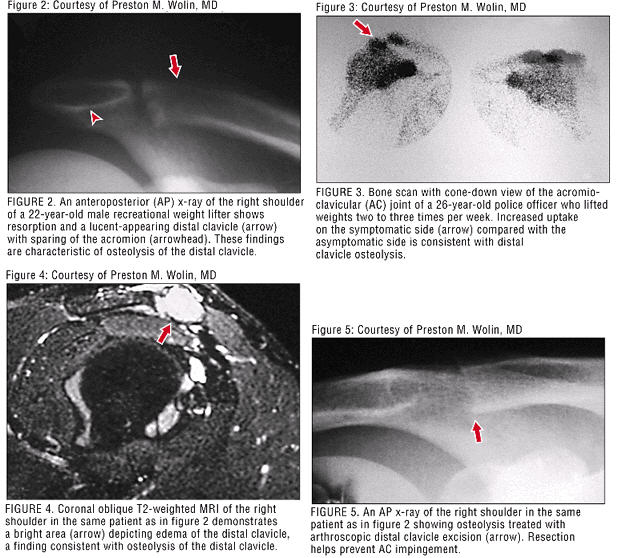
Plain films of the AC joint and clavicle usually confirm the diagnosis. Key findings include osteopenia and lucency in the distal clavicle (see figures 2, 3, and 4 below). Treatment consists of
discontinuing load-bearing activity (See Analysis B). Conservative management should be used for as long as the patient will comply. Consideration for resection of the distal clavicle should be individualized according to each patient's functional demands (See Analysis C) and symptoms." Ref: http://www.aafp.org/afp/20000601/3291.html
[RETURN TO THE TOP OF THE PAGE]
[RETURN TO THE TOP OF THE PAGE]
A scope would be inserted front and back to determine the exact nature of the injury. Finally, a larger cut would made to extract the clavicle bone, smooth out of the end of the bone, and clean up any arthritic tissue that was found. The surgical procedure went smoothly. Your are injected with a local anesthesia and a cocktail to prevent infection. Within about ten minutes, you are out. When you wake up, the surgery is done. The procedure was performed at a brand-new facility and the prep-nurse was actually the sister of my supervisor at work, so pre-surgery and post-surgery where spent joking around. She told me that my boss wanted the piece of shoulder they were going to take out, so that he could say he owned me. My boss has strange sense of humor.... but I digress.
With the surgery finished, the next steps were a steady diet of pain pills and daily stretching until I was free from pain and had enough range of motion to start physically therapy. I healed quickly (much to my doctor's surprise) and was ready for therapy just a month after surgery. My home therapy program is described in the latter sections of this article.
[RETURN TO THE TOP OF THE PAGE]
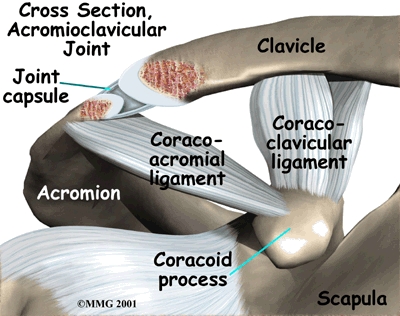
Figure 1
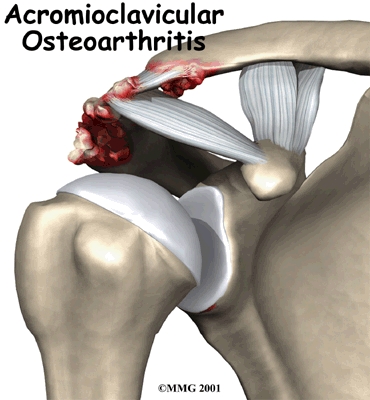
Figure 2
Basically the surgery scraped all that scar tissue off and they smoothed out the clavicle by taking a chunk out
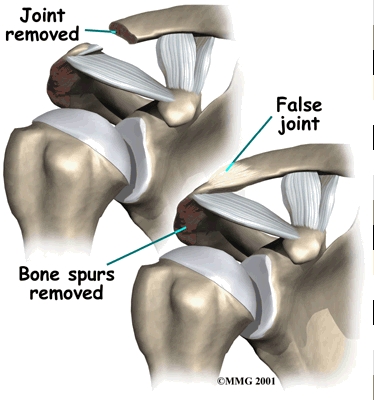
Figure 3:
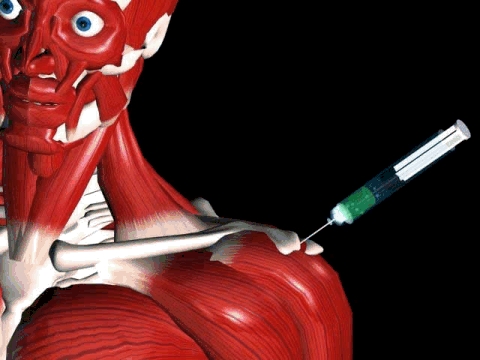
Figure 4
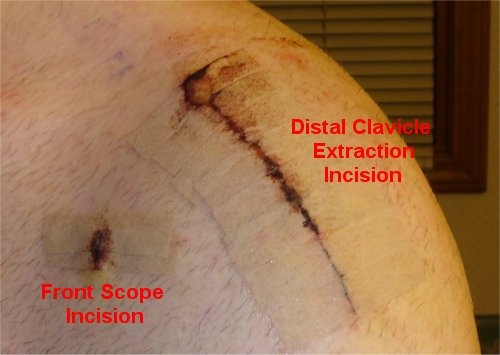
Figure 5: The front of my shoulder,
post-surgery
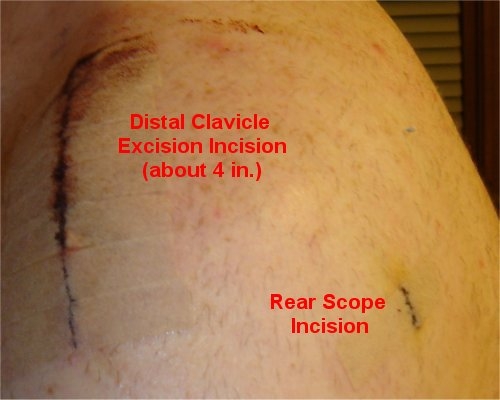
Figure 6: The rear of my shoulder, post
surgery
[RETURN TO THE TOP OF THE PAGE]
My progress was so good that my doctor felt that I could rehab at home, rather than under constant (read: expensive) supervision. I would meet once with a physical therapist to design the program. I was supposed to be "all better" in 3-6 months. Attached are the exercises I was prescribed to rehab with. I use a series of rubber bands to rehab. I sold most of my free weight equipment and was told not to left heavy weights again. I should stick with rubber bands, pulleys, or machine weights.
Get the Shoulder Rehab Exercises: HERE (PDF file reader, such as Acrobat Reader, required)
2007 Update: I finally started lifting with light weights again in May 2007, nearly 17 months after starting physical therapy with rubber bands. The 3-6 month estimate was a bit off, but all bodies and injuries are different as are success rates for the surgical procedure. I still have constant pain in my shoulder, but it is very light. That said, I still feel the surgery was successful. Before the surgery I could not sleep on my left side or raise the arm above my head. Post surgery, I could sleep on my left side without pain and I no longer get the sharp pinching pains I had before the procedure. I also regained full range of motion in my left arm. In fact, my left arm has better range of motion now than my much stronger right arm. I am proceeding in my workouts very slowly and carefully, and still performing my rehab exercises at least once a week.
[RETURN TO THE TOP OF THE PAGE]
[RETURN TO THE TOP OF THE PAGE]
[RETURN TO REV. OKE'S FITNESS HOME PAGE]
©2002 - 2005 by Rev. Oke: [email protected]