Statement
by the NGO Committee of the CGIAR
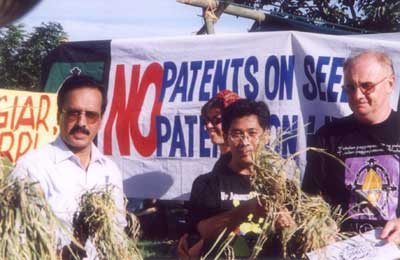 The
NGO Committee of the CGIAR held its biannual meeting in
Manila in advance of AGM02.
The
NGO Committee of the CGIAR held its biannual meeting in
Manila in advance of AGM02.
In
this review of the activities of the CGIAR, the committee
recognised the efforts made to open spaces for Civil Society
interaction and partnerships at Centre and System levels
and appreciated the efforts by a number of Centres to strengthen
integrated natural resources management programmes. However,
it became clear, in this review of the current trends in
the CGIAR, that civil society expectations of the System
as a whole in fulfilment of its mandate, are not being realised.
The
CGIAR mandate is to produce public goods for the benefit
of poor agricultural producers in developing countries and
to safeguard the genetic resources taken from farmers' fields
and held in public trust by the CGIAR gene banks. The NGOC
observes that the CGIAR is deviating from this mandate and
is adopting a corporate agenda for agricultural research
and development. CGIAR's consideration of Syngenta Foundation's
membership is a clear indication of the trend towards the
corporatisation of public agricultural research. Furthermore,
the quest for partnerships with the private sector undermines
the public role of CGIAR.
The
NGOC notes that the CGIAR and its Centres have:
-
Failed to support an immediate moratorium on the release
of GM crops in their centres of origin and diversity in
the light of GMO contamination in Mexico and the potential
contamination of other centres in the years ahead. These
GMOs include seeds, grains and food aid. The CGIAR has also
failed to initiate scientific work to assess the risks and
biosafety requirements necessary to protect the genetic
integrity of landraces on-farm, their ownership and the
livelihoods of resource-poor farmers in these areas.
-
Failed to uphold, in the face of threats of increased private
control and monopolisation of genes through lPRs, the principle
of the FAO-CGIAR Trust agreement that requires all germplasm
and its genetic parts and components, currently in the CGIAR
gene banks to be kept in the public domain.
-
Actively been promoting genetic engineering technologies
and products, which are incompatible with farmer-led agroecological
research, and will lead to further marginalisation of farming
communities. The CGIAR and some Centres have been promoting
biotechnology as the answer to world hunger.
The
NGOC urges the CGIAR to listen to and take seriously the
voices from the Peoples' Street Conference. NGOC calls on
the CGIAR to respond positively to the demands in Unity
Statement which we support, especially with reference to
those points that reinforce CSO Declaration for Durban with
its comprehensive set of proposals that was presented to
MTM 2001.
That
Declaration emphasised the need for transforming the CGIAR
Centres into regional research support systems to assist
farmer-led agroecological research and the need for safeguarding
the genetic resources in the CGIAR gene banks. These should
be the top two priorities of the CGIAR. We regret that the
majority of programmes being developed through the Challenge
Programme process are not reflecting these priorities.
In
the light of these concerns the NGOC, in dialogue with a
wide range of Civil Society Organisations including those
in Manila this week, is reassessing its relationship with
the CGIAR.
30
October 2002
Statement
also endorsed by Abou Thiam, Assetou Kanoute, Devinder Sharma,
Dwi Muhtaman, Eyasu Elias, Mariam Jorjadze