METHODS TO IMPROVE FOUNDATION GROUND:
Geotechnical process of improving
the required characteristics of the soil is known as ground improving
techniques.
The improvement process under which the influenced zone is limited to about a depth
of >=1m the techniques are
called surface stabilization techniques.
The processes who has appications at the depth extending at least 1.5 to 2 times the
width of the footing below the base of the foundation. The process is known as
the ground improvement.
SURFACE IMPROVEMENT TECHNIQUES:
There are different techniques that are used in
this type of ground improvement methods.
Mechanical Stabilization method:
In this method mechanical energy is used to improve the soil mass and the
method in general is known as compaction. For roads embankments this type of
method is used with the help of rollers.
Physical Stabilization method:
In this method physical properties of the soil is improved by blending two
or more soils. As by blending two or more soils increases the gradation
properties of the soil. This type of technique is used in roads when more than
one type is available nearby.
Quite often some additives are added into soil to improve the stability of
the material.
Cement stabilization:
Cement stabilization method is mostly used in road construction to improve
the stability of the sub grade. Heavy soils are difficult to pulverize and are
not suited for cement stabilization. The best soils suited for cement
stabilization are well-graded sand gravel mixtures with at least 10% of material
passing through #200
Lime stabilization:
In this method both hydrated and quick lime can be used. But quick lime is
more economical as compared with the hydrated lime. However quicklime is
somewhat can cause hazards for the health.
Lime mortar and same kind of material is used in Badshai Mosque (Lahore
Pakistan) as binding as well as ground improvement material.
Although the addition of this material causes increase in the shear strength
parameters but it should be noted that is material can be much reactive with
rainwater to form carbonic acid.
GROUND IMPROVEMENT
TECHNIQUES:
One of the most used methods in ground improvement techniques is deep
compaction there are different methods for deep compaction as stated below:
Dynamic compaction:
It is a simple method in this
method heavy loads unto 10 to 20 tons are dropped on the soil from height
freely. As the loads are very big so the waves generated by the impacts are
transmitted quite deep usually up to 15 m., which causes the soil to settle
down, and increase shear strength parameters. Biggest advantage of this type of
compaction is that it is a low cost method.
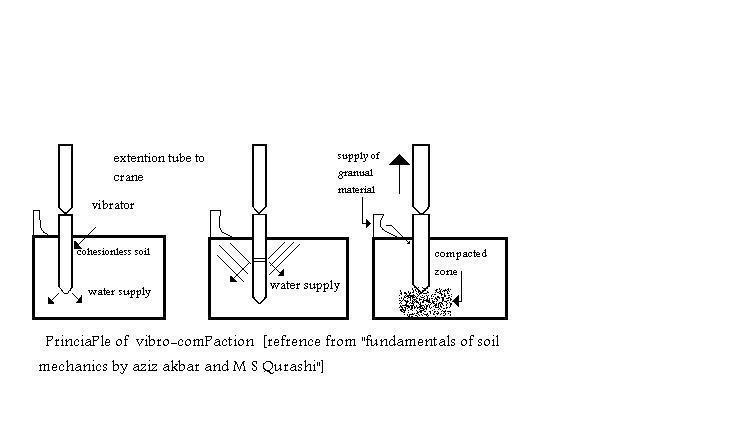
Vibroflotation process:
This type of process is used since 1960s this technique is called
vibro-replacement or stone column method. In
this type of method a vibrating device of dia about 300 to500 mm and
approximately 2 to 5 m long with water jets at the top and bottom is forced into
the ground. An eccentric disc inside the bottom causes the vibrations and causes
the soil to settle down.
For graphical explanation of the vibro-flotation process Click the pic