I actually purchased the rights to this article through Sports Illustrated.
Please read the whole article.
The Ugliest Game
An NBA brawl exposes the worst in player and fan behavior, and serves as a frightening
wake-up call
By Jack McCallum
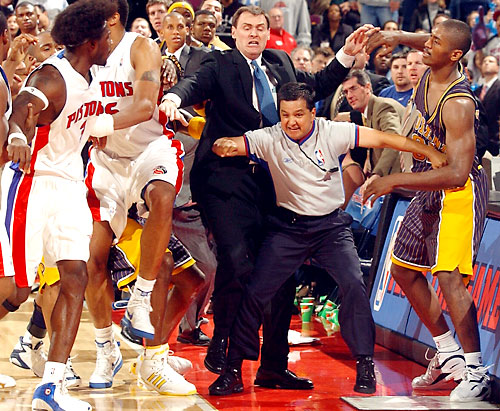
Ben Wallace's shove of Ron Artest (right) soon led to Stephen Jackson's punching
spree.
Allen Einstein/NBAE/Getty Images
Unless your gastrointestinal tract is immune to violence and bad taste -- a distinct possibility given their abundance in society today -- this was a week in sports that could turn your stomach. Rage, racism, sex, alcohol, possible lawsuits and felony charges: We touched 'em all, baby. And what followed the Terrell Owens-Nicollette Sheridan Towel Drop, the Lou Holtz Farewell Donnybrook and the Malice at the Palace Player-Fan Brawl (the nastiest incident in the NBA's 58-year history) was one of our sporadic sessions of head-scratching and soul-searching. What's happened to our games? What's gone wrong with our sporting culture? Aren't sports supposed to be something that kids can enjoy? Aren't they meant to entertain and even inspire us?
It's impossible to say whether any major changes will come out of it all, though
at week's end two things were clear. First, the ongoing criminal investigation
of NBA players and fans after last Friday's fracas at the Palace -- not to
mention the protracted battle shaping up between a league that imposed severe
suspensions
and a players' union that is appealing them -- is guaranteed to keep the ugly
episode in the news, further alienating the public. Second, the NBA now has
a Christmas Day doubleheader that's just as titillating as the smash hit Desperate
Housewives, which ABC was promoting with its lame Monday Night Football lead-in
featuring Owens and Sheridan on Nov. 15. Gather 'round the TV, kids, for Game
1, the Detroit Pistons versus the Indianapolis Pacers at Indy's Conseco Fieldhouse,
a rematch of the two teams at the epicenter of a fist-throwing, chair-launching,
beer-hurling riot. And in Game 2 watch a showdown between the Los Angeles Lakers'
Kobe Bryant, who recently had rape charges against him dropped, and the Miami
Heat's Shaquille O'Neal, whom Bryant tarnished after his arrest when he told
police that O'Neal had paid millions of dollars in hush money to women after
sexual encounters (an accusation Shaq denies). Happy holidays!
In the wake of the 10-minute melee at the Palace, which he termed "an unprecedented
fiasco," NBA commissioner David Stern has promised a reexamination of security
at all 30 of his league's arenas. At a press conference on Sunday he also talked,
though not in much detail, about "holding fans accountable for their antisocial
behavior." Both measures are a decade overdue. With Friday's Fight Night,
the league reached a new low -- and in Detroit, too, where just five months
ago the championship won by the team-first Pistons had engendered a fair measure
of positive feeling across the sports world.
Worse for Stern, when a brawl broke out at the South Carolina-Clemson football
game last Saturday afternoon -- one that had players swinging at one another
across half the field and required a phalanx of state policemen to break up
-- some of those involved cited the NBA as a factor. "For 24 hours [the players]
watched that basketball fiasco on TV," said Clemson coach Tommy Bowden,
whose team prevailed 29-7 in Holtz's last game in charge of the Gamecocks. "And
that's on 24 hours a day, every major news program ... and they watched it, watched
it, watched it." (How watching it didn't teach them the dangers of such
antics is perhaps better left to another discussion.) Soldiers and civilians
fall in Fallujah, but punches at the Palace are adjudged almost as newsworthy.
It's hardly a surprise that less than 48 hours after the Palace incident, a
website called BasketBrawl.us was up and running.
In fact incidents of reprehensible behavior at sporting events go relatively
unnoticed on a regular basis. Nebraska's Darren DeLone, a 6'5", 315-pound
senior tackle, has been charged with aggravated assault and battery after he
allegedly drove his helmet into the face of a member of the Oklahoma spirit
group before a Nov. 13 game in Norman. Adam Merritt, 19, required oral surgery
as a
result of the hit, which sent him flying eight feet into a brick retaining
wall. But there are two sides to the story, which is usually the case in a
sporting
culture that must claim obnoxious and provocative fans right along with overreacting
jocks. Merritt is a member of Oklahoma's Ruf/Neks, who typically sit in the
end zone at Owen Field and shoot popguns and heckle opposing teams. That doesn't
justify an assault by a heavily padded mesomorph, just as a thrown cup of beer
doesn't make it O.K. for the Pacers' Ron Artest to leap into the stands in
search
of someone to coldcock. But it is part of the discussion.
Plainly, the social contract that should govern our games has broken down,
and not just in the NBA. Clemson running back Yusef Kelly actually sounded
proud
after last Saturday's debacle that "at least we kept it to the football
teams." But is anyone naive enough to believe that alcohol-fueled football
fans wouldn't get involved if they had NBA-like proximity to the field? Saturdays
and Sundays are for rage in the stands and preening on the field, particularly
in the NFL, where court jesters like Owens celebrate six-yard receptions as
if they'd just won the lottery.
Baseball players, too, have frequently crossed that sacrosanct barrier between
field and bleachers. Texas Rangers relief pitcher Frank Francisco was charged
with felony assault (it was eventually dropped to misdemeanor assault; he pleaded
not guilty) after throwing a chair at a heckler during a game in Oakland in
September. Later that month Los Angeles Dodgers outfielder Milton Bradley threw
a bottle
at a fan's feet, during a home game, drawing a five-game suspension. Were the
players wrong in both cases? Absolutely. But a fan had heaved the bottle at
Bradley in the first place, and the spectator whom Francisco went after said
that he
had chosen his season-ticket location because it was near the visitors' bullpen,
the perfect spot for heckling -- "an American tradition," as he put
it.
A tradition of boorishness and a bent toward violence is not unique to the
U.S. Before Friday night the most famous instance of a player's going after
a fan
occurred in a 1995 English First Division soccer game when Manchester United's
Eric Cantona leaped over a fence and kung fu kicked a heckler in the chest,
drawing an unprecedented suspension of eight months. Even as they lamented
last Friday
night's incident, any number of NBA players and coaches talked about experiences
in Europe that were worse. When he played for Milan in the 1980s, Phoenix Suns
coach Mike D'Antoni was spit upon when he went into the corner to pick up a
loose ball for an inbounds play, then was hit with a technical foul after he
yelled
at the fan. "I played an awful lot of games in Europe where there were armed
riot police with shields," says Chicago Bulls coach Scott Skiles. "People
would spit down on you going out of the tunnel."
Likewise, civility in today's NBA arenas is as absent as the set shot. Souvenir
stands sell clackers, towels and thundersticks designed to distract opposing
players. The home team is announced in a smoke-and-firecracker ceremony that
resembles the arrival of a heavyweight fighter to do battle. With the blessing
of the front office, yahoo public address announcers try to whip the crowd
into a frenzy. Spectators risk life and limb when they lean over a balcony
wrestling
for a free T-shirt launched by a giant slingshot. And there is, of course,
alcohol, not only beer but also mixed drinks served to the high rollers in
the front row,
who at most arenas can stretch out their legs and put both feet on the court.
It's a small miracle that some fan has not gotten out of his seat, taken a
charge, then bitched about the call. "The NBA wants the fans to feel more connected
to us," says Indiana center Scot Pollard. "They feel there's a separation
between the fans and athletes because we get so much money and get glorified
so much."
Two nights before the Pacers arrived in Detroit, several members of the Minnesota
Timberwolves complained about the particularly vile nature of the heckling
at the Palace, where a month earlier, during a preseason game, a fan had thrown
a bottle toward the Minnesota bench. An NBA referee with 30 years of experience
honestly believes that "some official in a major sport is going to get killed.
You can see the craziness in the stands. You can feel it." When every
game features three hours of nonstop cacophony -- loud music, dot races, fan
shootouts,
giveaways -- the message conveyed in the arena is clear: The game does not
matter. Fan satisfaction does. And so some spectators, nurtured at the teat
of Jerry
Springer, begin to believe that they are, in fact, part of the game. They hurl
invective, then beer and feel frustrated that they can't get even more involved.
Richard Jefferson of the New Jersey Nets says that he has heard fans ridicule
a player for having a mentally handicapped child. Dude, nothing wrong with
that -- I paid to get in.
There is something else at work here, too, something that Indianapolis Colts
coach Tony Dungy mentioned in connection with Owens and the desperate housewife.
Dungy found the skit "racially offensive," saying that it played into
black stereotypes "on the heels of the Kobe Bryant incident." Few
connected with the NBA wanted to touch whether racism was kindling for the
firestorm last
Friday, but it was inescapable that black Indiana players were duking it out
with mostly white Detroit ticket holders. That image will not sit well with
those white fans who see some African-American players -- lavishly paid, richly
tattooed
and supremely confident -- as the embodiment of all that is wrong with sports.
Has there ever been a more reviled U.S. team than last summer's Olympic basketball
squad, which finished a disappointing third? They wore red, white and blue,
but when they lost, what too many saw was black.
At the same time, some NBA players see, in the white faces of the fans, the
embodiment of their frustrations: criticism from the media, the 24-hour sports
blabathons
that dissect their performances, racist remarks from the stands. Don't think
there isn't widespread support for what Artest did. The theory that players
should endure all manner of abuse without responding is just that -- a theory. "Nobody
gets paid to have stuff thrown at them unless they're circus clowns in a little
booth," says Indiana center David Harrison. Pacers opponents have closed
ranks too. "Hell, no, it's not Artest's fault," says Nets center
Alonzo Mourning. "What has this come to, when a fan feels he has the right
to throw something at a player on the court?" Adds New Orleans Hornets
forward Lee Nailon, "If we were in the same situation, and somebody did
something to my teammate, I would have been out there with them because it's
family." "
If the fans throw something," says Timberwolves guard Sam Cassell, "we've
got to protect our honor."
Players may fight one another on the court, but they always band together
against fans and authority. In a league that suffers from massive image problems,
the
biggest NBA stories before last Friday were Minnesota's Latrell Sprewell,
who makes $14.6 million a year, complaining during a contract dispute that
he "has
a family to feed," and Artest, who makes $6.1 million, asking for a month
off to promote an R&B album for his fledgling label, TruWarier. (O.K., Ron,
you've got the time now.) Those are two examples of incomprehensible stupidity,
yet few players criticized Sprewell or Artest. Neither did many rally behind
Stern's stern sentence, the reaction of Cleveland Cavaliers star LeBron James
being typical. "It was shocking, and it's kind of sad, that some of our
good players are suspended," said James. "To keep our image up, we
kind of need those guys." With the collective-bargaining agreement expiring
after this season, that sort of divide between labor and management hardly
bodes well.
The actions and comments of the Artests and the Sprewells should not define
an entire league. But to many they do. It's hard to imagine what kind of
criticism Allen Iverson of the 76ers would take if he acted out during
a game half as
much
as his fellow Philadelphian, Owens. Iverson is more of a target for angry
white fans than Owens. Iverson is visible. He's close to them. They see
his tats.
They see his cornrows. They see his emotions. They see his blackness.
For too long Stern has soft-pedaled the serious problems in his league:
the erosion of the players' fundamental skills, the influx of teenagers
unprepared
to be
professionals, the emphasis on individual virtuosity over team play.
Even if some of them are out of Stern's control, they are problems nonetheless.
The
review of arena procedures may turn out to be -- indeed, should turn
out
to be -- a
watershed moment in American sports. Stern seems poised to act, but he
also needs to see the big picture, perhaps convening a summit of the
major sports
to discuss
issues such as security, player behavior, abusive fans, alcohol service
at games and the provocative way that all sports are marketed. And while
he's
at it, he'd
better get his own players onboard.
The image that may linger the longest from last Friday's mayhem was that
of a young and fearful Pistons fan being consoled as he wept. The kid
must be
wondering
where all the fun went.
Issue date: November 29, 2004