When I was a child—perhaps seven, perhaps eight—I stood in the asphalt driveway of our suburban home in Holliston, MA. It was a Saturday or a Sunday in the middle of summer, and my parents and I had just moved there from Dallas. I had none of the usual associations about me. No friends and no old habits. I was just standing in the driveway for a moment with nothing particular to do and nothing particular on my mind, when an idea suddenly swept down and tore my brain from its hinges.
The universe appeared in my mind’s eye. The Earth I stood upon, the planets, the galaxies, stars without number, and space itself reaching out forever—massive, cosmic volumes of space—all of it was pictured to me, filling my mind with vastness and emptiness, until I came to the edge of it. The edge of the universe. I then perceived that the universe was contained in a small vial, tended by a gray-bearded scientist existing upon a much larger planet Earth that floated in another, greater universe, among further galaxies, stars, and space—space expanding infinitely in all dimensions until it likewise reached a further terminus, only to appear within another small vile tended by another hoary scientist. By the time this idea had multiplied itself in my mind several times, my head was reeling with the sheer immensity of the idea, as if infinity began at the center of my self-conception, or radiated outward from my ego, until the ego began to fear annihilation and could recover itself only by halting the idea so as not to become engulfed by it.
The importance of this idea of mine lies in the fact that it came uncaused and unbidden. Nothing in my education thus far had equipped me to have such a powerful idea. Excepting the presence of the conceptual terms of planet, stars, space, and so forth, nothing known to me in memory or thought process had prompted me to make use of these terms in such a manner as to create in the mind an infinitely expanding and hierarchical model of the universe that might resemble one of the Carceri d'invenzione of Piranesi. How did the idea originate, and why?
I had no answers then—not until another twenty years had passed would I be able to look back on this brief episode and recognize its significance. I had elementary school ahead of me at the time, and junior high and high school waiting for me as well. I began to count the years of schooling that lay ahead with a kind of morose fatality that one might find striking in a boy so young. A dislike of school and a dread of futurity were upon me; a division had arisen in my mind between the inward creative impulses whose significance was self-originating—akin to Whitman’s afflatus—and the intellectual platform of schooling which insisted that all knowledge was external and must be laboriously assimilated. As I began to recognize this inward nature of creativity, a question posed itself to me, much as the idea had: "Which is more true, the words that I speak in my head, or the…knowingness that knows what it means to say, but is always silent?" I had no answer at the time for that one either. I was beginning to write poetry, to fall in love, to feel sexual urges. I recall only a few lines from a poem I had written to a girl named Kelly, who had become my one, true romantic obsession for more than a year: "You, Kelly, are the jelly, and I’m the peanut butter, / And we belong in a sandwich together." Is it not impossible or at least improbable that I was writing extended metaphors before being formally introduced to and methodically instructed in that difficult concept? Yet this is the miracle of the creative consciousness. My synapses were fully formed and the body was ready to bear the full force of this consciousness.
Behind Closed Portals
I know I am solid and sound,
To me the converging objects of the universe perpetually flow,
All are written to me, and I must get what the writing means.
--Whitman, Leaves of Grass, ll.403-405.
It is appropriate that I trace the life of my literacy from the instant of turning from these grand conceptions, these inquiries of lasting philosophical import, only to enter the halls of academy and suffer drudgery upon drudgery for reasons I could not fathom—except perhaps that learning was a necessary chore, much like taking out the garbage. My ability to decode information, to remember it, and to parrot it back to instructors was rated on the high side of satisfactory; but this middling competence did not lend itself to a sense of confidence in my intellectual resources, for it conflicted and actively opposed the determined urges of creative abandon, whose still, small voice was becoming drilled out of me by an educational insistence on rote knowledge.
Intellectual adequacy, as it was defined in the schools, seemed to lurk just beyond the horizon for me, just out of eyeshot, just out of reach. I recall being motivated primarily by fear in the acquisition of my literacy skills—mostly the fear of exposure—and perhaps for that reason my competence was only middling. Certain questions would be asked of me, certain points of view were expected, certain memories retained from my "adventures" in reading. I could not ascertain what was important. All of this seemed exterior to the relevance of my own desires and curiosity, so I could only assume that everything was equally important. I had to know everything if I wanted to avoid failure. I was always certain that David Brown, who in the third grade was pedestalled as the epitome of genius in the arts of reading and writing, was going to know the answers; but I on the other hand, was decidedly uncertain about myself. I gulped down my lessons and hoped my brain would stay full.
Owing to this insecurity about my literary intelligence, I also suffered from a furious impulse to know more than I was ready to know. As a first-grader, I began to indent my writing to create the appearance of paragraphs. In the third grade, I was trying to read books that presumed at least a ninth-grade reading ability. I remember struggling for weeks trying to understand an historical account of the Midway, the WWII aircraft carrier that was of signal importance in the war against Japan. I pored over words and phrases that stood far outside the scope of my vocabulary, my background in history, and probably even my interest, had I ever managed to figure out what I was reading. I find it inconceivable that my parents had never noticed what I was trying to do and had never thought to put more appropriate books into my hands.
It was a blind, mechanical process in which I was involved, accumulating facts and words and pint-sized concepts and all the little rules and regulations of the universe. I recall being intimidated in the third grade by a poster above the blackboard describing the concepts of primary and secondary accent in the pronunciation of words. It was an unknown that I had to know, there was a fact or idea existing outside of myself for which I was responsible or would soon be responsible, and would I be able to understand it? Doubts of my own competency nagged at me persistently. Where was the insistent voice within me that could declare its consciousness amid the clamor of discrete, abstract knowledge—cold and external and reified?
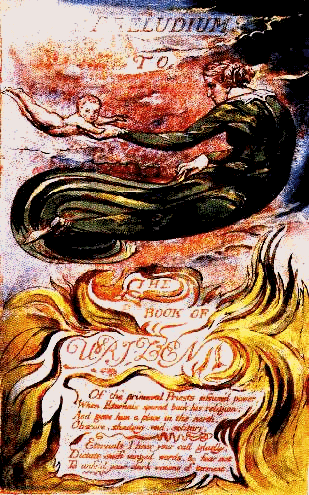
Detail of The [First] Book of Urizen, Plate 2. This image when printed
separately bore the title "Teach These Souls To Fly" (Erdman 184).
You might say I left that third-grade classroom and moved down the hall a few million doors. During summer vacation, I moved to the middle of a vast cornfield in south-central Michigan, a village called North Adams, composed of nearly 500 people—most of them farmers—that was located not in the heart, but in the rump of rural America. It was quite a switch from the suburban, upper-middle-class community I had known in Boston. And I, a newcomer with an outlandish and conspicuous Bostonian accent, got to live there among them all. I was destined to remain there for the next eight years.
I think it was a turning point for my academic life that the grossly underfunded school system in North Adams was about a semester behind Holliston, so I was farther ahead academically than the rest of the students. This situation, combined with the fact that I was a stranger and an outsider in these new surroundings, where everyone seemed to be related to each other or to have known each other since birth, made me decide once and for all to turn to scholastics as a means of self-validation. The different grading system contributed as well. North Adams gave us "report cards" with anything from an "A" to an "E" in individual subjects, whereas Holliston had "progress assessments" using one of four relatively benign concepts: unsatisfactory, fair, satisfactory, and commendable. The grading system in North Adams was more like a cattle brand. Since at first it was easy for me to get A’s, the grading stigma at North Adams became a strong incentive for me to keep on getting A’s than it had been for me to try for "commendables" in Holliston. A "B" seemed more negative than a "satisfactory," since I hardly knew what commendable really meant.
I rose to the head of the class immediately, and it was my motive ever afterward to retain that position, until I graduated as valedictorian in 1986. I had abandoned poetic effluence for scholastic accumulation, expertise in memory. Was there a thirst for learning in what I did for school? Was there a desire to discover anything? No. I simply wanted to keep my status, my class ranking. Owing to my pallid faith in rote knowledge, I still mistrusted my intellectual capacities, but found that hard work and diligence could make up for it. I recall feeling a frustrating gap between what I knew and what I thought I should know when it came to reading comprehension. In the sixth grade, for instance, I was assigned a short story that had an ending I simply could not understand. I had to admit defeat and ask my mother for help, and after she read the story and told me the answer, I felt…relief. I was afraid that I would be exposed as a moron if I did not know the answer. But, as it turned out, no one else in the class had figured out the ending to that story. No one cared. My teacher afterwards asked me to be a tutor for students with reading problems. I agreed. Head of the class. I win.
The nebulosity of literary interpretation still hovered and loomed and lurked about me as I was making the grades and moving through the grades. My freshman English class had to read Lord of the Flies by William Golding. At that time, I was adept at retaining the facts of the story, such as the setting, the characters, the plot—I could even draw up plot diagrams showing the rise and fall of action, the climax, and the denouement. But these accomplishments were merely mechanical in nature and required no real interpretive capabilities. My English class now, however, was being introduced to rhetorical devices such as simile, metaphor, and symbol. The teacher patiently explained that the conch in the novel symbolized power and authority, and the glasses that Piggy wore symbolized his intelligence and fair judgement. I think her skill in forming these connections made me a little uneasy. It reminded me of a short story I had read in the sixth grade. There was a bridge between the explicit and the implicit; yet I had no way to find it or to cross it. I could see that the interpretations my teacher assigned to these seemingly incidental signifiers made sense and seemed right. But I just could not understand how she did it, what special x-ray vision glasses made the bones of these questions and answers plainly visible to her. Why did Golding not just come right out and say what he meant, instead of making me guess all the time? Nevertheless, my turn to cross the bridge finally did come after class when my teacher asked me a question about the book: "What does the pig’s head symbolize?" I had never even considered asking myself such a question, and I had no clue. I drew a blank for a moment, but then decided to hazard a guess. "Does it mean death?"
She told me I was right; and I was so very pleased with myself. In a way, I had put on the robes and graduated. I was beginning to perceive that literature was deliberately coy; it partly concealed itself from the immediately apparent for the sole purpose of rousing our faculties to act, to engage the reader in the mystery of making meaning. It wore a negligée and posed seductively, instead of just standing there stark naked. Unfortunately, however, what works for one novel does not necessarily woo another.
The reading I did later in high school gave me the same tentative, mental queasiness, I never felt confident about my relationships with the novels I was reading. They were being secretive about something—I knew this well. But how to give them the third degree remained a mystery. My instructors likewise seemed to be reticent about encouraging any degree of interpretative interaction between the students and their novels or poems. As a senior I was reading more difficult texts, such as Macbeth, but I was being evaluated with the same kind of multiple-choice tests that I remembered from middle school: "What are five of the ingredients the witches used in their stew?" One assignment had us posing questions to the whole class about Huckleberry Finn. We wrote them ourselves and the class had to answer. Everyone but me asked simple fact-oriented questions like: "What was the name of the hare-lipped woman?" I knew better than that; but I still did not know how to do any better. I was reading from my father’s copy of the text, in the margin of which was a note that turned into a very good interpretive, leading question: "What does the bowl of fake fruit signify in relation to the characters who owned it?" No one could answer, of course. It represented the phony façade that those characters projected, and their corresponding moral hollowness. Could this question have been any more appropriate for a guy like me?
I was writing poetry again, probably having stopped writing when I was eight and school took intellectual preeminence. What got me writing again was an assignment my senior English teacher gave us in connection with Twain and Huckleberry Finn. We were to write a five-page story using local color as a literary device. For the first time in my academic career, I had a serious assignment that allowed me to do nearly anything I wanted to do. It just had to be a piece using local color. So I wrote. And the results stunned my teacher. More importantly, the results stunned me as well. She submitted the manuscript to a local college professor she knew, who eventually sent me a letter saying not a word about my story, but telling me to "have courage and go forth, but first…" He then listed all the practices great writers have adopted to make their writing great—keeping journals, imitating various writing styles, knowing what your goals are, and so on and so forth. I was not wretchedly disappointed by the silent treatment this professor had given my paper. I understood it was not great literature. But he was a college professor, and the very fact of his writing to me at all had given me the impression that I was not playing a silly high school game anymore. I was in the big leagues now. Have courage and go forth. Good advice to a young man who would be attending the University of Michigan the following autumn.
The Gates of Paradise
If the doors of perception were cleansed
every thing would appear to man as it is: In-
-finite.
--William Blake, The Marriage of Heaven and Hell, pl. 14
Considering how ill-prepared I was for it, I survived the university experience by miracle. I had written one essay in high school that might be construed as practice for collegiate composition—a five-page literary analysis of Thomas Harding’s poetry, or what little of his poetry I had read. I managed to put together a rather sophisticated argument about the theme of mortality running through some his better-known pieces; and what I failed to surmise for myself, I borrowed from the few critical sources I had could scrape together from the local public library. My borrowings probably skirted dangerously close to plagiarism. But I was still uncertain as to what was appropriate in literary analysis. I began reading secondary literature on my own—quite by accident, in fact—when my independent trigonometry class became library study-hall and I picked out of the line up a brutally hardcore explication of the poetry of e.e. cummings. After reading this book, I felt that my blindness was turning to vision; I finally understood that interpretation, while being responsible to the literary artifact, was also creative in nature. Suddenly poetry was opening its pearly gates to me! It suddenly possessed a deep and personal significance to me, because its basis was creative exploration in a way I had never understood before. As Harold Bloom had said, literary interpretation was always a "creative misreading." I got to choose my own readings, for one thing; and that kind of autonomy had never before existed for me. I was also acquainting myself with the art of close reading and could see how sophisticated our reactions to literature might become—as complicated as we chose to make them. To appreciate literature was an exercise in philosophy and creativity.
I believe if I had not made these realizations before college I would have had a far more impossible time succeeding than I did. With this new attitude toward interpretation in mind and with an senior-level expository essay my father had written in college as a model for tone, structure and content—I was ready to tackle the first essay assignments for English Literature 240: Introduction to Poetry. And my essays earned me an "A" for the course. However did I manage it?
After thirteen years of schooling, I was no longer completely immersed in the drudgeries of academic nuts-and-bolts work: no vocabulary tests, no sentence parsing, no weekly paragraph exercises that sucked the enthusiasm out of the writing process with the mechanical redundancy of one topic sentence, three body sentences, and one concluding sentence. Ridding myself of this compositional formula became one my first great challenges as a college writer—but no matter. I now had the freedom to chose classes that interested me; I was the master of my own destiny to a degree I had never known previously. Suddenly my thinking was of central importance to the academic game and not my ability to memorize facts for a test, or to perform mechanical exercises that were aimed at strengthening my skills in reading and writing. I was attending classes devoted to understanding literature, instead of merely acquiring certain aspects of literary technique, such as the function of local color. Literary devices, techniques, genre—these concepts were but incidental to the induction of meaning from a text. Our interpretations were framed by lectures and class discussions, so I had a base of possible approaches to take in my reading strategies and in writing essays. The parameters of my literacy had expanded tremendously. I was on the narrow road of high-stakes acculturation; and my education was becoming part of an almost religious dedication to knowledge, as I lived and studied within a campus studded with huge gothic architectures and neo-Grecian palaces fronted by ranges of fluted Corinthian columns that made perfect, living exhibitions of the principles of sublimity described in Edmund Burke’s A Philosophical Enquiry into the Origin of our Ideas of the Sublime and Beautiful. I was a neophyte in an esteemed discourse community; and my professors seemed to preside over this ceremony of initiation with a calmly imperturbable and informed benignity. They were my intercessors between a penitent ignorance and a redeeming body of knowledge. And at this prestigious institution, tipping cows was not the expected pastime for students in their idle hours.
But my proficiency in writing essays and reading and understanding literature eventually led to an intellectual malaise, a disaffection with the discourse community in general. I could pick up any book, fix its location within a matrix of geography, history, and literary genre, and encase it within a convincing analysis of form, genre, and historical and biographical contexts. I completely understood the hidden curriculum of literary studies to be that anything is right, so long as thinking makes it so. I could offer any kind of interpretation of a book that was assigned, so long as I could prove and justify those ideas, in firm, concise, standard English prose, full of allusion and subtle word-play and exacting analysis. Even though I was now part of a community that exalted the relevance of its subject matter to a god-like immensity, I began to feel almost unconsciously that my interactions with literature were becoming mechanical. Its philosophy was becoming two-dimensional, flat and abstract. Yes, my thinking processes were being expanded and refined, and I was increasing my knowledge base, thereby enabling myself to frame my analyses within greater and greater intellectual contexts. I could trace the biographical influences in the works of Dickens and how Victorian concepts of society were involved in shaping plot and characterization, building abstruse arguments from relevant quotes taken from several of his novels and using citations from a wide body of secondary resources—then move on from there to show how the Edwardian political climate that followed Victoria’s reign led to a stance of philosophical unrest with the social order, that was reflected in the use of symbolism and even cynicism in the novels of Joseph Conrad and Evelyn Waugh. But it was a game I was playing. I knew the rules and the stratagems, and I knew I was good at playing it. Proficiency gave me the intellectual space I needed to stand back and ask myself, "What is the purpose of all this effort? How does poetical explication and literary analyses of 200-year-old novels improve my understanding of reality, of myself? Who cares how meaning is constructed in The Heart of Darkness when I’m not sure how to create meaning in my own life? How is all of this relevant to me outside of the confines of the university discourse community?
Mike Rose describes similar feelings in Lives on the Boundary, when he realizes how "solipsistic" the literary discourse community really is—how scholars spend years in little offices making quaint and curious glosses and connections and corrections and patiently digging at the grave of greater relevance and looting semantic coffins (76-77). Academic disciplines are very much self-fulfilling tautologies. The English Department determines what the conceptual parameters of inquiry should be, and by working within those parameters, scholars reinforce that pre-determined relevance. It is self-referring and self-reinforcing. I did what the discourse community deemed important; and because I did what I did, that importance is made evident and is preserved, not just by me but by the scholars and the professors and the guardians and participants in the discourse community. Suddenly that was not enough for me. I felt a nagging hollowness in me that was not being addressed when I wrote a brilliant, insightful explication of a poem or novel that someone else had written, someone else had experienced and put down in crafted words which we uphold as the embodiment of literal ability—or even as a Truth that we must lasso by strength of argument and wrestle to the ground by means of the literary essay, the monograph, or the scholarly book. I remember hearing from a professor that 98% of all secondary literature in the field was never read: it just collected dust in the library stacks and occasionally earned tenure for some lucky professor. But how was the "truth" of constructed meanings in a novel by Dickens relevant to me as a human being? The relevance seemed to exist only within the confines of the English Department, between students and professors like a secret. I was a senior in the Honors College at a prestigious university. No one could take that status from me. The crown of validation I had sought for was finally in my possession—I had my laurel—but now the question was, "What good is it?"
Fortunately I ran into a professor who knew the answer to this far better than I ever imagined during my brief acquaintance with him. John had been teaching at Michigan for about twenty years and was still an untenured assistant professor. He had very little standing in the department, and was known chiefly for his habit of making the hallway stink like an ashtray whenever he opened the door to his cramped, disastrously unorganized little office, filled with heaps of books, papers, paintings, drawings—and unemptied ashtrays.
I wrote my best work for him, because he seemed to be constantly inquiring into the nature of reality, with his head held back philosophically and smoke twining about his long, tangled hair. Life did not seem to be so much an exposition of what he knew, but an exploration of what he did not yet know. He was always on the prowl for understanding, and was open to it from any source, in any venue, in any form—from toilet-paper ads to the writings of Immanuel Kant. I felt I had an opportunity in his class to explore avenues of thought and philosophy that were closed off and taboo in other classrooms, where the climate suggested a stricter adherence to the investigative norms of literary scholarship. I wrote an incredible piece on Whitman’s Song of Myself, a labor of excruciating induction, synthesizing the overt sexuality of the poem with the creative process itself. He called me into his office and told me, "I hardly know what to say about your paper…It’s fantastic and could be readied for publication." A little later in the discussion he mentioned, ever so gently and tentatively, that the poem "means something else, too." But I did not know what he was driving at, and I dared not ask, not yet anyway.
Shattered Glass Houses; Or, The Alumnus Unbound
Unscrew the locks from the doors!
Unscrew the doors themselves from their jambs!….
Through me the afflatus surging and surging, through me the current and index.
--Whitman, Leaves of Grass, ll.501-04
I had intended a doctorate in English and American literature, but the thought of endlessly repeating the same type of thinking—though it spirals outward inclusively and elaborately and kaleidoscopically—and also of accumulating the same kind of literary knowledge, to which in terms of quantity there was practically no limit—filled me with horror. It was all pointless and irrelevant to me. I had my laurel: let me rest on it a while. I worked part time doing "joe" jobs such as janitor work and assembler work. But I studied what life meant to me, struggled philosophically, trying to read my own knotted, kenning-like existence as a poem, hoping that one day I would be able to write the interpretation of my own life, and live it with truth and energetic conviction. And oddly enough, although I no longer had to satisfy the intellectual expectations of a university English department, although I had no grades to sacrifice and nothing substantial to gain or lose in terms of what the world demanded of my mind—for what does a janitor need to know of poetical exegesis or deconstructionism?—it was during this stage of my life that I truly became the master of my own literacy. I think it was because I was setting the agenda, learning for myself and not for the oftentimes arbitrary parameters of a survey course in English literature. Now was the time for selecting choice viands, not for gulping down literature and language for the purpose of acquiring a comprehensive acculturation—learning Victorian literature for the sake of owning Victorian literature.
Not surprisingly, I was drawn to the French, Czech, and Russian existentialist writers: Kafka, Sartre, Camus, Celine, Dostoevsky. Then I turned to the turgid philosophies of Heidegger, onward to the French symbolists, which in turn lead me to the Beat writers of the fifties and sixties—the San Francisco Poetry Renaissance, Kenneth Rexroth, and through him to Chinese and Japanese literature, through Gary Snyder to Zen Buddhism and Chinese Poetry, and then Kerouac and the theory of "spontaneous writing"—from there to Burroughs and the idea that language is a virus from outer space that gets ignored because of the symbiotic relationship it has established with its host—shamanism, and the shaman practice of taking drugs that opened their eyes to an infinite wisdom, full of truth. No longer was I reading books in order to dig out little semantic connections, constructing overarching themes in a book that could be extended to current theoretical trends in the Western literary tradition. I was reading for life, for a philosophy that attempted to capture existence with the ineluctability and ubiquity of its truth. I had no need for little essays that "demonstrated" my understanding. The urge in me was too voracious for such trifles. Reading and writing took wild and crazy turns now—truth was like greased pig I was heatedly chasing down. I was on a furious quest for what was Right and what was Wrong. I wanted to know exactly what these ideas were to mean. Is it Heaven or is it Hell? I read. I read with a fiery purpose. I picked books up and put them down if they did not serve that purpose. I had dreams, heard voices, felt impulsions toward certain books I had never heard of nor ever seen before. I was far afield in literature by now, reading The Hundred Thousand Songs of the medieval Tibetan yogi, Milarepa, and then getting into Indian yoga. I was struck by a conception that was slowly beginning to dawn on me, that good and evil were mere states of mind and that they really did not exist in the world, that heaven and hell were likewise unreal, that there was, in fact, no original sin—because these contraries were impossible to define. After years of dedicated pursuit to resolve this issue, I was reading in Yogananda’s autobiography about the doctrine of karma and I realized that this was it, this was the cardinal philosophy that explained the dialectical nature of apparent good and apparent evil and gave them a united purpose—it was the only solution that worked, and I could see it clearly. Our own deeds and thoughts create their own repercussions, which return to us in the form of created circumstances and physical experiences: therefore we are living out the life we have created unconsciously and also have the power to overcome those physical and necessarily mental deeds and further ourselves by the power of creative instigation, because we are consubstantial with the Universal creator, and our misdeeds serve as their own retribution, because we create them and also experience their creation—they are not a punishment, per se, but a means of seeing the fruits of our own intellectual labors, our intellectual creations.
It was as if a gong had gone off in my head, with a long and fading resonance that permeated my entire mind and being. A door was flung wide open; my mind reached forth, grasped the sky. I saw the ramifications of this doctrine spreading outward from myself in all directions, infinitely—but primarily in intellectual directions. For if this doctrine was proof of a universal genius, and I was the transparent eyeball that drew from that genius, employed that genius, and was that genius, then…wow. There was no end to the use and application of such a doctrine. I was suddenly transported out of myself, seeing myself apart from all conditioning, all physical and mental contexts. I was privy at last to the idea behind Spinoza’s remark that "Mens aeterna est, quaternus res sub aeternatis specie concipit" (Wild 389). The mind is eternal to the extent that it perceives things in their eternal aspects. My mind, every human mind, has the potential for creative self-realization. The mind is not solely the reflection or ratio of all that it has ever known—such as memories, rote knowledge, learned concepts and learned ideas—it is also inspiration, the intuitive guidance of consciousness that molds these atomic variables into comprehensive equations, symbolic truths. The mind determines what it can know. Understanding, as Spinoza implies, is self-born, since the mind can perceive the universality of all specifics and is not bound by what is known in memory or learned from practice, for it exists beyond time and space. These realizations, therefore, do not come from merely accumulating external knowledge. The absorption of syntactic and substantive knowledge based on that which is previously known or experienced, constructing an endless web of contextual references which, according to the Bhaktinian notion of heteroglossia, are the sole means of constructing meaning—these are finite notions of knowledge and allow for no influx of new ideas, new viewpoints—they are modulations of the already known, or that which the mind has already created. The creative underpinnings of the concept of karma led me to this different understanding of meaning and how it is created. For if experience is but derivative of an intellectual impetus, and all that we know is the effect of causes our very mind has set in motion, then to truly know more than we know demands that we turn to the cause of knowledge and not its experiential derivatives. We must turn to the creative principle, the consciousness, the knowingness itself. After twenty years I was back to the same essential philosophical question that came to me in childhood: "Which is more true, the words that I speak in my head, or the…knowingness that knows what it means to say, but remains silent?" This knowingness is the mental extrusion of that universal creative impulse that was revealed to me through the instrumentality of the doctrine of karma
BIBLIOGRAPHY
Atwell, Nancy. In the Middle: New Understandings About Writing, Reading, and Learning. Second Edition. Portsmouth, New Jersey: Boynton/Cook Publishers, 1998.
Barthes, Roland. S/Z. Translated by Richard Miller. New York: Hill and Wang, 1974.
Bloom, Harold. Kabbalah and Criticism. New York: Seabury Press, 1975.
Boulton, James T., ed. A Philosophical Enquiry into the Origin of our Ideas of the Sublime and Beautiful. By Edmund Burke. Notre Dame, Indiana: University of Notre Dame Press, 1980.
Bradley, Sculley, and Blodget, Harold W., eds. Leaves of Grass. By Walt Whitman. New York, New York: W.W. Norton & Company, 1973.
Erdman, David V., ed. The Illuminated Blake. By William Blake. Garden City, New York: Anchor Press, 1974.
Foundation for Inner Peace. A Course in Miracles: Combined Volume. Second Edition. New York, New York: Penguin Books, 1996.
L’Engle, Madeleine. A Swiftly Tilting Planet. New York, New York: Dell Publishing Co., 1978.
Murray, Donald M. "The Listening Eye: Reflections on the Writing Conference." In The Writing Teacher’s Sourcebook. Edited by Tate, Gary; Corbett, Edward P.J.; and Myers, Nancy. New York, New York: OUP, 1994.
Rose, Mike. Lives on the Boundary: A Moving Account of the Struggles and Achievements of America’s Educationally Underprepared. New York, New York: Penguin Books, 1990.
Whicher, Stephen E., ed. Selections from Ralph Waldo Emerson: An Organic Anthology. By Ralph Waldo Emerson. Boston: Houghton Mifflin Company, 1960.
Wild, John, ed. Spinoza: Selections. By Benedictus de Spinoza. New York: Charles Scribner’s Sons, 1930.