René Mogensen CD:
Sound Brain One
at Nadine 2004
now available
November, 2004
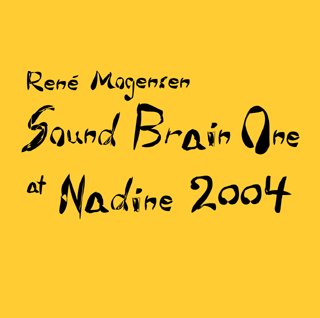
This cd contains the recording of Sound Brain One from the evenings performance of April 24, 2004. To create a better cd listening experience, some silences have been shortened, and it has been mixed from four-speaker surround to stereo. Otherwise uncut, this audio recording documents the live performance of Sound Brain One in Four Seasons, at NADINE .
Request a cd by email while supply lasts. ([email protected])

tracks and timings [minutes:seconds]
Track 1: Season 1 (part 1) [4:21]
Track 2: Season 1 (part 2) [6:30]
Track 3: Season 1 (part 3) [8:39]
Track 4: Season 2 (part 1) [8:20]
Track 5: Season 2 (part 2) [12:00]
Track 6: Season 3 (part 1) [6:07]
Track 7: Season 3 (part 2) [8:37]
Track 8: Season 4 [4:28]
The CD is signed and numbered, only 100 copies are made.
With Sound Brain One (title of the interactive music composition for Four Seasons,) I have created a formally dynamic electroacoustic composition which has identity as a musical work, and yet is shaped by a dancer, through a sensor mechanism that is substantially transparent for the performer. It is a performance environment built on mutual interdependence and interaction.
The sound environment has a specific formal identity which is linked to the 68 minute time-line (or "biological" clock) of the performance part of the work. The formal identity is designed as having four "seasons, " each lasting between 5-20 minutes. Also structural to the work’s identity are a number of processes that continue throughout the one hour+ performance duration. These processes, which actually generate the sound, are affected by input from the sensors, and are modified by design along the time-line, according to the compositional ideas of each season, and the shaping of the work as a whole. The processes generating the music are predictable, but the sensor input is not predictable over time. The information from the sensor input is given varying tasks in the music-generative processes, according to the compositional plan, so that details and even formal structure may vary with each performance, but the identity of the piece as music is always retained. The use of sensors is ideally transparent to the performer in this work, in order that the performer can interact directly with the sound of the music, without consciously trying to control the sensor-input.
At this point in the development, Sound Brain One is playing in a way consistent with what I want compositionally, and yet is completely tied to the sensor input, so that it unfolds dynamically in a way responsive to the performer’s movement. In this way we can achieve a real-time feed-back loop during the performance between the performer and the composed electroacoustic musicwork: an interaction of two identities.




