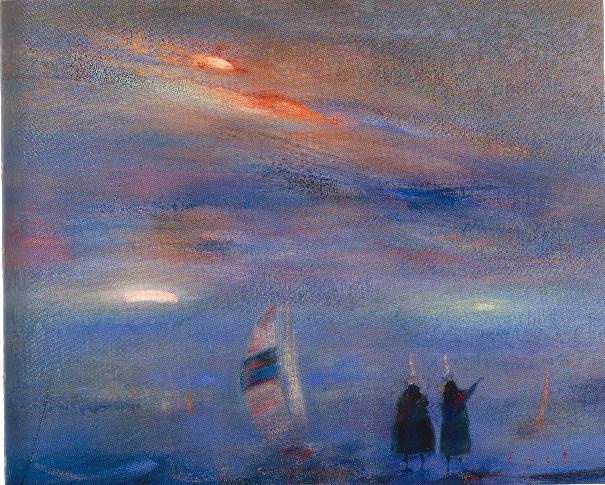
Le retour
Le retour
René Louis SMET was born in Belgium in 1929.
His artistic career began with his joining the St-Luc High School of
Art where he proved to be a talented draughtsman and experienced a vital
urge to paint. He became an enthusiastic reader in the library, and
was exposed to history of art as well as the works of the Old Masters through
reproductions. It became clear that painting was to be his life.
Having passed the entrance examination to the Fine Arts Academy in Brussels.
He became a boarder at the Leon Devos School for two years. 1949 &
1950, where he received a very thorough grounding in drawing and draughtsmanship.
He was able to pursue his interests as a young artist during his military
service in the Ardennes by teaching other recruits.
In 1954 SMET left Belgium, the melting pot of different civilisations
and land of intense pictorial experiences, for Brazil where he lived for
four years without returning to Europe, particularly in Sao Paulo, Rio
de Janeiro and Manaus. From there he made several extensive visits
to Amazonia.
Brazil and the rich and gorgeous colours of the Amazonian forest represent
an important land-mark in his experience as a painter. His palette,
the colours he used, became more luminous, and from then on SMET became
a lover of pure colours.
Without ever succumbing to the temptation of being anecdotal about
places and subjets, he painted unceasingly and produced many works, particularly
a whole series of "camavals".
He was deeply and sincerely absorbed by Brazilian life and culture.
To earn his living he illustrated short stories and novels at the same
time exhibiting his paintings.
1956 SAO PAULO (Modem Art Salon - Portrait Salon).
1957 SAO PAULO (Exhibition at the Institute of Architecture).
1958 Travelled to enrich his experience to BAHIA, PERNAMBOUC, AMAZONIA,
BELEM, RIO DE JANEIRO (Exhibition at the Maison de France).
But he felt the need to maintain contact with other artists and to
continue further studies and returned to Brussels in 1959. He was
admitted to the painting section of the Paul Delvaux studio at the famous
Institut Supérieur de la Cambre. At that time Brussels was
one of the artistic capitals of the COBRA movement and attracted confrontations
between various factions of the different schools of artists. The
two years spent at the Institute were rich in experience and happy.
In order to afford these studies he worked with several advertising
agencies and produced many posters and models. It was obvious that
an interesting career opportunity was opened to him and he received offers
of permanent work. But tempting though it was, it was impossible
for him to give up his solitary painting. The desire and need to
work alone at his easel was far more attractive to him than the bustle
of the team work at the agencies.
1959 He received a grant from the Belgian government and due to the
Franco-Belgian cultural agreements he was able to spend two years at the
Cité Universitaire in Paris, during which he grew very fond of the
city and decided to settle there permanently.