| New Kid in Town: from Spiro T. Agnew to Philosopher Kings |
| Part twelve of sixteen |
| Plato�s text emphasizes that he will see [the sun] in his own proper place, and not in another. Again, this refers to an aspect of ascent, the �Voyage to the Sun,� and the subsequent Atonement with the Father. This is the pinnacle of the Western spiritual tradition to date. Now we enter the next phase � reintegration of the Ascended Son, or Ascended Masculine, with earthly matter and the feminine. The Dialogues suggest that the Philosopher King is able to relate to that entity we so blithely refer to as �our Sun� with flexibility -- on scientific, esoteric, imaginative and emotional levels, without dissonance. Science, in its pride, thinks it has stripped old Sol of all his secrets, calibrating him down to the last molecule of hydrogen. Meanwhile, he guffaws at his clever precocities. He will then proceed to argue that this is he who gives the season and the years, and is the guardian of all that is in the visible world, and in a certain way the cause of all things which he and his fellows have been accustomed to behold? Translation: our Hero is off and running in the West, having encountered the Intermediate Father, the sun. As noted above, in the current trinitarian tradition, which far exceeds the historical record, humans have three fathers and three mothers. On the maternal side is the nymph/matron/crone Triple Goddess. On the paternal side, we have genetic or blood fathers, an intermediate Father, and the transpersonal Father, hidden within and without. Catholicism interprets this as its own male trinity, but it is actually a unified quaternity. Science is becoming conscious of this hidden, fourth aspect of the trinity, which it terms �black holes,� �dark matter� and �dark energy.� This presages integration of humanity�s personal and cosmic shadow. |
 |
| Sol Invictus The sun makes internal adjustments � at great sacrifice -- to maintain equilibrium between external gravity and internal fission. By this stupendous sacrifice he regulates the solar system, down to the peristalsis of an earthworm. That beings of such limited consciousness as ourselves could imagine the sun as inanimate and insensate is a cosmic knee-slapper. To be sure, at one point in our development it was necessary to break with worship of the sun. Worship isn�t healthy for humans. But an inanimate ball of hydrogen? Hoo-boy. We�ll never live it down. And when he remembered his old habitation, and the wisdom of the den and his fellow-prisoners, do you not suppose that he would felicitate himself on the change, and pity them? Certainly, he would. And if they were in the habit of conferring honours among themselves on those who were quickest to observe the passing shadows and to remark which of them went before, and which followed after, and which were together; and who were therefore best able to draw conclusions as to the future, do you think that he would care for such honours and glories, or envy the possessors of them? Would he not say with Homer, "Better to be the poor servant of a poor master, and to endure anything, rather than think as they do and live after their manner�? Yes, he said, I think that he would rather suffer anything than entertain these false notions and live in this miserable manner. Imagine once more, I said, such a one coming suddenly out of the sun to be replaced in his old situation; would he not be certain to have his eyes full of darkness? |
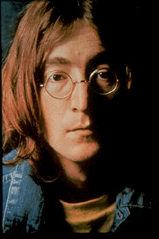
| Such a one coming suddenly out of the sun fuses philosophy and prophecy, referring not merely to the historical Jesus but to all knights of the Queen of Heaven, all servants of the Father, the Host of solar heroes from Osiris to Moses, from Gilgamesh to Finn McCool, from Heracles to Baptist John Lennon. Again, the Philosopher King shuns rule, taking up power like a handful of steaming shit. No silver spoons here -- this king came up from the bottom. He is shamed before Papa Ra's brilliant sacrifice, and must re-evaluate the practical limits of his free will. He makes of himself a conscious sacrifice, in image of the sun. Like Tolkien's magnificent Aragorn, the true King's life is one of service, humility, duty, and anonymity -- often until the Big Showdown. Like "Strider" at Bree, he expects to be mocked, belittled. Such a life tests right relationship to power, which is always the crucial issue in Kingship. For this reason, it's always those who start nearest the bottom who are eventually favored with royalty most high. |