What about prose and poetry/prosody before the class?
24Jul00
R.F.Williams
When I first got the detail study materials for this class, I was somewhat alarmed. There are many references to study in diverse genres besides prose. I thought I could understand how some work in poetry could possibly be helpful to me, but drama and/or song are not within my ability or area of interest. Even extensive work in a rhyming type of poetry did not at all seem like it would help me move toward my goal.
So, after exchanging some emails with the tutor and some friends, I reluctantly decided to go ahead and attend the course. The tutor discusses how practical work in other genres (and structured work in poetry in particular) can help in the discovery of one's (so-called) natural voice. I ended this interaction with him thinking that he basically gave me a sales job for the class.
I decided to begin the preparation for the class by reviewing some of the books that I liked, hoping to find some poetic passages. The grammar book, Sin and Syntax by Constance Hale finally (for me!) explained how sentence fragments and other non-standard forms can be used to effect in the books that I have liked. With this fresh in my mind, I was very surprised to find that some obviously poetic passages could be found just by thumbing through several pages, although admittedly to different degrees. Not all of these can be converted to verse easily. However, if they are read rhythmically, their form and stylized prose resonate off of the tongue or the brain very nicely.
Again from the Hale book, there is a section on verse and rhythm. She discusses Joyce's use of alternate punctuation forms in Ulysses to produce an alternate rhythm. Looking at the last chapter of Ulysses out on the web, it is easy to see that it is many pages of unbroken, uncapitalized, unpunctuated text, with (what techies call) delimiters that were specified in Ms. Hale's book. While reading a T.S.Eliot poem for the class, he also use one of these words (O! in this case) as a delimiter in his poetry.
In my Narrative Form class last year, we did some analysis of The Sound and The Fury, by William Faulkner. There is a difficult passage at the end of Quentin's section just before he commits suicide. It took me a while, but I was finally able to figure out that this passage is delimited by "and I", and "and he". It has no paragraph breaks, capitalization or punctuation, as it is an internal narrative in Quentin's head between him and his father. It finally dawned on me, that the structure of this passage is completely modeled after Joyce (who Faulkner was supposed to have admired very much).
As an aside, I want to know what is so special about 1929 in the literary world. Published in this same year are: The Sound and The Fury, Ulysses, Eliot's The Waste Land, and Mrs. Dalloway by Virginia Woolf!
The book, An Introduction to: The Art and Craft of Poetry, by Lawrence J. Zillman, explains all of the poetic forms (like iambic tetrameter) very well, and was the first book in which I was able to find some poems that I could at least understand. I am not convinced that any of them moved me emotionally, but the rhyming structure, feet, verse forms were very helpful. This was specifically listed as preparatory work for the class.
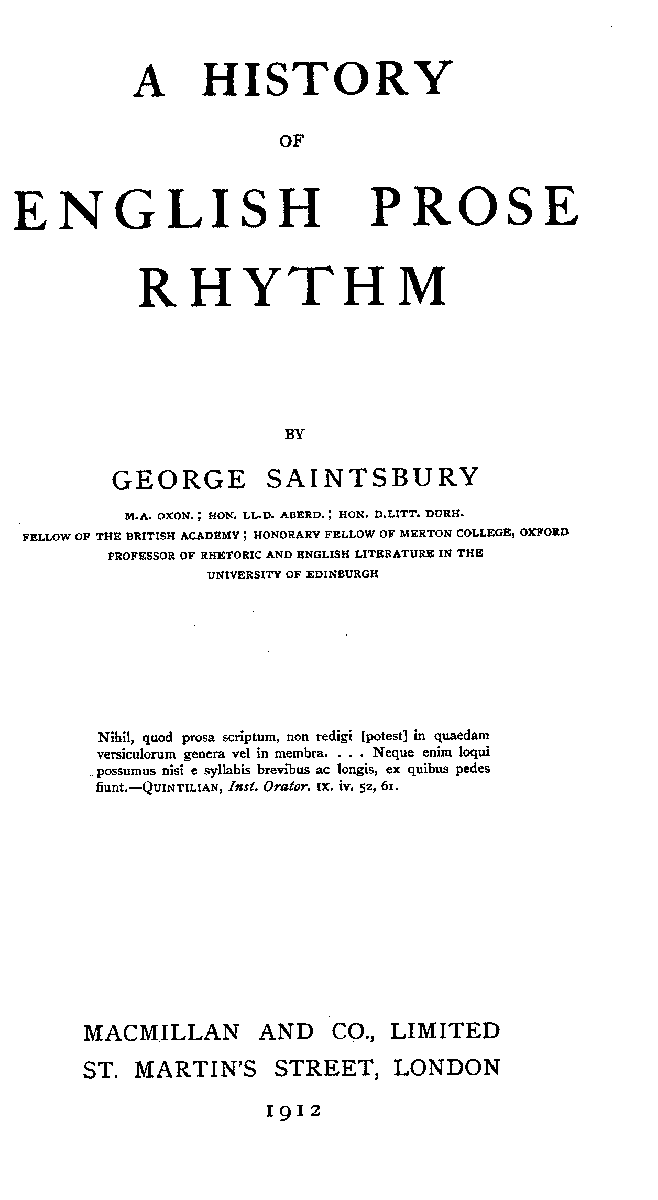
One of the references in the Hale book (yet again) is to The History of English Prose Rhythm, by George Saintsbury, published in 1912. Luckily, this book was available for checkout from the Berkeley library, and the author was connected to Merton College where I am studying. This book, of which I only read a small fraction, was extending a tradition that goes back to the Greeks, where you measure the feet and syllables of prose, and do analysis based on this. In this book, there is a section about Carlyle, and a short piece of his prose is presented, which I find very rhythmic and from which I venture to say that the emotional context has been made clear to me now.
Finally, I list here the poems from which I will chose my favorites in the class:
Blake - The Little Black Boy
Carl Sandburg - Chicago
Dylan Thomas - Do Not Go Gentle into That Good Night