|
|
 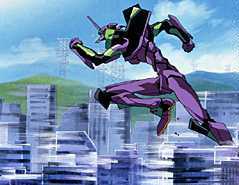 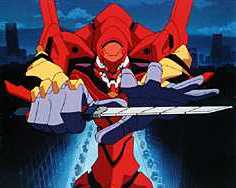  Four Barons of Hell:- The first Baron has one large eye--Eva Unit 00 The second Baron has a single horn upon its head--Eva Unit 01 The third Baron is blood red with four eyes and two jaws--Eva Unit 02 The fourth Baron is pitch black with exceedingly long arms --Eva Unit 03 The religious symbolism in Neon Genesis Evangelion does not stop at organisms. NERV itself is full, in every sense of the word, of symbolism. The phrase, "God's in His Heaven; All's Right With the World" can be seen clearly underneath the NERV logo. Then there is the MAGI computer system which has been named after the three wise men, Melchior, Balthazar, and Casper. Gendou's office is full of mystery as it has the Systema Sephiroticum, drawn by the German priest Athanasius Kircher in 1953, on the ceiling. It was here that we were first introduced to Adam, the first human, which is said to be the corner-stone of the Human Instrumentality Project. Deep inside the Central Dogma is the LCL plant which contains the second Angel Lillith, who in Judeo-Christian mythology was the first wife of Adam. Lillith is attached to a crucifix-like support by the Lance of Longinus, which is probably symbolizing Jesus and the Spear of Destiny. Lillith has seven eyes on its face which represent the seven eyes of God. The third impact is said to occur when an Angel is able to come together with Lillith. The two other "impacts" were the flood and the melting of Antarctica respectively. The second impact occured when NERV was trying to shrink the first Angel, Adam, down into embryo form. |