| The early Reis family
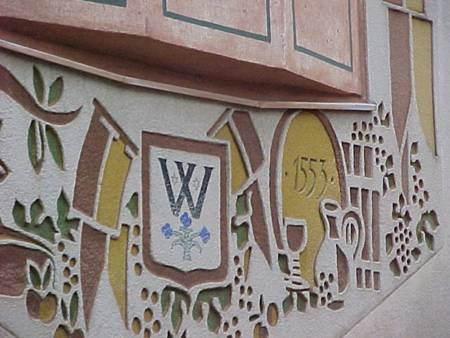
The earliest documented reference to our Reis ancestors so far dates back to 1682 in Wollmesheim in Germany. According to �Wollmesheim Chronik� a history of the town published to celebrate its 1000th anniversary, the village of Wollmesheim was established in 1007. It lies a few kilometres from Landau, a much larger town which was founded as a monastery in about 1200AD. The township of Wollmesheim is one of several small villages that surround Landau and has a current population of around 395 people. Wollmesheim remains quite similar to how it looked 400 years ago and to date is considered as the ancestral home of the Reis family, beginning with Mathis Reis recorded as a citizen in 1682. During the 1600 and 1700s, the economy in this region was largely agrarian, with modest trade of surplus goods in return for other daily essentials of life. This was a time when two thirds of household income in rural Germany was spent on food, with little margin for any luxuries other than to survive and eat well. Nutrition was a critical determinant of life expectancy, so the Reis family must have lived quite well � for example Balthasar Reis (1786-1855) lived for 69 years and his brother Johannes David Reis (1782-1843) lived for 61 years at a time when their fellow countrymen had an average life expectancy of 37 years. His son Georg Reis (1813-1883) who subsequently immigrated to Australia lived just beyond his 70th birthday. During the 19th century, serfdom and feudal obligations (Leibeigenschaft) were lifted across the various German states, beginning with the Grand Duchy of Baden. Villagers similar to our ancestors who were wood cutters, vine dressers and farm labourers, were now free to sell their services and compete for work in an open market. The Reis family were already land owners by the 1790s and their occupations suggest that they were not tied to any particular Nobel. We can only speculate that they may have been home owners for sometime, but we do not yet know for how long. This was a period of rapid change, and it was not uncommon for land to be granted for service and loyalty by a benevolent land owner or government official. Alternatively, certain rights may have been conferred by simply occupying the land for a period of time, or they may have simply bought it. In any case, the modest 25 acres and small house that belonged to Johannes Reis would have been self-sustaining for a family, notwithstanding the vagaries of farming in the 1700s. For the most part of the early 1700s, these were simple and largely safe years, and for as long as sustenance could be provided, the good people of Wollmesheim enjoyed a standard of living that was high by European standards at that time. Political reform was relatively mild; incomes were higher than their Prussian cousins; and �amenity� in this part of Germany as measured by the number of physicians per capita was acceptable for the period. Like most other villages, information was mostly contained to local news passed on by travellers or delivered from the pulpit of the local Catholic Church. Hence, our Reis forebears carried out their professions of cutting and removing timber, or growing vineyards, with only hearsay knowledge or concern for events that might be unfolding beyond the village boundary. Leaving Wollmesheim However, the good fortunes of the family came to an abrupt and unexpected end on 13 May 1793. This was the day Johann Georg Reis and his wife Katharina Deibel, discretely packed their belongings into carry sacks; equipped each of their children Bernhard, Georg, David, Katherina, Maria-Eve and Konrad with walking boots; loaded what little furniture and tools of trade they had then quietly and quickly climbed the small hill at the east of the town and made a hasty exit, leaving behind their son Balthasar. As JG Reis moved quickly through the fields, shepherding precious livestock along a small track the width of a cart, their cottage, their farmland, their village became an increasing distant sight. They were leaving their heritage, their forebears, and their past at a time when re-location beyond the town�s perimeter was simply unheard of. The reason for their hasty departure was that J. Georg had fought against the French Revolutionary Army. Despite courage and determination, J. Georg and the other villagers were unable to repel the French Army from advancing across the border and laying siege to the nearby towns and hamlets. J. Georg realised his own town would be next so he retreated to collect his family and prepared them for their escape. His son Balthasar Reis on the other hand stayed behind and was either captured then conscripted into the army, or possibly volunteered to save his own life. The Reis family were, in today�s language, refugees forming the vanguard of a wave of dispossessed people and broken families estimated to eventually number in excess of 130,000 people that fled the invading French army. They were fleeing an army they distrusted and a foreign revolutionary regime that dressed up its social ideals with liberal promises, but underscored it with a brutal and feared military regime. Stories of the French occupation had passed quickly from town to town, with harrowing accounts of pillaging and destruction. With the safety, survival and welfare of their seven children in mind, the Reis family was on a desperate and rapid quest for a new, safer future somewhere else. Their destination was Mannheim, about 4 or 5 days walk. Today the trip takes an hour by train. Meanwhile Balthasar Reis served under Napoleon�s flag through to 1806, however it would seem this was not sufficient to save his father�s property from confiscation which was still to come. K�fertal, Mannheim Mannheim at the time was the jewel in the crown of provincial Germany, with its beautiful palace and rich farming country along the Rhine River. The Reis family, along with other refugees were welcomed and quickly settled into a new life. Back in Wollmesheim, the family�s farmhouse, land, winter provisions and private possessions left behind were seized by the French. Johannes Reis and his family were ordered by the French Military to return to Wollmesheim or their possessions would be permanently confiscated and disposed of by public auction, and the proceeds remitted to the French Government. The family refused, and their property and life�s possessions except those few things they managed to carry with them, were sold at auction to Mr J A Wagelein, a citizen of Landau. Wagelein went on to purchase all the property from the French that belonged to absent villagers, including the local Catholic Church when presumably even the priest decided it was safer not to return. After finding suitable farming land in K�fertal, on the outskirts of Mannheim, the family once again resumed farming. Unfortunately the safety and relative comfort of Mannheim was short-lived. The French Army likewise followed the same route as the Reis family as it fanned out across the various independent states that made up Germany at the time. With promises of social reform for all, their entry into Mannheim was never challenged and soon the French had control of what was then considered one of Europe�s most beautiful cities. Not long after the arrival of the French, Johannes Georg and his eldest son David lost their civil rights. They were to be known until they died as �Exiled Citizens� or �Citizens without Rights�. This label was to shame them for J Georg's role in fighting the French. Meanwhile, Balthasar Reis having reached the age of 20 years and had served in the French Army, was spared similar humiliation. The story might have ended there, but the Reis family had a very German robustness and with no shortage of experience and resourcefulness, turned their minds to think about what next. It was a turning point that was to irrevocably fragment the family and set each down quite different paths over successive generations - through Germany, Russia, Australia and the USA. Today, only a small handful of branches belonging to these forebears are known to still flourish in Mannheim Germany, the eastern states of Australia, and in North America. |
 |
 |
| Return to Main Page |
| History by C C Reis with thanks to Heinz Reis of Mannheim, Germany for his valuable research contribution on JG Reis & Wollmesheim |