 |
| Houseless Journal, Issue #3, February 1994 ON "CREDENTIALS" "Cindy Newman gathered information for this column as part of her research for a master's thesis in geography at the University of Oregon." "Vickie VanArtsdalen is a Eugene School District high school instructional assistant. She lived in the homeless camp near Armitage Park for two months last year." "Bridget Reilly is a homeless person who recently moved to Portland from Boston where she worked with the Homeless Civil Rights Project and edited its bi-monthly newsletter, Homeless Times. She moved in the hopes of finding better economic opportunities, but remains homeless." What do the three individuals named in these three quotes have in common? |
| I'll tell you in a minute in case you can't guess. But first I'll tell you where the quotes came from. The first two were bios that appeared with guest editorials in the Register-Guard, respectively: "Car camp offered temporary sense of home, family," June 1993, and "We shouldn't stereotype homeless people", December 1993. (Sorry I don't have the exact dates.) The third bio appeared with a guest editorial in the Portland Alliance: "On Homeless Empowerment", February 1992. The first two indicated that the authors are members of the academic world, which is what supposedly qualifies them to make intelligent observations about homelessness and therefore merits them a place on the editorial page of a mainstream newspaper. The third describes me as a "homeless person" and in fact uses the word "homeless" four times. Such credentials earned me half a page in a left-wing alternative newspaper, but still don't seem to merit a guest editorial in the Register-Guard. Would it be different if I also mentioned that I have a Bachelor of Fine Arts degree in filmmaking from San Francisco Art Institute, and also that my father is an eminent sociologist who has had numerous books published (his latest a very big seller?) These things are no less true than the fact that I am now homeless, but up until recently I haven't seen any reason to include them in my list of "credentials" as a homeless writer. By now you have probably guessed the riddle: we are all three, in some sense, members of the World of Academia and therefore we all view the homeless issue through the intellectual glasses that academics possess. The main difference is that Cindy and Vickie have used their academic credentials as a way of getting their writing into print, whereas I have so far only presented myself as a homeless person who, for some inexplicable reason, happens to know how to write (contrary to the popular stereotype of the homeless as uneducated illiterates.) There are other differences too, of course. Cindy and Vickie only spent a very brief time living in the homeless world: Cindy as a voluntary guest in the car camp and Vickie as very temporarily homeless while still working. I, on the other hand, have been genuinely homeless for two and a half years and have very little hope of ever ending this condition. But all three of us have done/ are doing our best to use our homeless experience as an education, and in turn to teach what we have learned/ are learning to an ignorant public. Cindy's thesis project on the car camp is important in that it is one of the first of its kind: a serious scholarly study of homelessness by a student of the social sciences which attempts to present the views of the homeless people themselves as being valid. But unfortunately, there have also been numerous other scholarly studies by other people with impressive academic credentials that serve quite a different purpose: to re-inforce the negative stereotypes of the homeless that are already held by conservative Americans, and to justify our continued mistreatment. Take, for example, the article that appeared in the Register-Guard on November 7, 1993 entitled "America losing compassion for street people." It announces a new book called A Nation in Denial: The Truth About Homelessness by Alice Baum and Donald Burnes. It's one of those books that comes out every few years, that tries to undo all the progress homeless advocates have been making, by stating that homeless people are, after all, just a bunch of single male alcoholics, drug addicts, loonies and idiots who should all be locked up in instututions so people won't have to look at them any more. Nowhere are the actual credentials of Baum and Burnes mentioned, or on what kind of "research" they based their conclusions. But the mere fact that they have published a book is supposed to give them all the credibility they need in the eyes of the public. A couple more "credible" people are also quoted in this article, along with their academic credentials: "Beggars seem more numerous, more menacing and more irrational than they did a few years ago, George Kelling, the criminologist, said last week..." (So now begging is a criminal activity?!) And "Howard Bahr, a historian of homelessness in America, writes that the new homeless are mostly "multiproblemed men, very much like the Skid Row winos of the past." Again, no mention of where they got these "facts": as far as anyone can see from this article they are doing nothing more than stating opinions, yet, their "credentials" are supposed to be sufficient to convince the ignorant reading public that their statements are true. Then there was another choice article that appeared in Reader's Digest in June 1991, entitled "Myths About the Homeless" by Robert James Bidinotto. It starts out by describing a research project by Dan McMurry, a sociology professor at Middle Tennessee State University, in which he went incognito, posing as a homeless person and visiting homeless shelters and soup kitchens all over the country. "McMurry found aging alcoholics of the sort he had long seen on skid rows. He found mentally disturbed people, runaway kids, cocaine addicts and street criminals. But he found virtually no intact families." Of course, this is because he only went to the Mission-type places where such "skid row" types go, and which the "intact families" and people like ourselves avoid like the plague. He did nothing to seek out the invisible homeless who live in their cars, camp in the countryside and such; in other words, he actually only saw a fraction of the homeless population and concluded it was all there was. The article goes on to quote all kinds of people in the academic world, politicians, shelter directors, and unidentified "studies", all of whose statements back up the conclusions made by McMurry: "Peter H. Rossi, director of the Social and Demographic Research Institute at the University of Massachusetts", "Anne Kondratus, an assistant secretary of the U.S. Department of Housing and Urban Development", "the Rev. Mark Holsinger, executive director of the Los Angeles Mission", "a nationwide study by the Urban Institute in Washington, D.C.","Fred Hoffman, who runs the Nashville Union Mission's education and job-training program", "A detailed, clinical survey of Baltimore's homeless by researchers from the John Hopkins University School of Medicine," etc. etc. etc. ad nauseum. You get the idea. It goes on and on and quoting people whose impressive-sounding credentials seem to "prove" the truth of their statements to the gullible reading public, and their intent is obvious. Besides re-inforcing the tired old stereotypes and thereby assuaging the guilt of Americans about homelessness, such articles also re-inforce the silly notion that only people with college degrees who have never been homeless are qualified to make intelligent observations about homelessness. It never seems to occur to anyone that there might be homeless people who actually possess college degrees themselves, and some of whose fathers might even be sociologists... America needs more homeless writers like myself, doing what I am doing. But also, because of the importance that Americans still attach to Academic credentials and scholarly studies as the most legitimate vehicles for teaching people the truth, we desperately need many, many more Cindy Newmans and studies like hers, to balance the scales against sociologists like Dan McMurry, whose "research projects" only do the homeless more harm. (click here to view next page) ( |
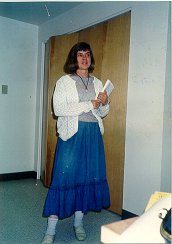
| Bridget Reilly, sometime in the spring of 1993 while living in the quad. |