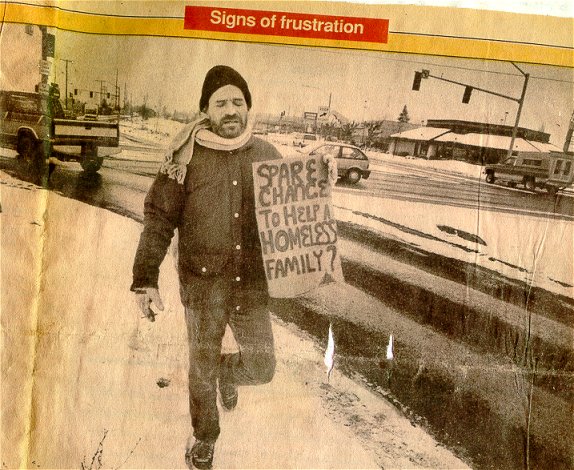
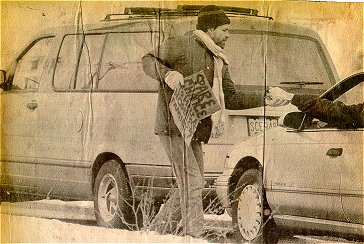
| So for the next few weeks Rick and I lived in the relative comfort of a motel room in Springfield, the city just east of Eugene. This room was being paid for by the state, while Catholic Community Services was helping us look for housing. During this time another issue came to light that was soon to draw the attention of the Springfield media. Rick's unemployment had run out during the summer when we moved to Armitage, and since we hadn't found any ongoing work, we were reduced to begging as our only source of income. We found that the intersection of Q Street and Pioneer Parkway, the busiest corner in Springfield, was a good place to stand holding a sign. The sign, which I had created, read "SPARE CHANGE TO HELP A HOMELESS FAMILY?" This was of course somewhat misleading, seeing as how this "family" consisted only of two cohabitating adults, but the idea was to elicit sympathy. We were to be accused many times of "scamming" the public, and this was only one of the many degrading compromises we had to make during our homeless years. But once the news crews started interviewing and photographing us while we were engaged in this occupation, we saw this as a new opportunity to try and educate the public about the employment discrimination issue. We were to point out repeatedly over the next year or so that homeless people wouldn't have to beg if employers wouldn't refuse to hire them simply because they are homeless. The first of these stories appeared on the front page of the Springfield News on January 13, 1993. It was fairly sympathetic in tone, but the reporter clearly didn't have firsthand knowledge of homelessness and what it's like to have to make a living this way. So I saw this as another occasion to compose a letter to the editor. The following is the original letter, of which they printed an abbreviated version in the Springfield News: PANHANDLING A LAST RESORT Dear Editor, I have mixed feelings about the appearance of my partner on the front page of today's Springfield News, engaged in his daily occupation of panhandling--or "stemming" as we call it in Boston. I am very often out there with him (the sign he is holding was my creation), but I was elsewhere that particular day. It remains to be seen what types of reactions we will get from the public as a result of this story being printed. But I can tell you that right after the reporters left he was chased off that corner by the Springfield Police, who told him that they could arrest him for "soliciting without a license" and also warned him not to talk to reporters. This was because they recognized him as one of the activists involved in the Armitage camping battle; they also took this opportunity to interrogate him about what was going on in the camp. He has long been accustomed to police harassment for his political activities, and the continued public exposure of his/our homelessness only means that he will continue to be a target of such harassment unless there is enough positive response from the public to deflect it. There were some effective quotes in the story, but I don't know if the point was driven home strongly enough that people like ourselves are reduced to begging only because we have tried all the other options time and time again, and they have not worked. One of the first things Rick did upon moving to Eugene was to register with Tempsource, and they have simply refused to give him any work ever, because they know he is homeless. It is the fault of such discriminatory policies on the part of employers that we have to make this humiliating public display of our poverty. The people who yell "Get a job!" at us are apparently ignorant of this fact, though Rick has stated it to the press again and again. He has spent a fortune in quarters calling Tempsource and other agencies, only to be told that they have no work for him, and that furthermore they seem to keep "losing" his application. As for Terry McDonald's comment that "begging is quick, easy and effective", it's obvious that he has never tried standing in the snow for hours on end, freezing his toes off. His assumption that people with "Will Work" signs don't actually want to work is not true of us; we have accepted several job offers from passersby: helping someone move, landscaping, raking leaves. People like him need to understand that we are between a rock and a hard place and have no alternative but to do what we are doing, until society comes through with something better. We DO NOT enjoy advertising our desperate circumstances in this way, but when all other means of making a living have been denied us, there is nothing left for us to do but to appeal to the sympathies of the public. (click here to view the next page) |
 |
 |