| The following represents an early attempt at starting a newsletter at Armitage, after I discussed it with another camper who had a word-processor. This project wasn't shared with more than a few people in the camp, however. The thoughts I express in this piece also show I was having second thoughts about the utopian community the campers were trying to create at Armitage Park. |
| ARMITAGE JOURNAL |
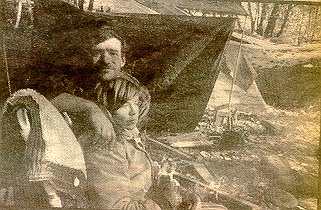
| I am one of the Armitage campers who has just been "bought off" by the state. I accepted their offer of a motel voucher as a supposed step toward permanent housing in the hope of getting away from that cold, muddy campground forever. My partner Rick, on the other hand, participated in the attempted takeover of Armitage Park on Friday night and spent 24 hours in jail. My/our future is still very uncertain. The only thing I know for sure right now is that I am in a warm motel room instead of my rain-soaked campsite, walking on a dry carpeted floor instead of muddy ground; and I have a place to plug in my new electric typewriter, acquired with a voucher from St. Vincent de Paul's for the purpose of starting a newsletter for the homeless of Eugene. As my offering for the first issue of this newsletter I will share with you some of the thoughts I wrote down a few days ago, before the famous walk to Armitage took place (in which I did not participate except to hold a candlelight vigil of my own in the camp as I watched the others parade across the bridge). When I had a house in Boston there was a book I used to read every year at Thanksgiving time called Stories of the Pilgrims. It was written for children and full of quaint illustrations and poignant nostalgia. I fantasized about living in a primitive pioneer community like the pilgrims did while I sat in my warm kitchen. I would pretend I was one of them while I chopped wood outside to feed into our wood stove. I also indulged in a baking orgy for the occasion, making spicy breads and pies in our electric oven. Now it is a few years later; I no longer have the house or the book or the electric oven or the baking equipment to observe the holiday in the comfortable fashion I used to. Now I am acting out the fantasy of living like the pilgrims for real--before they even got their cabins built--making fires over a fire pit on the ground rather than a wood stove inside a cozy house, and dealing with all the discomforts and inconveniences of cold, wet weather. The pioneer settlement I am living in on the banks of the McKenzie River is one which was established haphazardly through a set of circumstances which none of us chose, and our existence there is quite miserable and bleak. Yet a part of me feels that in some perverse way it has been arranged for me to have a wish fulfilled: to go back to a more primitive form of existence and learn how to build things from raw materials, to carve out a life in the wilderness as the pilgrims did. This is something I had always felt a need to do, though the way I have now been given to do it is rough indeed. But many of the tools for doing this, as well as the needed community spirit among the campers, are still lacking. The people who are planning to donate food for our Thanksgiving feast seem unaware of our need to make our own food for it as some of us used to do in our former lives. We are expected to be grateful for charity instead of being frustrated at not having the means to do things for ourselves as we did before. And now, on this eve of our planned takeover of Armitage Park across the river, I am full of misgivings, as probably many of us are. How will the new campground, if we do get it, be an improvement over the one we have now, which is so crowded that even the basic first-come-first-serve rule of squatting has been rudely thrown aside? This camp has turned into a hall of mirrors. All kinds of things that need to go on in private are instead heavily scrutinized. So many nerves are laid raw. Personality and lifestyle differences are aggravated in these claustrophobic conditions where we don't have the normal ways of getting our needs met that people with houses take for granted: the needs for privacy, distance, quiet. Only because we are too poor to afford houses we are expected to be endlessly flexible and adapt to these conditions, to live in each other's laps as a "tribe" as if the mere common denominator of being homeless made us compatible roommates. This is the situation that has developed on the north banks of the river--the part of our lives that is not publicized in the mainstream press--while we make our plans to "take" the park on the other side which will supposedly be better. Please pardon me if I'm having a hard time believing it. If all we can get is another campground, we can only expect a continued mediocre, second-class existence in a ghettoized community as we have here. We will continue to live in an uncertain limbo unless we have the freedom and the tools we need to evolve, to build our own structures for increased privacy and efficiency in getting our needs met. If we have to continue following rules imposed from the outside that restrict this freedom, we will never have the chance to evolve fully into the human beings we were meant to be, to pick up where we left off when we lost our homes, to continue the business of living we were engaged in before we were so rudely deprived of our full citizenship rights. There needs to be hope, and I fear there will only be more stagnation and uncertainty. We need to go back to being private citizens and I fear we will continue to be a public spectacle. We need to go back to self-sufficiency and I fear we will continue to be passive recipients of charity. We still won't have the same ownership and privacy rights that other citizens have. And we will be expected to make this sacrifice graciously, endlessly, in exchange for the privilege of being a unique part of history. Pardon me if I'm having a hard time getting excited over this prospect. The pilgrims were subject to no governmental restrictions on the land they could use or the ways they could use it. They had ample room to spread out and the freedom to create whatever kind of homes and community they needed in order to live the lives they intended to live. In that context all the endless wood-chopping, water-hauling and myriad of other daily chores made sense. They had a future to look forward to. WE need to have one as well, or else the acquisition of a legally-sanctioned campground will mean nothing. November 23, 1992 (click here for next page) |
 |