FX Correlations (January): How Do Currencies Move In Relation To Each Other?
By Kathy Lien, Chief Strategist
Published Date:
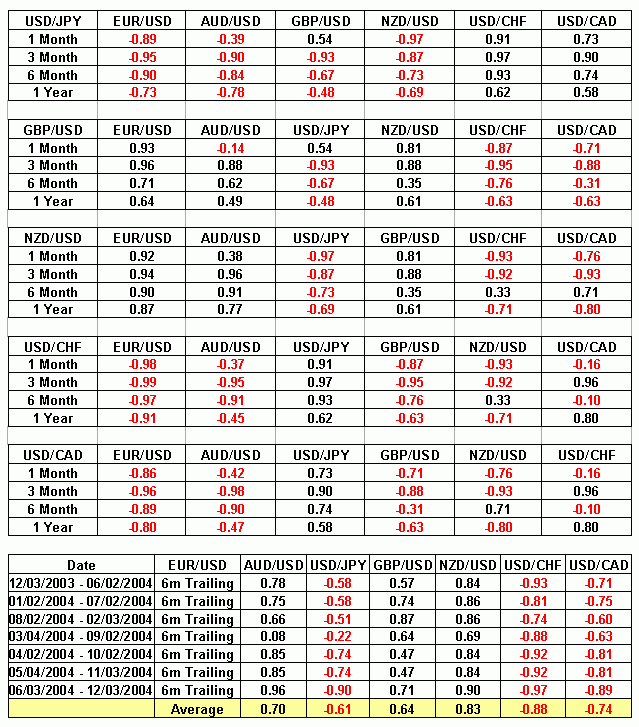
The following is our monthly correlations update for January. As we have previously mentioned, correlations between different currency pairs shift over time, therefore it is of utmost importance to regularly follow changes in correlation. We have also included the 3 month and 1 year correlations to give traders a better sense of historical trends and added 6 month trailing correlations as further confirmation of the correlation results.
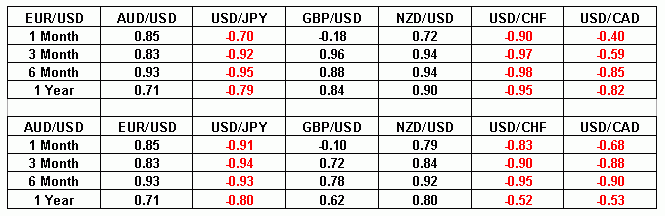
In order to be an effective trader, it is also important to understand how different currency pairs move in relation to each other. There are a few reasons why this is significant, but most importantly, it allows traders to understand their exposure. That is, having a portfolio that consists of the EURUSD and NZDUSD is different from having a portfolio that consists of the EURUSD and USDCHF. As indicated in the tables below, over the past six months, the EURUSD has had a strong positive correlation (+0.94) with the NZDUSD and a strongly negative correlation with USDCHF (-0.85). Therefore having a long EURUSD and long USDCHF exposure would generally lead to negated or nearly zero profit or losses because when the EURUSD rallies, USDCHF will sell off the majority of the time. Of course, these two currencies have different pip values, so the P/L may not be exactly zero. On the other hand, holding long EURUSD and long NZDUSD exposure is similar to doubling up on the position since the correlation is so strong. Furthermore, we can tell from our tables that correlations shift with time. Although the EURUSD and GBPUSD have had a strongly positive correlation over a longer-term basis (ie. 6 months and 1 year), the correlation has not been as prevalent over the past month (-0.18). Having this knowledge will allow traders to effectively diversify and manage their portfolios.
Shifts such as these can be partially explained by changes in the severity of monetary policy or changes in unique domestic conditions. For the UK, their sharp shifts in monetary policy bias towards the possibility of lowering rates has prompted carry traders to rush out of long GBPUSD trades, exacerbating the movements in the currency pair and causing a breakdown in its correlation with the EURUSD.
Regardless of your trading strategy and whether you are looking to diversify
your positions or find alternate pairs to leverage your view, it is very
important to keep in mind the correlation between various currency pairs and
their shifting trends.
FX Correlations (data as of