
|
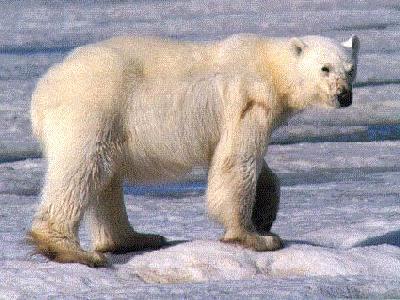
Polar Bear Description Habitat Food Predators Reproduction Facts Polar bears are the largest members of the bear family. They can grow to be ten feet long and can weigh up to 1,700 pounds. They have a small head with a black nose, a long neck and very powerful paws. Their front paws are webbed to help them swim. They steer with their hind feet. Although polar bears have white fur to help camouflage them in the Arctic snow and ice, they have black skin underneath. They also have a very thick layer of fat under the skin to help keep them warm. This is called blubber.
The polar bear’s fur is made of two types of hair. There is a thick wooly fur close to the skin that keeps it warm; it is called ground hair. There are also hairs that stick up and are hollow in the middle. These are called guard hairs. Air gets trapped inside the guard hairs, which helps to keep the bear warm. The guard hairs also don’t let water get into the ground hair next to the bear’s skin, so the bear never gets wet. The guard hairs help the bear float too. A polar bear has longer legs than most other bears and large feet. Its wide feet help it spread its weight around on the ice and not sink into the snow. It has fur on the bottoms of its feet to help it keep warm and move over the snow and ice. Polar bears have an excellent sense of smell. They can smell food from many miles away, even through the snow and ice. Polar bears are also excellent swimmers and good climbers. Even though they are so big, they can run very fast too—up to 35 miles per hour. They use their sharp teeth for biting and killing their prey.
Polar bears are predators and they eat mostly fish, seals, and walruses. They usually catch their prey in the water, but sometimes they eat grasses and dead whales that wash ashore. They also eat sea birds, lemmings, fish, and berries. If a polar bear is very hungry, it will even attack a human being.
Adult polar bears do not have too many enemies. However, life is a little more dangerous for baby polar bears. Sometimes, wolves may attack the cubs, or they may be eaten by adult male polar bears, especially if they are very hungry. Humans are about the only other predator of the polar bear. People used to kill polar bears for their meat and fur. However, there are now laws to protect the polar bears from hunters.
|
Page created by Elaine
Rehm
Arcadia University 7/25/01
E-mail
us
| Home | Animals | Activities | Gallery | Resources | Credits |
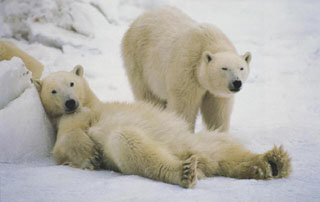
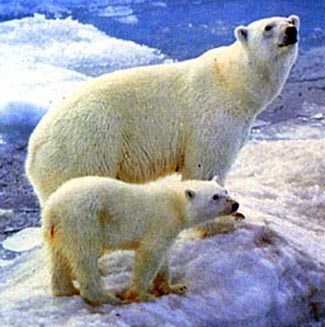 Polar bears live in the Arctic
region near the northern coasts of Canada, Greenland, and Russia, as well
as islands in the Arctic Ocean. While they spend much of their time in the
frigid waters, they also ride on floating chunks of ice called
Polar bears live in the Arctic
region near the northern coasts of Canada, Greenland, and Russia, as well
as islands in the Arctic Ocean. While they spend much of their time in the
frigid waters, they also ride on floating chunks of ice called 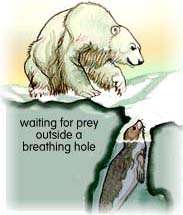 Polar bears spend a lot of time hunting for seals. A polar bear
will sit next to a
Polar bears spend a lot of time hunting for seals. A polar bear
will sit next to a 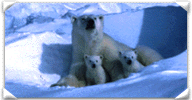 Female
polar bears dig dens out of the snow and ice. They go inside their dens in
November and stay until spring when they come out with their babies,
called cubs. Male polar bears spend very little time in the den. They are
out hunting all year long. Polar bears may have up to four cubs, but one
or two is most common. The cubs are born with their eyes closed and weigh
about a pound. They have no teeth, no blubber, and their hair is very
thin. The mother bear
Female
polar bears dig dens out of the snow and ice. They go inside their dens in
November and stay until spring when they come out with their babies,
called cubs. Male polar bears spend very little time in the den. They are
out hunting all year long. Polar bears may have up to four cubs, but one
or two is most common. The cubs are born with their eyes closed and weigh
about a pound. They have no teeth, no blubber, and their hair is very
thin. The mother bear