|
Emperor
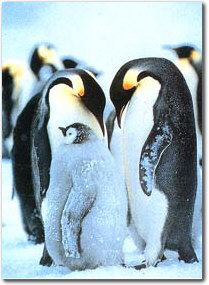
Penguin Description Habitat Food Predators Reproduction Facts The emperor penguin is a bird, but it cannot fly. Penguins have not been able to fly for millions of years. Although there are seventeen different kinds of penguins, they all have black backs and white bellies. The patterns of color around their head and neck are what make them look different. The largest penguin is the emperor penguin. It can grow to be over 4 feet tall and weigh up to 100 pounds. The smallest penguin is the little blue penguin. It is only one foot tall. Over millions of years, penguins’ wings have turned into flippers because they have spent so much time in the water. Penguins do not need their wings to fly, but they do need them to swim. Penguins have strong muscles in their flippers and can swim very fast. They use their tails and feet to steer themselves underwater. They also jump out of the water to get a breath of air every minute or so. Although penguins look like they have a very smooth body, they actually have lots and lots of small feathers all over them. The feathers are very stiff. They make the penguin’s coat waterproof. Penguins also have thick layers of blubber under their skin to keep them warm in the cold waters of the Antarctic.
There are no penguins at the North Pole. All penguins live in the southern hemisphere. They live in the waters around Antarctica, New Zealand, Australia, and the Galapagos Islands. They live in the sea and on the ice. Since penguins live mostly in the water, it is not surprising that their main source of food is the sea. Penguins eat fish and other creatures in the ocean. They dive to get their food underwater and eat what they catch. Penguins like to eat fish, squid, crustaceans (shrimp and crabs), and especially krill. Seals,
sea lions, sharks, and killer whales are the penguin's predators. The
leopard seal is especially fond of eating penguins. Although these animals
are enemies of the penguin at sea, they usually don’t bother it on
land. Birds, such as the giant petrel, brown skua, gull, and sheathbill,
eat penguin eggs and attack penguin chicks, but they don’t hurt adult
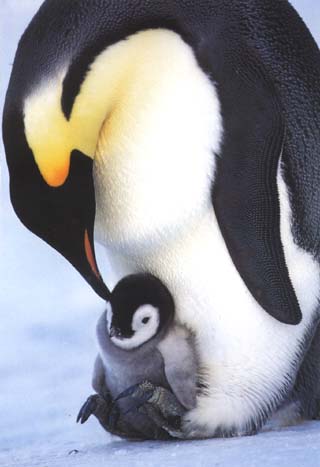
penguins. Millions of penguins swim ashore and gather together in groups called colonies or rookeries to mate. A rookery is a very loud and messy place because there are so many penguins and they are all making croaking or grunting noises trying to find their mates and court them. Penguins usually keep the same mates for many years. They have no trouble finding each other. They can tell their mates by the sound of their voice. Penguins lay their eggs in May or June. While some species of penguins make nests to have their babies, the emperor penguin does not. The mother emperor penguin lays one egg, then passes it to the father and swims out to sea to feed because she is very hungry. She will need a lot of food in her belly to feed her baby when she returns. She will stay at sea for about two months. The father emperor penguin is in charge of keeping the egg warm while she is gone. He holds the egg on top of his feet under a special flap of skin under his tummy. This is called a brood pouch.
Pretty soon, the mother comes back from sea to take care of it and it is the father’s turn to swim away and feed in the ocean. Now the mother emperor penguin keeps the baby warm in her brood pouch. The penguin chick has soft, gray feathers that are not very warm, so the mother must take very good care of it. She feeds her baby by spitting up food from her belly and giving it to him. Both the mother and father take care of the baby when the father comes home. They feed it and keep it warm until it is too big to stay in the brood pouch. Then, all the baby chicks gather together in groups called crèches and learn how to be penguins. Mom and Dad come back often to feed their babies. After about five months, the chicks lose their baby fur and start to grow their waterproof feathers. Pretty soon they will be old enough to survive on their own. When it is time for them to have babies of their own, they will come back to the same place they were born to raise their chicks. They usually come back in about four years.
|
Page created by Elaine
Rehm
Arcadia University 7/25/01
E-mail
us
| Home | Animals | Activities | Gallery | Resources | Credits |
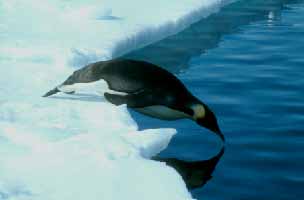 On land, penguins cannot fly, but
they can jump. They jump in and out of the water and climb over the ice
and rocks. When penguins want to get somewhere in a big hurry, they slide
over the ice on their bellies. This is called toboganning. When they walk, penguins seem to waddle
because of their long bodies and short legs.
On land, penguins cannot fly, but
they can jump. They jump in and out of the water and climb over the ice
and rocks. When penguins want to get somewhere in a big hurry, they slide
over the ice on their bellies. This is called toboganning. When they walk, penguins seem to waddle
because of their long bodies and short legs.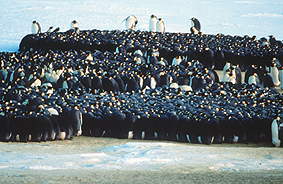 While the mothers are gone, all
the father penguins gather together. They stand very close to each other to keep themselves and their eggs
warm. Because it
is very, very cold, they take turns standing on the outside and inside of the
While the mothers are gone, all
the father penguins gather together. They stand very close to each other to keep themselves and their eggs
warm. Because it
is very, very cold, they take turns standing on the outside and inside of the