|
Arctic Hare Description Habitat Food Predators Reproduction Facts
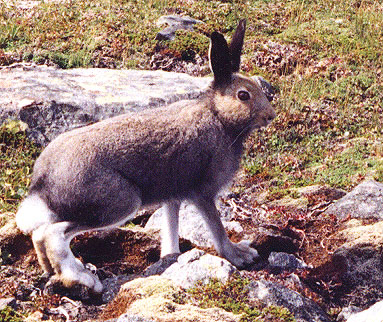
Unlike other hares, the Arctic hare has short ears that are black at the tips. Their short ears help them to conserve body heat. Short ears have fewer blood vessels that are exposed to the cold. Arctic hares have very powerful hind legs and large feet. Their large feet act like snowshoes, helping them to stay on top of the snow and move quickly to escape their enemies. Arctic hares can run very quickly, up to 50 miles per hour.
Arctic hares live on the tundra of northern Canada, Newfoundland, Greenland, and Alaska. They like to live in sloping, rocky areas, and stay out of low, wooded areas.
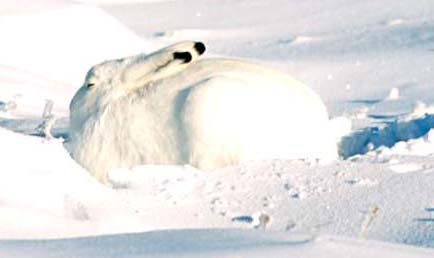
While resting in their nests, they sit on their large feet, flatten their ears against their bodies, and hunch up in a ball to conserve body heat.
Arctic hares sometimes huddle together in large groups of 150 to 200 members. Huddling keeps the animals warmer, and if an enemy attacks the group, the hares scatter in all directions and hide in cracks and crevices to escape being caught. This is very confusing to the enemy.
Arctic hares feed mostly on grasses, small plants, willow leaves, herbs, and wild berries. Sometimes in the winter, they may have to eat twigs or meat.
The biggest enemies of the Arctic hare are the fox, the polar bear, the wolverine, and the ermine. However, sometimes, birds of prey, such as the gyrfalcon or snowy owl, can swoop down and capture the smallest hares, carrying them off in their talons. Arctic hares have also been hunted by people for their fur. Breeding season for Arctic hares is in the spring and summer. Their babies, called leverets, are born about 42 days after mating. Arctic hares usually produce two or three litters each year. There can be up to seven babies in every litter. Leverets are born with their eyes open and with dark fur. They can run very soon after being born and leave their nest almost immediately. Life is full of danger on the tundra and they need to be able to get away from it quickly, even if they are babies.
|
Page created by Elaine
Rehm
Arcadia University 7/25/01
E-mail
us
| Home | Animals | Activities | Gallery | Resources | Credits |
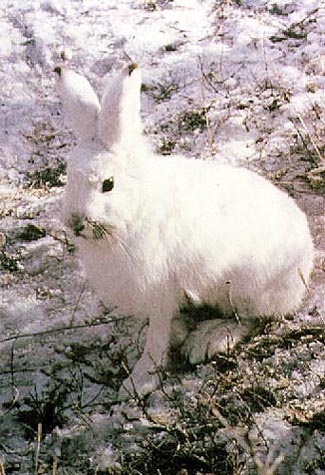 The Arctic hare is the largest member of the hare family. It grows to be
about 27 inches long and it weighs about 12 pounds. In summer, when
there is no snow, its fur is brownish gray, but as winter nears, it
grows a thick white fur that helps to keep it warm. Hares that live in
the far northern regions of the Arctic keep their white fur all year
long. The ability to change the color of its fur is called
The Arctic hare is the largest member of the hare family. It grows to be
about 27 inches long and it weighs about 12 pounds. In summer, when
there is no snow, its fur is brownish gray, but as winter nears, it
grows a thick white fur that helps to keep it warm. Hares that live in
the far northern regions of the Arctic keep their white fur all year
long. The ability to change the color of its fur is called