|
Arctic Fox Description Habitat Food Predators Reproduction Facts
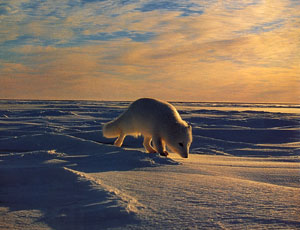
Arctic foxes are meat-eating hunters. They prefer to hunt alone rather than in a pack. Sometimes they follow polar bears and eat what the bear has left behind after he has killed a seal or some other animal for his dinner. They also raid birds’ nests and eat the eggs. In the summer time, they often collect berries and other tidbits and hide them under rocks, saving them for winter when it is harder to find something to eat. Other favorite foods of the Arctic fox include lemmings and voles, birds, insects, squirrels, and fish. Lemmings are small animals that are about as big as guinea pigs. Arctic foxes are hunters and predators. They are very sly and have learned how to survive very well in their cold, cold homeland. They have to be careful around the polar bears they follow, however, so that they won’t become the bear’s next meal. Their white fur helps them blend in with the ice so they don’t get caught. Humans are predators of the Arctic fox. People have hunted them for their beautiful fur.
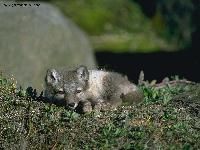
Foxes mate in mid-winter. The babies are born in late May. There are usually five or six kits in a litter, but there can be as many as twelve. The kits are brown and are born with their eyes closed. Both parents take good care of them for the whole summer. The kits stay in the den for a few months while the parents go off to hunt for food for them. The male fox is both a hunter and a protector. He gathers food for the family and guards the den from enemies.
|
Page created by
Elaine Rehm
Arcadia University 7/25/01
E-mail
us
| Home | Animals | Activities | Gallery | Resources | Credits |
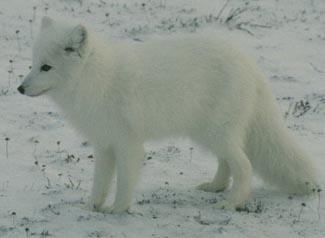 The Arctic fox is a member of
the dog family. When it is fully grown, it is about 2 to 3 feet long and
has a bushy 12-inch tail, which it uses to keep its nose and feet warm
when it curls up to go to sleep. Its thick fur is grayish-brown in
summer to blend in with the rocky land of the
The Arctic fox is a member of
the dog family. When it is fully grown, it is about 2 to 3 feet long and
has a bushy 12-inch tail, which it uses to keep its nose and feet warm
when it curls up to go to sleep. Its thick fur is grayish-brown in
summer to blend in with the rocky land of the