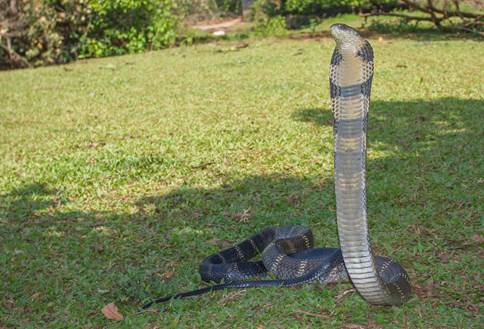
KING COBERA
King cobras (Ophiophagus hannah)
are not particularly venomous nor are they aggressive or bad tempered. The
venom LD50 is 1.80 mg/kg SC according to Broad et al. (1979).[124]
The mean value of subcutaneous LD50 of five wild-caught king cobras in
Southeast Asia was determined as 1.93 mg/kg.[125] However, because the king
cobra is the longest venomous snake in the world, it can inject very high
volumes of venom in a single bite. Between 350 to 500 mg (dry
weight) of venom can be injected at once (Minton, 1974). In another
study by (Broad et al., 1979), the average venom quantity was 421 mg (dry
weight of milked venom).[124] The maximum venom yield
is approximately 1000 mg (dry weight).[17] The king cobra has a fearsome
reputation. When annoyed, it spreads a narrow hood and growls loudly, but some
scientists claim that their aggressiveness is grossly exaggerated.[126] In most of the local encounters with live, wild king
cobras, the snakes appear to be of rather placid disposition, and they usually
end up being killed or subdued with hardly any hysterics. These support the
view that wild king cobras generally have a mild temperament, and despite their
frequent occurrence in disturbed and built-up areas, are adept at avoiding
humans. Naturalist Michael Wilmer Forbes Tweedie felt
that "this notion is based on the general tendency to dramatise
all attributes of snakes with little regard for the truth about them. A
moment’s reflection shows that this must be so, for the species is not
uncommon, even in populated areas, and consciously or unconsciously, people
must encounter king cobras quite frequently. If the snake were really
habitually aggressive records of its bite would be frequent; as it is they are
extremely rare."[127] Mortality rates vary sharply depending on many
factors.