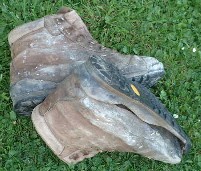
Boots

A good pair of boots is an indispensible part of your tramping inventory.   Here are a number of things to consider when buying a pair of boots.

Weight

No sensible tramper carries more weight than he can help -- and especially not on his feet, which he will have to lift over fallen logs, pull out of mud puddles, and occasionally extract from his mouth.  Therefore his boots should be light.  It may sound surprising, but modern tramping boots can be as light and as comfortable as a pair of sneakers.
In the shop, that is.  Because in the shop, they are not filled to the brim with water and small sharp stones (their usual state during a normal tramp).  Water and stones are heavy.  Here are a few suggestions which will help keep the weight factor down:
  1. Stay at home, thus avoiding wearing the boots.
  2. Avoid getting your boots wet.  This means (a) staying in your sleeping bag on rainy days, and (b) removing your boots every time you need to cross a river.  Self-respecting trampers will avoid doing the latter in popular areas where there is a high risk of being seen.

Comfort

Choose boots which seem comfortable in the shop.  Better boots that are only comfortable in the shop than boots which are not comfortable anywhere.  As long as you remain in the shop, you will not suffer the following discomforts:
  1. The aforementioned water and stones;
  2. The unmitigated pleasure of sliding icy boots over your cold wet socks just after getting up (assuming you decline to pre-heat these in the billy as some have been reported to do);
  3. Losing your toenails on a long descent, from constant ramming into the nose of your boot.  Your mother was right after all: you should cut your toenails from time to time!

Grip


A tramper needs a firm grip on the world.  Slipping is dangerous.   For this reason, we advise avoidance of all the ice and loose rock you'll find in the alpine regions.  Yes there are crampons, ice axes, and ropes, but hey: would you rather be warm and alive down below the bush line, or cold and dead at the bottom of an icy slope?  Come to think of it, wouldn't you rather be warm at home in bed?

Rigidity

Boots should give good support to your soles and (particularly) ankles.  In theory stiff boots mean you won't sprain your ankles by coming down awkwardly.  In practice, stiff boots will act as a good tight splint to keep you upright after you do sprain your ankle.  Also, the cold water in your boots will help reduce the swelling in lieu of an ice-pack.

Safety First.
Safety is our primary concern.


Price

You want all that and cheap?!  You must be kidding.


Used Boots on Display

Caring for your Boots

Our advice is to remain seated comfortably on your sofa, with your boots off your feet.  If they don't look completely new, put them somewhere where visitors will see them and gain the impression that you are a sporty, outdoors type.  Used in this manner, a good pair of boots will last your whole lifetime.


Hosted by www.Geocities.ws

1