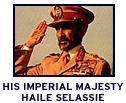
When, in 1930, Ras
Tafari Makonnen, great-grandson of King Saheka Selassie of Shoa, was
made Emperor of Ethiopia and proclaimed Negusa Negast (King of Kings),
Jamaica's slum-dwellers and rural poor, for whom Garvey
had been something of a gallant oracle, regarded this event as the
fulfillment of a prophecy of deliverance. Indeed, Ethiopia had
symbolized all of Africa for the slave-descended Jamaicans since as far
back as 1784, when American Baptist minister George Liele founded the
Ethiopian Baptist Church on the island. These "Garveyites"
were awed by newspaper and newsreel accounts of the pomp of Selassie's
coronation in Addis Ababa and took note of the sybolism in the choice of
his formal title, Haile Selassie being an honorific meaning "Power
of the Holy Trinity." Selassie, they knew, claimed to be directly
descended from King Solomon, so they reasoned that he must be the
long-awaited savior of the planet's far-flung African peoples.
In Africa, Selassie was hailed as the greatest of modern monarchs and a
symbol of the continent's vast potential. In the United States,
residents of Harlem jammed movie houses to watch the newsreel footage of
his coronation. And in the Caribbean, as elsewhere in the West, the
advent of Selassie's reign was taken as shining proof for all
downtrodden people of color that, as the back-to-Africa Garveyites and
the firebrands of the syncretistic Rastafarian cult had foretold, the
day of Deliverance was at hand.
To the Garveyites, Haile Selassie I was a hero without peer. To the
Rastafarians he was the Living God of Abraham and Isaac, He Whose Name
Should Not Be Spoken. |
|
|