Reformed Spirituality
Network
Number
Six Fall
2003
In
this Issue:
The Reformed Spirituality Network presents the
Gathering on Reformed Spirituality, July 21 - 23, 2004
Meeting God in Worship: The Heart of Reformed Spirituality
The Psalmist extends God's invitation and desire for humanity when he declares, "0 come, let us worship and bow down. Let us kneel before the LORD, our Maker" (Ps 95:6)! Worship is one of the central actions and ministries of the church. However I worship is also a topic that is hotly debated today. This both reveals the importance and passion people have for worship as well as the uncertainty how to best offer God our praise and our lives.
Our next Gathering will be held on the beautiful campus of Western Theological Seminary in Holland, Michigan, July 21-23,2004. Our theme will be "Meeting God in Worship: The Heart of Reformed Spirituality". Our goal and desire is threefold: to explore the biblical and theological foundations of worship, especially seeking to appreciate the distinctives of the Reformed tradition, to reflect and recognize the formative nature or how worship shapes our lives, and as a result how can we craft worship that will guide us more fully to meet and experience God in worship?
We have summoned the wisdom and insights of three very capable leaders to guide our time together:
In
addition to a variety of worship expressions and experiences we will offer workshops
that address (some of) the following themes: Worship and technology, Youth and
worship, Preaching, Family worship, Children in worship, Daily Prayer , Historical
Foundations of the Sacraments, Designing and Developing Liturgy, How to Make
Changes in Worship, Westminster Directory and Reformed Spirituality, Worship
and the Arts, Spiritual Formation through Worship, Selecting Music, Worship
and Social Justice, and Hospitality .
Reformed Spirituality Tour
Fifteen
of us set out June 24, 2003, on a pilgrimage billed as a "Reformed Heritage
Tour." It had been advertised in this newsletter, sponsored by the Reformed
Spirituality Network. Our intention was to drink at the streams of grace that
flow from the reformation in France and Switzerland.
One of John Calvin's favorite metaphors for God was a fountain. In his commentary
on the Psalms Calvin speaks of God being "the fountain of righteousness"
(Ps. 97:10) and that when we are cut off from God as the fountain
of life reconciliation brings blessings poured upon us (Ps. 102:28). Throughout
the Institutes Calvin
refers to God as the "fountain of righteousness" (Book " chap.
2, Section1) and the "fountain and source of all things" (I, 13, 18).
He also speaks of Christ as the fountain
of unity for the church (4,2,6) and that, when that fountain of life dwells
in us, he is the source of our vitality (4,17, I, 8). We learned that the fountain
of grace that brought about the reformation continues to enrich us and our world.
Our
first destination was Calvin's birthplace, Noyon, France. The house in which Calvin lived as a small child,
was destroyed in World War II. But a building has been designated in which to
house memorabilia of Calvin. The museum contains portrait paintings of Calvin
and drawings of events in the 16th Century. They brought home to me the intense
conflict that ensued in the reformation. It was a dramatic step that Calvin took when he gave up the stipend he was receiving
for a chaplaincy, with no duties connected, with the cathedral of Notre-Dame
in Noyon. His actions meant he had to
leave France
and escape to Switzerland.
The cathedral is awesome as a sacred space. Calvin did not leave it because
it lacked beauty but because the Spirit was at work in him and others who found
an experience of God centered in Christ. Instead of following the dictates of
the church headed by the Pope the reformers stressed the importance of a personal
relationship with God.
Our
visit to Chartres
brought us first to the Reformed Church there. The church was founded in 1550.
They were anticipating the coming of a pastor the next week. We
met the very pleasant president of the council, Ms. Annick Liffran. She told
us how the Reformed faith meant that every one of us is called by God, not only
clergy. Their congregation governs its life by group vote not by hierarchical
orders. Their synod is currently wrestling with questions regarding homosexuality
.We brought a gift to them of a chalice and paten made by potter, Mary Dozema,
of Grand Rapids.
They served us juice and cookies.
We visited the famous cathedral at Chartres, best preserved of 12th & 13th century cathedrals
with its spectacular stained glass windows. The noted English guide, Malcolm
Miller, gave us an explanation of the windows. In the evening we had the unusual
privilege of walking the labyrinth. The labyrinth was a form of pilgrimage in
the Middle Ages, taking one to a center point and back out again. It was put
in the floor of the church in 1220 and is the pattern used by many in the revival
of interest in the labyrinth in America. It was a profound experience for the group to walk
that ancient path. At the center I was aware that I was on a path walked by
thousands of pilgrims through the years. As I walked out I was aware that renewed
trust and compassion were gifts God wanted to give me.
At
Taize we witnessed the fruit of the efforts of a Reformed churchman from Switzerland,
Brother Roger Schutz, who, in 1940, had the vision of a community dedicated
to Christian unity .Close to one hundred monks are now in the community , Protestant
and Catholic. Their worship draws young people from allover the world. The week
of our visit 1,500 young people were there, the next week 2,000 were expected
and for some weeks in August there were 5,000 registered. The singing at worship
is gorgeous and deeply moving. Friday evening the service centers about the
cross. Saturday evening is a candlelight service. Sunday morning the Lord's
Supper is celebrated. It is all prayer, in song, listening to scripture and
silence, offered to God drawing the worshipers
into communion with God. Taize songs are prayer, expressing desire for God,
not a performance. No director or singer or Instrumentalists are visible. The
chancel is filled with candles and large saffron streamers resembling flames
of Pentecostal fire.
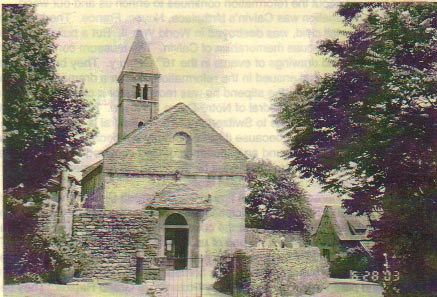
Old church at Taize where the community began. A large church
is now used
for the thousands of young people that come to pray and worship
with the community of Protestant and Catholic monks.
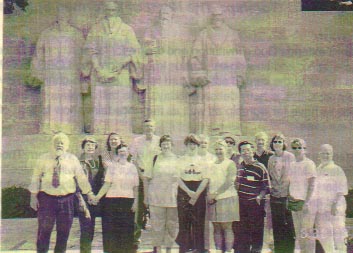
Our tour of Geneva began at the monument to the reformers. John Calvin wanted no attention to himself. No one is certain of his burial place. But a monument has been erected with carvings of him and other reformers. Four large figures represent Guillaume Farel, the fiery preacher who persuaded Calvin to stay in Geneva; Calvin; his successor, Theodore de Beze; and John Knox, who studied with Calvin in Geneva and then brought the reformation to Scotland. Anyone who comes to the park has this visual reminder of these men. But I wondered if their influence was still a significant part of the life of modern Geneva. Our guide, Marilynn Geiger, a resident of Geneva, spoke of the "Spirit of Geneva." That spirit is a concern for justice and for the value of the individual person. Because of this spirit, Geneva has become the center for international organizations including the second home of the United Nations, original headquarters of the Red Cross, the headquarters of the World Council of Churches and the World Alliance of Reformed Churches and many associations for relief work around the world. All that is fruit of the transformation of Geneva that resulted from the reformation.
Visiting
the church where Calvin preached, the hall where he lectured and the college
he helped to organize made the great reformer more real. Reticent to be in the
forefront, sometimes ill, Calvin demonstrated great courage in the face of opposition.
His mind, legally trained and theologically
astute, put the reformation on a solid
biblical footing. Yet it was his heart, so deeply in love with God, which sustained
him.
The
other great reformer whose haunts we visited was Ulrich Zwingli. He preferred
the name Huldrych which means "rich in grace."
Like Luther, Zwingli was preaching
the grace of God. He was strongly opposed to anything that could become
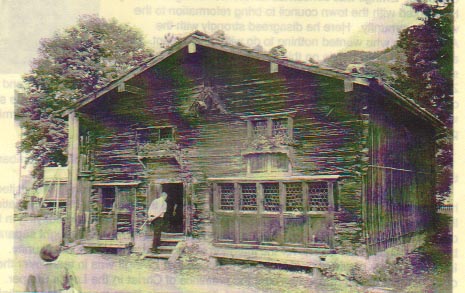
Birthplace of Ulrich Zwingll, born in 1404
an idol, preaching that it is God only who we serve. We visited the house in which he was born in Wildhaus. There we saw some more present day fruit of the reformation. Friends of Roland and Una Ratmeyer, who were in our group, have a holistic health center in that village. Called Sunnehus it is a place of healing for people with various emotional and spiritual needs. The director is Hanna Amman. She grew up in a "Zwingli Reformed" church. Hanna and her husband, Christophe, were our guides in our visit to Zurich where Zwingli was the pastor of the large "Grossmunster" church.
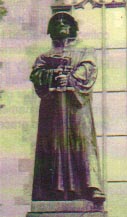
I was impressed with the large statue of Zwingli next to the Wasserkirk. I had heard that in the sculpture's representation of him he had a Bible in one hand and a sword in the other. My anticipation of the statue was colored by my concern over the "preemptive strike" policy of our current American administration. So I thought the statue might say that we should be prepared both to preach the word and to strike our enemies with the sword. Zwingli was an army chaplain and died from wounds suffered
 in
a battle for religious freedom between Zurich and other Cantons. But
in
a battle for religious freedom between Zurich and other Cantons. But
the statue actually gave me a different feeling than I expected. In the work
of the sculpture Zwingli holds the Bible close to his breast. It seemed to me
to be saying that it was the Word that Zwingli held most dear. His ministry
was aimed at inner transformation. The sword he holds in the other hand is in
repose with point to the ground. Hanna Amman, director of Sunnehaus,
helped
me understand it as the sword of justice. Zwingli was concerned
for the well being of society . He worked with the town council to bring
reformation to the whole community .Here he disagreed strongly with the
Anabaptists who wanted nothing to do with government. He also differed
from
Calvin on this. In Geneva there was a separate consistory of the
church from the town council. In Zurich, as Zwingli was the leading pastor,
the council governed both the town and the-- church as one community .Whether
we agree with Zwingli's approach or not the seeds were sown of a Reformed branch
of Christianity that sought to bring the transforming power of Christ to the
world.
Here is more
reflection on the trip from Bernice Meagor, one of the members of the tour group:
The Reformed Heritage
Tour was very meaningful and inspiring. We visited historical sites of both
Calvin and Zwingli and realized the impact of the Reformation on life today.
Taize was particularly inspiring and greatly appropriate and edifying in the
context of our study of the Reformation. Although the Reformation brought separation
between churches, it was never the intention of the Reformers to cause disunity
. Instead it was a cause of grief to them. I learned that Zwingli was in tears
over the lack of agreement of Luther and him over the presence of Christ in
the Lord's Supper
.How inspiring it was
to be at Taize! There people from many different religious backgrounds worship
together in unity and live out the theme of reconciliation. Young people from
allover the world come to find meaning and hope for their lives.
As a person brought
up in and committed to the Reformed tradition, the Reformed Heritage Tour has
been a ministry to me as I grow in faith and continue my journey in finding
reconciliation and unity in the church.
The Future of Protestant Worshipl Beyond the Worship Wars, by Ronald
P. Byars, Louisville: Westmjnster John Knox, 2002. 138pp.
Would you
like to know how worship can be traditional and contemporary but not just in
the "tradition" of the older generation nor confined to the styles
of one younger generation? This book will give you some answers to this question.
Ronald Byars, professor of preaching and worship at Union Theological Seminary
in Richmond, VA., has provided a helpful guide that addresses the issues that
have led to the "worship wars" and confusion over style of worship
in our time. It is a timely and perceptive resource.
The Reformed Spirituality Network is a group of leaders from the Reformed tradition of the historic Christian faith who have been gathering since 1993. Our vision is to support the Christian community in Reformed spirituality through networking, educating and resourcing. We believe that Reformed spirituality helps people: -to respond to God's call to grow in godliness, -to deepen their own union with Christ, and -to
be transformed by the Holy Spirit. The Reformed Spirituality Network has been supported by members and agencies of The Christian Reformed Church in North America, The Presbyterian Church (USA) and the Reformed Church in America. For more information see our web site at www.geocities.com/refspnet/index.html
Our mailing address: Tom Schwanda, 6125 Capitan SE, Grand Rapids,
Ml 49546
Please send us your feedback! Donations are always appreciated. RSN is a tax-exempt charitable organization. Please let us know if you wish to be added or dropped from our mailing list or if you have an address change.
|
Return to RSN homepage