
Reformed Spirituality
Network
Number
Four Fall
2000
In
this Issue:
Gathering on Reformed Spirituality
Deepening Our Life in Christ is the theme for our next Gathering at Western Theological Seminary in Holland, Michigan July 18-20, 2001. As announced in our last newsletter, Ben Campbell Johnson, professor emeritus of Christian Spirituality at Columbia Theological Seminary, and Marjorie Thompson, director of the Pathways Center of the Upper Room, will be our keynote speakers and guides. Ben will be making presentations on "Welcoming Christ's Presence in the Church" and "The Spiritual Dimension of Leadership". Marjorie will be addressing the Gathering on the themes "The Family as a Spiritual Center" and "The Congregation as a Center for Spiritual Nurture."
A number of outstanding workshops are being planned that will compliment the themes of the plenary addresses. In addition, Marjorie will be offering a special workshop entitled "Congregational Spiritual Formation through Small Groups." This workshop will introduce a new resource being developed by the Upper Room. Whether you might be considering joining us for the first time or whether you have been at previous Gatherings we encourage you all to give prayerful consideration to this important event. Our goal is to help the church and other Christian organizations and institutions (including colleges, seminaries, and judicatories) create more opportunities for exploring and experiencing the presence of Jesus Christ within our various structures. Foundational to that is assisting individuals and groups to become more aware that their hungers and restlessness is often the nudging of God's Holy Spirit to awaken them to a more abundant and meaningful life. We hope to see you at Western Seminary next July. --Tom Schwanda
CONTEMPLATIVE PRAYER AND REFORMED SPIRITUALITY
by Tom Schwanda
Contemplative prayer has become a topic of renewed interest today. Typically the focus turns to the Roman Catholic tradition with its long history and numerous examples of those who practiced this form of prayer and living. However, many are surprised to discover that this is not foreign territory for Reformed spirituality. As I began searching the primary sources I was delighted to uncover many rich expressions of how the Reformed people engaged in contemplative prayer. While contemplation was practiced in many areas of life, I discovered that our spiritual fathers tended to focus their experiences around God, nature and creation, Jesus Christ, scripture, the Lord's Supper, and heaven. One of the most outstanding examples is that of Jonathan Edwards (1 703-1758). Tragically the only connection most people have of Edwards is his sermon "Sinners in the Hands of an Angry God." But no one should be judged exclusively by one sermon or statement or anything else. Consider and ponder the following two samples from his writings and see if you have a different perspective. The first is a description of his wife, Sarah Pierrepont Edwards' (1 710-1758) experience of Jesus Christ. The second captures Edwards'own experience of God through creation.
"I have been particularly acquainted with many persons that have been the subjects of the high and extraordinary transports of the present day ... a very frequent dwelling, for some considerable time together, in such views of the glory of the divine perfections, and Christ's excellencies, that the soul in the meantime has been as it were perfectly overwhelmed, and swallowed up with light and love and a sweet solace, rest and joy of soul, that was altogether unspeakable ... and the heart was swallowed up in a kind of glow of Christ's love, coming down from Christ's heart in heaven, as a constant stream of sweet light, at the same time the soul all flowing out of love to him, so that there seemed to be a constant flowing and reflowing from heart to heart. The soul dwelt on his, and was lost in God, and seemed almost to leave the body; dwelling in a pure delight that fed and satisfied the soul; enjoying pleasure without the least sting, or any interruption; a sweetness that the soul was lost in." [Jonathan Edwards, Some Thoughts Concerning the Revival in Works of Jonathan Edwards, ed. C.G. Goen. Vol. 4 (New Haven and London: Yale University Press, 1972), 331-332] Edwards continues to describe Sarah's experience as one that was "perfectly swallowed up" (p. 333), "rapturous affections" (p. 335), "sweetness and ravishment of soul, that has been altogether inexpressible" (p. 339), and "seeming to be much overcome and swallowed up by the late great increase of grace" (pp. 340-41).
"God's excellency, his wisdom, his purity and love, seemed to appear in everything; in the sun, moon and stars; in the clouds, and blue sky; in the grass, flowers, trees; in the water, and all nature; which used greatly to fix my mind. I often used to sit and view the moon, for a long time; and so in the daytime, spent much time in viewing the clouds and sky, to behold the sweet glory of God in these things: In the meantime, singing forth with a low voice, my contemplations of the Creator and Redeemer. And scarce anything, among all the works of nature, was so sweet to me as thunder and lightning. Formerly, nothing had been so terrible to me. I used to be a person uncommonly terrified with thunder: and it used to strike me with terror, when I saw a thunderstorm rising. But now, on the contrary, it rejoiced me. I felt God at the first appearance of a thunderstorm. And used to take the opportunity at such times, to fix myself to view the clouds, and see the lightnings play, and hear the majestic and awful voice of God's thunder: which often times was exceedingly entertaining, leading me to sweet contemplations of my great and glorious God." [Jonathan Edwards, Personal Narrative in Letters and Personal Writings in The Works of Jonathan Edwards, edited by George S. Claghorn. Vol. 16 (New Haven, CT and London: Yale University Press, 1998), p. 794.]
In
reflecting upon these experiences there is much we can learn to encourage our
own contemplative awareness and attitude. In particular, notice three
things:
1. It takes time to be contemplative. Fast
food and microwave living does not create the
proper
attitude for holy leisure. Jonathan Edwards lingered and savored the beauty
of
nature.
2 Increase your awareness of life around
you and within you by asking "What do you
notice?"
Contemplatives cultivate a heightened sensitivity to notice God in all areas
of
life.
3. Contemplatives are filled with a sense of wonder
and gratitude. As they taste the
goodness
of God they are not only brought more fully into God's presence but also
inspired to deepen
their experience and noticing of God.
Elsewhere in this newsletter Dave Muyskens explores his awareness of how contemplative living is being shaped in his own life. We trust both the historical and the contemporary examples of contemplative practice will encourage our readers to be open to similar expressions and experiences of God. S.D.G.
God is present,
God is in our midst, let us worship from deep within. |
CONTEMPLATIVE WORK
by Dave Muyskens
It took me years to realize that being a contemplative was not opposed to being active. For a long time I thought the Reformed way was to be an activist. Our Reformed faith in God who reigns over all of life seemed to lead us into active service in the world. It seemed to me that contemplative prayer would take me away from that. That's the way I looked upon all forms of meditation until I learned better.
I'm learning, actually, that work goes best when done in a contemplative mode. I call it contemplative work. The idea came to me as I was doing some rather tedious labor. When I became anxious to get the job done and acted hastily the effort did not go well. And the whole effort became quite unpleasant. When I decided to apply what I was learning from contemplative prayer I entered the work with more attention to what I was doing. I entered more fully into the moment. Instead of being anxious for that time to arrive when I could get on to something else I simply entered into doing what I was doing and doing it as well as I could. This contemplative attitude even made the tedious work more enjoyable. Sawing a board can become a moment to appreciate the cut Of the saw and perhaps to celebrate the beauty of the grain of the wood. Washing the dishes can become a moment to be grateful for clean dishes and good meals. And in the moment one can sense that God is present and active.
Far from taking me out of the world of work contemplation gives me a better way to fully enter into it. Contemplative prayer is not escape from the world but rather a way of being more aware of reality. Thomas Merton, one of the great contemplatives of the last century, came to discover this truth. Contemplation he said was the spring, compassion the stream. Compassionate effort grows out of contemplation. The springs of living water are allowed to flow in us as we are open in prayer, the stream that flows is expressed in compassionate action.
I am convinced that a practice of contemplative prayer is needed. It opens us to the gift of communion with God. The practice results in a contemplative attitude. The attentiveness developed in prayer carries over into the rest of life. Work becomes a continued prayer, extended attention to God's presence and action.
Make my way simple,
in the silence of prayer, in the solitude of your peace. |
RETREAT WITH DON POSTEMA
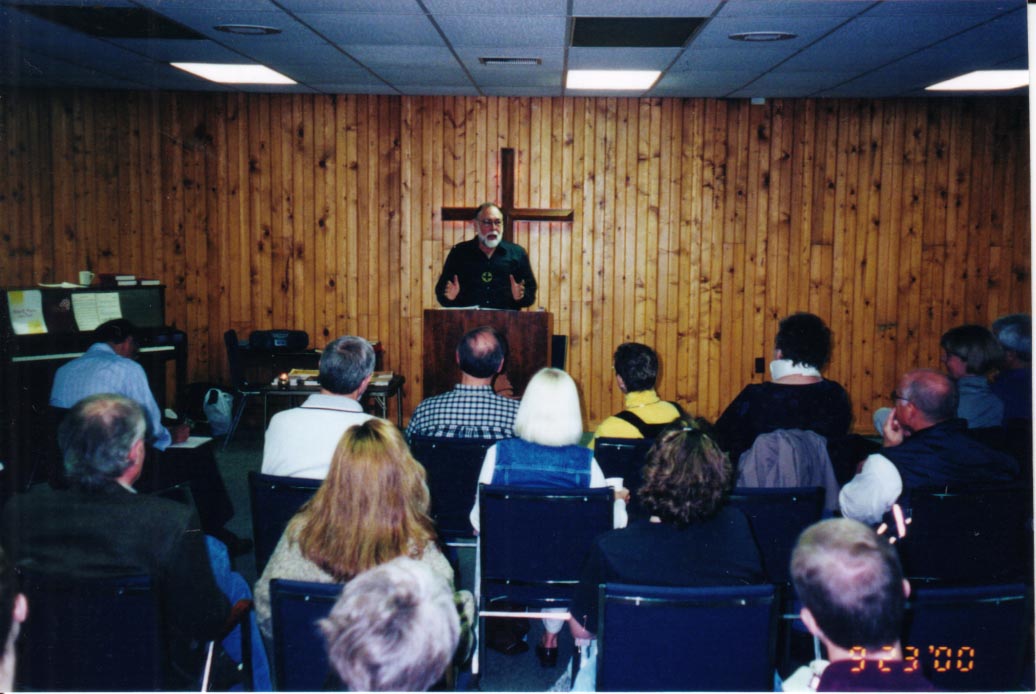
Don Postema asked the retreatants at Camp Geneva on Lake Michigan to consider, "What do I treasure about being Reformed?" The retreat was held September 23, 2000. Don is an ordained minister of the Christian Reformed Church who lives in Ann Arbor, Ml where he was for many years pastor of Campus Chapel. He is widely known as a retreat leader and the author of Space for God and Catch Your Breath.
Don
answered the question of what he treasures 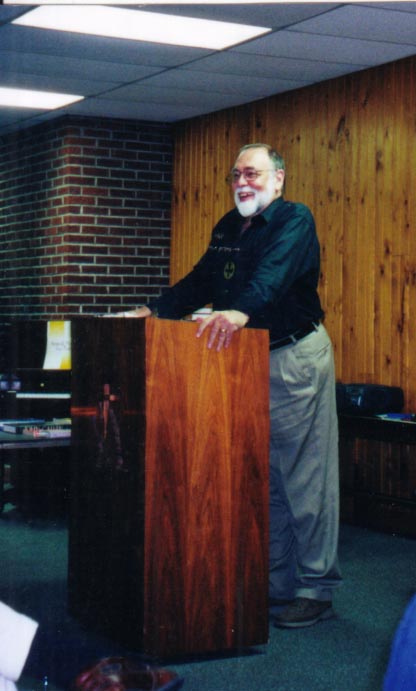
about being Reformed saying he likes the balance of Reformed spirituality with
its three elements: knowledge of God, experience of God and service of God or,
in other words, loving God with mind, heart and hands. With Don's humor
and warmth and a sunny day at the lake, the event was inspiring for all who
attended. A group came from a church in the Chicago area, a class led
by Matthew Floding at Western Seminary came, and some 40 others from Western
Michigan. Our hope is that the Reformed Spirituality Network can sponsor
other events like this between our big Gatherings every other year. Watch
for announcements of a retreat on Sabbath.
BOOK REVIEW
Discerning God's Will Together., A Spiritual Practice for the
Church, by Danny E. Morris and Charles M. Olsen,
published by Upper Room Books, Nashville, 1997.
This book is a guide
for church boards and judicatories in their function of discerning God's leading.
It is built on the work of the two authors. Danny Thomas was Director
of Developing Ministries of The Upper Room at the time the book was written.
He has helped create a network of churches interested in the practice
of discernment. A previous book of his was entitled Yearning
to Know God's Will. Chuck Olsen is Program
Director and Staff Mentor for Worshipful-Work headquartered in Kansas City,
MO traveling widely to help church judicatories in discernment. His previous
book has been a guide for many church boards in practicing prayerful spiritual
discernment through story telling, biblical and theological reflection and vision.
It is entitled Transforming Church Boards
into Communities of Spiritual Leaders. Discerning God's Will Together provides a guide for doing prayerful discernment. Chapters
of the book deal with the what, why, who, how and where of spiritual discernment
for church assemblies. The book delineates ten steps that a group can
take to find God's will in major decisions. The steps have been gleaned
from the rich tradition of the whole church including Roman Catholic, Reformed,
Anabaptist, Methodist, Eastern Orthodox, Pentecostal and Quaker traditions.
It explains how the process of discernment is grounded biblically, how
the group process of listening and exploring alternatives works, and how a decision
is prayerfully weighed. It offers an alternative way of decision making
to procedures standardized by Robert's Rule of Order. The design of the
book is for groups but contains much wisdom for a process of discernment that
can be useful for persons as well. It is a must for congregations that
would like to shape their life together more out of spiritual practices than
according to the patterns of the corporate business world.
--J.
David Muyskens
Gerhard Tersteegen (1697-1769) was a merchant and mystic poet in the Reformed Church in Germany. The two verses in this newsletter are from hymn #323 in the Hymnal of the Reformed Churches in the Netherlands, translated by David Muyskens. |
ANNOUNCEMENTS
The next issue of this newsletter (in the Spring of 2001) can announce events and web sites sponsored by members of the network. Send your announcement to J. David Muyskens, 2130 Griggs St. SE, Grand Rapids, Ml 49506, or by e-mail to [email protected].
The Reformed Spirituality Network is a group of leaders from the Reformed tradition of the historic Christian faith who have been gathering since 1993. Our vision is to support the Christian community in Reformed spirituality through networking, educating and resourcing. We believe that Reformed spirituality helps people: -to respond to God's call to grow in godliness, -to deepen their own union with Christ, and -to
be transformed by the Holy Spirit. The Reformed Spirituality Network has been supported by members and agencies of The Christian Reformed Church in North America, The Presbyterian Church (USA) and the Reformed Church in America. For more information see our web site at www.geocities.com/refspnet/index.html
Our mailing address: Tom Schwanda, 6125 Capitan
SE, Grand Rapids, Ml 49546
Please send us your feedback! Donations are always appreciated. RSN is a tax-exempt charitable organization. Please let us know if you wish to be added or dropped from our mailing list or if you have an address change.
|
Return to RSN homepage