Reformed Spirituality
Network
Number Two
October
1998
In this Issue
Sexuality, Intimacy, & Commitment:
An Invitation to Transformation
I often think of spiritual direction as one way of recognizing
how sanctification works in our lives. So when I am doing spiritual direction,
I ask questions like "What has happened? How has God worked in your life
to redeem you, to bring new life to birth in you? And how can you recognize
God acting in your day to day life?
 One part of our lives that is often hard to talk about is our sexuality.
Sexuality is a difficult topic for us these days. There is much talk in the
media. Behaviors and values are expressed and affirmed which appear contradictory
to all that we have learned and taught. We need to find ways to affirm our sexuality
as a gift from God, which frees us to be all that God has created us to be.
In Romans 8:28, we read "all things work together for good for those who
love God." When we read that text, we usually think of the struggles and
pain in our lives. I think we can also include sexuality in "all things."
One part of our lives that is often hard to talk about is our sexuality.
Sexuality is a difficult topic for us these days. There is much talk in the
media. Behaviors and values are expressed and affirmed which appear contradictory
to all that we have learned and taught. We need to find ways to affirm our sexuality
as a gift from God, which frees us to be all that God has created us to be.
In Romans 8:28, we read "all things work together for good for those who
love God." When we read that text, we usually think of the struggles and
pain in our lives. I think we can also include sexuality in "all things."
So how does sexuality and spirituality fit together? How
does our sexuality reflect God acting in our lives? As I have over the past
several years tried to explore what it means for me to be sexual, I have come
to know that sexuality is a call to intimacy and commitment.
Intimacy is the meeting of two individuals, not to merge,
but to share and affirm and enjoy. It is the gift God has given to teach us
about love, including the love of God. Our desire for intimacy reflects our
desire to be known and to know another. It is in knowing and being known that
we truly come to know ourselves. When I can see and hear myself through the
eyes and ears and body of another, I can see and hear and know myself more clearly.
And then I also may become free to change, to be transformed as I experience
the grace of unconditional love.
I don't know about you, but I do know about me, that I
rarely change my behaviors in isolation from others, or because someone tells
me to do something differently. But I have changed behaviors out of being loved.
In the clarity that comes through intimacy, I can discover truth, the reality
of what is, of how my behaviors really affect another or me. That knowledge
frees me to change, to let go of the denials I often use to protect myself.
Set me like a seal on your heart,
like a seal on your arm.
For love is strong as Death,
jealousy relentless as Sheol.
The flash of it is a flash of fire,
a flame of Yahweh himself.
Love no flood can quench,
no torrents drown.
Song of Songs 8: 6-7. (JB)
Sexuality also calls us to commitment. It calls us to
live, not just for ourselves, but in self-transcendent relationships with God
and with other people. In the context of committed love, we are called to change.
We are called to become free of our own self-centeredness, to risk committing
ourselves to another person or persons, to risk the sometimes painful shaping
of personality that can come through long intimate relationships, to risk loving
another person even when it hurts. And just as intimacy calls us to transformation,
so also commitment calls us to transformation.
Our human desires for intimacy and commitment reflect
God's desires. The incarnation demonstrates God's desire to be known by the
beings God Created. God, in the person of Jesus, leaving the safety of heaven,
committing God's own self to the risks of human living and human dying.
Commitment and intimacy are two of the gifts of our sexuality.
They are gifts given to everyone who is sexual, and since everyone is sexual,
they are gifts to everyone. My question is how can all people -- married, divorced,
single, homosexual, heterosexual -- experience God's love through their sexuality.
How can all people, and particularly people who are not married, find intimacy
and make commitments?
That is a question we need to struggle with. Certainly,
the community of the church is one place. But how will that look and feel? I
don't know the answer and want to invite responses and reflections from our
readers.
—Gladys Verhulst
Fasting & Prayer Revisited
What a fantastic discovery I made when it became real
to me that the combination of prayer and fasting was the most complete way God
has established for believers to communicate with Him.
 As is often the case in biblical history, as well as in modern life,
this insight came to me through overcoming a personal hardship. After surviving
a “blown-out colon” (the widest rupture from which my surgeon has known anyone
to recover) I used some of my recovery time researching dietary remedies. My
most important discovery was how different forms of fasting cleanse the body
and provide healing opportunities for our marvelous digestive system.
As is often the case in biblical history, as well as in modern life,
this insight came to me through overcoming a personal hardship. After surviving
a “blown-out colon” (the widest rupture from which my surgeon has known anyone
to recover) I used some of my recovery time researching dietary remedies. My
most important discovery was how different forms of fasting cleanse the body
and provide healing opportunities for our marvelous digestive system.
Then the lights went on. In my thirty years of ministry
and Bible study I had neatly compartmentalized the 80+ times fasting is mentioned
in the Bible as a “back there” phenomenon—a gift [practice] no longer necessary
or useful.
What a pleasant surprise to discover that the combination
of fasting and prayer is omnipresent [a “right here” phenomenon]. It has provided,
is providing, and always will provide one of the most powerful means of communication
with our Lord. This breakthrough led me to not only to deepen my commitment
to Reformed Spirituality Network, but also to the Fasting and Prayer movement
envisioned by Bill Bright in 1994. In the words of Bill Bright himself:
I
believe the power of fasting as it relates to prayer is the spiritual atomic
bomb that our
Lord
has given us to destroy the stronghold of evil and usher in a great revival
and
spiritual
harvest around the world.
If
you sincerely humble yourself before the Lord, repent, pray, and seek God’s
face; if you
consistently
meditate on His Word, you will experience a heightened awareness of His
presence.
The Lord will give you fresh, new spiritual insights. Your confidence and faith
in
God
will be strengthened. You will feel mentally, spiritually, and physically refreshed.
You
will
see answer to your prayers.
It
takes time to build your spiritual fasting muscles. If you fail to make it through
your first
fast,
do not be discouraged. You may have tried to fast too long the first time out,
or you
may
need to strengthen your understanding and resolve. As soon as possible, undertake
another
fast until you do succeed. God will honor you for your faithfulness.
I
encourage you to join me in fasting and prayer again and again until we truly
experience
revival
in our homes, our churches, our beloved nation, and throughout the world.
Please contact me for further dialogue and/or information.
Prayerfully consider adding fasting and prayer to your preparation for our next
RSN Gathering in July 1999.
By the way, my internist thoroughly examined me last year,
a year and a half after colon surgery, and proclaimed that I had a colon of
someone 20 years my junior! Now, go fast and pray!
—Kurt W. Freund
Reclaiming the Guidance of the Holy Spirit
In recent years there has been an increased interest in
spiritual direction. Historically many associate this practice with the Roman
Catholic tradition. However, within the Reformed community a similar rich heritage
exists. Normally Reformed people referred to this practice as spiritual guidance
rather than direction. Their concern was to ensure that God through the Holy
Spirit was directing one's life and not another person. Unfortunately, we have
become disconnected with this and many other spiritual practices that refreshed
the souls of earlier Christians. However, today, ecclesiastical dryness coupled
with cultural barrenness has created a hunger even within Reformed circles to
recover the benefits of spiritual guidance. Related to this recovery is the
development of one of the most balanced
training programs for spiritual directors in the United
States. San Francisco Theological Seminary began this program known as the Graduate
Certificate in the Art of Spiritual Direction (GCASD) at San Anselmo and has
since expanded it to the Lutheran Theological Seminary at Gettysburg, PA.
Since spiritual guidance is such a huge topic this will
be the first of two articles. This issue will examine the traditional ways Reformed
people have practiced one-on-one spiritual guidance. Normally that is how many
people today envision spiritual direction. However, the Reformed tradition,
was more likely to practice these principles in group settings (through the
preaching of the Word, self-examination, celebrating the sacraments, home visitation,
small groups, catechizing, etc.). This second or corporate theme will be addressed
in the next issue. Space does not permit the full treatment I would like to
offer at this time but these introductory thoughts will at least orient us to
the importance of spiritual guidance for our Reformed brothers and sisters.
Principles of Reformed Spiritual
Guidance:
God is the fountain of every good
Foundational to all spiritual guidance is noticing the
presence and movement of our triune God within our life and world. John Calvin
offers a striking image in the opening pages of his Institutes that alerts us to this important principle; "For, quite
clearly, the mighty gifts with which we are endowed are hardly from ourselves;
indeed, our very being is nothing but subsistence in the one God. Then, by these
benefits shed like dew from heaven upon us, we are led as by rivulets to the
spring itself" (Institutes. 1.1.1. I am grateful to Andy Dreitcer for drawing my attention
to this passage.). Spiritual guidance seeks to awaken us to noticing these numerous
benefits and thereby follow the rivulets of God's grace back to the source.
Moreover, Calvin continues by reminding us that God "is the fountain of
every good" (Institutes.
1.2.1). Therefore, the spiritual guide seeks to help us notice these rivulets
and trace them back to God and thereby encouraging our relationship with God
and the world.
While Reformed people have often had the reputation of
being cerebral that is a radical departure from our earlier spiritual fathers
and mothers. Calvin stressed the critical element of piety (Institutes. 1.2.1).
Uncle John valued the great importance of knowing God with our head. But at
the same time, he stressed the equally urgent need for us to know God experientially
in our heart. This stream is easily traced throughout the Reformed tradition.
Dutch pietists, English and New England Puritans frequently spoke of experimental
or heart religion. They were all concerned with the affections, a theme that
received careful development in Jonathan Edwards' writings. What becomes evident
to the student of Reformed piety is that those people who exclusively emphasized
the intellectual often neglected the value of spiritual guidance. But in the
experimental and pietistic stream one finds abundant examples of spiritual guides
such as J. Lodenstein, Gerhard Tersteegen, Dina VanBergh, Cotton Mather, Moses
Hoge, Richard Baxter, etc.
Baxter (1615-1691) was clear about the importance of this
ministry for pastors when he reminds them; "A minister is not to be merely
a public preacher, but to be known as a counselor for their souls, as the physician
is for their bodies, and the lawyer for their estates: so that each man who
is in doubts and straits, may bring his case to him for resolution" (The Reformed Pastor. Banner of
Truth Trust, 1974, p. 96). While not to demean the power of the preached word,
Baxter recognizes that personal counsel might be more effective to a struggling
soul; "One word of seasonable, prudent advice, given by a minister to persons
in necessity, may be of more use than many sermons" (Ibid., 97). Baxter
is speaking specifically to ministers, but as we shall see later, lay persons
were also spiritual guides.
The combination of Word and Spirit is central to the understanding
and practice of spiritual guidance. Reformed people have always placed a strong
dependency upon the Word of God. They have respected the nature and purpose
of Scripture as the revelation of God to us. Likewise, Reformed people have
given careful attention to the  Holy Spirit. Numerous Reformed thinkers (Owen, Smeaton,
Winslow, Kuyper, Berkouwer, etc.) have produced massive works on the ministry
of the Holy Spirit. Ann Griffiths (1776-1805), a Welsh Presbyterian, is know
for her hymns and letters of spiritual counsel and reflects this dependency
upon the Word and Spirit; "And I give myself to prayer....O for the privilege
of being under the detailed supervision of the Holy Ghost...Thanks always for
a Bible which fits a condition that has sunk so deep. Dear sister, it is a great
privilege that one's condition can be found reflected in God's Word. O to hold
it up to the holy mirror to the end that we may make use of a mediator."
(A.M. Allchin, Songs to Her God: Spirituality of
Ann Griffiths. Cambridge. MA: Cowley, 1987, p.94-95).
Related to this is Calvin's unique contribution in emphasizing the inner testimony
or witness of the Holy Spirit (cf. Institutes. 1.7.4; 3.1.1; 3.1.3-4; 3.2.15; 3.2.33-36).
Holy Spirit. Numerous Reformed thinkers (Owen, Smeaton,
Winslow, Kuyper, Berkouwer, etc.) have produced massive works on the ministry
of the Holy Spirit. Ann Griffiths (1776-1805), a Welsh Presbyterian, is know
for her hymns and letters of spiritual counsel and reflects this dependency
upon the Word and Spirit; "And I give myself to prayer....O for the privilege
of being under the detailed supervision of the Holy Ghost...Thanks always for
a Bible which fits a condition that has sunk so deep. Dear sister, it is a great
privilege that one's condition can be found reflected in God's Word. O to hold
it up to the holy mirror to the end that we may make use of a mediator."
(A.M. Allchin, Songs to Her God: Spirituality of
Ann Griffiths. Cambridge. MA: Cowley, 1987, p.94-95).
Related to this is Calvin's unique contribution in emphasizing the inner testimony
or witness of the Holy Spirit (cf. Institutes. 1.7.4; 3.1.1; 3.1.3-4; 3.2.15; 3.2.33-36).
Reformed Christians were also highly sensitive to the
reality of sin and its ability to divide our heart and twist our loyalties.
Further, they grasped the human susceptibly to numerous variegations of idolatry.
An important insight of the Puritans was the effect of residual sin. John Owen
wrote a major work on The Nature, Power, Deceit,
and Prevalency of Indwelling Sin. While Christ's
death on the cross made atonement for our sin there were still traces of sin
in our life and environment. However, truth can often be carried to excess.
This was particularly true of some of the Puritans and Dutch Reformed as time
unfolded. They created such lofty standards that few could reach. The result
was a wide spread malaise of melancholy which was frequently addressed in sermons,
letters, and devotional manuals. Tragically the resulting oppressiveness of
sin caused many people, including some of the best pastors, to get mired in
lengthy periods of spiritual depression. Many questioned whether they had assurance
of salvation. The end product was casuistry, or the process of guiding troubled
souls to God. Originally developed by the Jesuits the Puritan method had its
own unique flavor. Reflective of the Augustinian emphasis the focus took sin
seriously and sought to reduce its grip on the individual through the sanctifying
process of mortification. Additionally the resolution of these cases of conscience
were intended to grant believers a firmer assurance of faith.
Discernment was another significant element of Reformed
guidance and no one addressed this more systematically and completely than Jonathan
Edwards. He pastored during the Great Awakening (c.1740's) when many spiritually
amazing things were happening. Some people were highly critical that these expressions
were counterfeit and manipulated while others were enamored and drawn into the
emotional appeal of fresh experiences of God. Edwards sought to offer sane counsel
to his parishioners and others. In The Religious
Affections, he offered both genuine and artificial
signs to detect the grace of God.
The principle of coram Deo called Christians to live out their lives before the face of
God. Few have exemplified this more vividly than Abraham Kuyper. He was a theologian
who founded the Free University of Amsterdam, began Christian labor unions,
served as prime minister of the NL, wrote weighty theological treatises and
deeply moving experiential devotional works. Inherent with this awareness is
the reminder that we experience God not in some beautiful or exotic place, as
beneficial as that may be, but rather in the regular ordinariness of life. Reformed
spiritual guidance pays attention to the routines and normal patterns of life.
John Bunyan reminds us of this through his own experience of noticing God in
the commonplace of daily life; "Have you forgot... the milk house, the
stable, the barn, and the like, where God did visit your soul" (quoted
in Leland Ryken (preface to Grace Abounding) in Worldly Saints, p. 209)?
Unlike some traditions, there is not an abundance of literature
detailing the specific methods of guiding other souls. Reformed people saw little
need for recording these practices due to their strong reliance on allowing
the Holy Spirit and Scripture to speak to a person's situation. They reasoned,
why do you need a method when you have the Bible? This approach was probably
strongest among the Puritans who possessed great skill in quoting Scripture
appropriate to an individual's situation. However, we are not without some helpful
windows to view this practice.
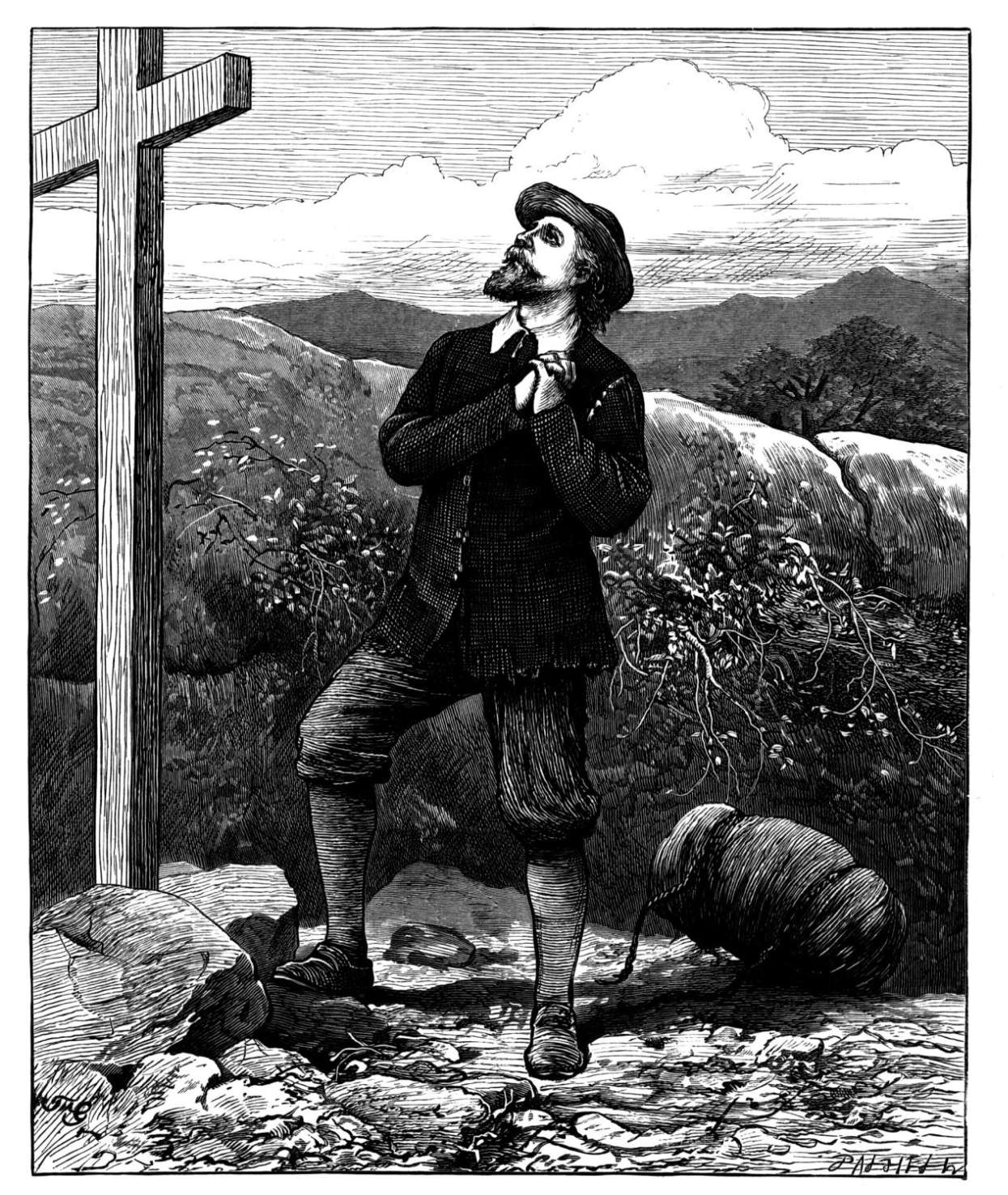 In John Bunyan's classic
The Pilgrim's Progress
Christian stops at the House of the Interpreter for counsel and direction regarding
his journey (The Pilgrim's Progress. Holt, Rinehart and Winston, 1933. p. 29). Christian and Faithful
walk together as "companions" (p.69). Christian learns the hard way
about the importance of discernment. Once he has traveled further along the
pilgrimage he discovers the danger of being gullible and following anyone (p.138).
The powerful spiritual direction question is asked by Christian to Hopeful;
"How stands it between God and your soul now" (p.149)? Christiana,
his wife, made use of Christian's previous pilgrimage as a means of encouragement
and direction for her own journey (p.225).
In John Bunyan's classic
The Pilgrim's Progress
Christian stops at the House of the Interpreter for counsel and direction regarding
his journey (The Pilgrim's Progress. Holt, Rinehart and Winston, 1933. p. 29). Christian and Faithful
walk together as "companions" (p.69). Christian learns the hard way
about the importance of discernment. Once he has traveled further along the
pilgrimage he discovers the danger of being gullible and following anyone (p.138).
The powerful spiritual direction question is asked by Christian to Hopeful;
"How stands it between God and your soul now" (p.149)? Christiana,
his wife, made use of Christian's previous pilgrimage as a means of encouragement
and direction for her own journey (p.225).
Private conferences was the name most often given to the
Reformed practice of spiritual direction. Isaac Watts urges his readers to "engage
in holy conferences and divine discourse" (Watts, Works, vol. IV, p. 147). Further, it is clear from his writing that
this was to be practiced by the laity and not just the clergy. It was not uncommon
to find women serving as spiritual guides. Susan Watkins Hunt, the second wife
of Moses Hoge, provided spiritual guidance to the well-known future Princeton
theologian Archibald Alexander before his conversion. The Directory
for Family Worship of the Westminster Assembly
(1647) includes an interesting reminder for those requiring spiritual comfort
and companionship; "And, because it is not given to every one to speak
a word in season to a wearied or distressed conscience, it is expedient, that
a person (in that case,) finding no ease, after the use of all ordinary means,
private and publick, have their address to their own pastor, or some experienced
Christian: but if that person troubled in conscience be of that condition, or
of the sex, that discretion, modesty, or fear of scandal, requireth a godly,
grave, and secret friend to be present with them in their said address, it is
expedient that such a friend be present" (chapter XIII).
Richard Rogers (1551-1618) makes this entry in his journal
on November 30, 1587 about his attending to the spiritual life of his community;
"After our meetinge according to our custome this 30 of November I had
a veary sweet conference with mr. L. of the practize of godliness, of the necessary
frute and comfort of it, of the way to bring it foorth" (Two
Elizabethan Puritan Diaries by Richard Rogers and Samuel Ward. edited and introduced by M.M. Knappen. Chicago: The American
Society of Church History, 1933, p. 68). This sort of language is frequently
repeated throughout his diary.
Themes covered in private conferences included assisting
people in the process of conversion, preparation for public profession of faith
and church membership, dealing with doubt and sticky cases of conscience, preparing
for the Lord's Supper, and continuing the process of growing in grace or godliness.
Additionally, parents would employ similar methods to guide their children and
servants to faith in Jesus Christ and further growth in grace. The raw material
for these conferences often arose from family worship or events of daily life.
My practice is to leave souls…to
the free
leading of the grace of God
Gerhard Tersteegen (1697-1769) illustrates another example
of guidance. He was a German devotional and hymn writer and lay theologian who
originally earned his living as a ribbon weaver. As his popularity grew more
people were attracted to his preaching and soon opened a "Pilgrim's Hut"
where he offered spiritual guidance. His basic approach is captured in the following
lines; "And so my practice is to leave souls very much to the free leading
of the grace of God, and to direct them only to those things to which I notice
God wants to lead them, according to my reading of his will. I just watch God
and caution them when they might strike something harmful" (Jay C. Rochelle,
"Wherever You Are, Pray and Remain Collected in the Presence: An Introduction
to the Life and Thought of Gerhard Ter
steegen" The Covenant
Quarterly. vol.46 (Fall 1988): 34). Notice the
important spiritual guidance themes of listening to and depending upon the Holy
Spirit, grace, and the attitude of wonder and awareness.
Reformed people like other traditions used letter writing
as an important avenue for offering spiritual counsel. The Reformed examples
are legion but probably the richest examples are seen in Calvin, John Bradford,
Samuel Rutherford, John Knox, and Ann Griffiths. Bradford's letters were held
in such high esteem that they were often chained to a post along with the Bible
in many Puritan churches. They were frequently consulted to encourage a doubting
or struggling soul. Related was the use of diaries and spiritual autobiographies
which have been called the Puritan's spiritual director. People would often
write them to be shown to their pastors or others for comment and further direction
towards growing in Godliness.
—Tom Schwanda
The Book Corner
The Cloister Walk, by
Kathleen Norris, Riverhead Books (Putnam), 384 pages
Author Kathleen Norris once more invites us into her personal
life and journey in The Cloister Walk. If in writing Dakota, Norris mapped out the  landscape of cultural and spiritual life on the plains
of the Dakota’s, The Cloister Walk maps out the interior life and landscape
of life inside a Benedictine monastery.
landscape of cultural and spiritual life on the plains
of the Dakota’s, The Cloister Walk maps out the interior life and landscape
of life inside a Benedictine monastery.
Although raised a Christian, Norris essentially left the
church after high school, as is the road many choose once leaving home. Literature,
especially poetry, became the substitute for
religion in her life until she relocated to Lemmon, South
Dakota, to deal with family home following her grandmother’s death. She is still
there; and having been called back to the faith, is now a Presbyterian lay preacher
as well as a Benedictine oblate. In Dakota, and now in The Cloister Walk, we receive glimpses of her journey back to the faith and into
monasticism.
Being a Benedictine oblate and spending two nine month
terms with the Benedictines, provided Norris with life experience in the "Liturgy
of the Hours" as well as being part of a community larger than herself.
"Once I became an oblate, I found that I’d gained an enormous family. Benedictines
are everywhere, and like a good family, they keep interfering in what I like
to pretend is my own life."
It is a gift that the author is also a poet. Her knowledge
and use of language reveals life in the monastery with humor and insight. Being
the outsider provides the reader with a fresh view to many facets of the Roman
Catholic tradition. Encountering the Lectio provided a fresh hearing of the scriptures—the Psalms as poetry,
the book of Revelation as "metaphor head-on." Hearing the words of
John and the choir singing those words that God
(has) this against you, that you have abandoned
the love you had at first. Remember from what you have fallen…"
(2:4-5). These are the words of conversion; taking hold, they can change
a life. When I first heard them in the monks’ choir tears welled up
in me, unexpected and unwelcome. I remember how completely I had loved
God, and church as a child, and how easily I had drifted away as a young
adult… I realized suddenly that I’d been most fortunate in being given
another chance to encounter worship, in middle age, in a context that
restored to me the true religion of my childhood, which was song. For
me, participating in monastic Lectio has meant rediscovering a religion that consist not
so much of ideas or doctrines, but of song and breath. It’s encountering
scripture in such a way that they become as alive as the people around
me. As Emily Dickinson put it, words that "breath" (p.218).
Kathleen Norris is an author who is able to make Christianity
and monasticism as expressed in the Benedictine community "breathe."
The "Liturgy of the Hours comes alive as do saints from the past, feast
days of the calendar, sacraments, and the daily rites, rituals, tasks and duties
that we all encounter in life.
The Cloister Walk is
a rich and resourceful book for all that are engaged in seeking a "rule
of life" in their personal, family or communal life.
—Mary Huisman
The Reformed Spirituality Network is a group of leaders from the Reformed tradition
of the historic Christian faith who have been gathering since 1993. Our vision
is to support the Christian community in Reformed spirituality through networking,
educating and resourcing. We believe that Reformed spirituality helps people:
to respond to God's call to
grow in godliness,
to deepen their own union with
Christ, and
to be transformed by the Holy
Spirit.
Members and agencies of The Christian Reformed
Church in North America, The Presbyterian Church (USA), and the Reformed Church
in America have supported the Reformed Spirituality Network. For more
information, see our web site at
www.geocities.com/refspnet/index.html
Our mailing address is:
Tom Schwanda
6125 Capitan SE
Grand Rapids, MI 49546
[email protected]
You can receive printed copies of future issues of the
RSN Newsletter by requesting that your name be added to our mailing list. Please
e-mail your request to Sue Van Eerden at [email protected].
Return to RSN homepage