|
The Toy Box
Gotta love toys! And what better place to find them that the World Wide Web.
If we offer something, which interests you, we're jazzed. If you've discovered a website or topic that piques you interest, share it! ([email protected])
Previous issues of The Toybox are achived here.
Welcome to the toybox.

Born August 2, 1924
|
In the four decades of his writing career, James Baldwin made an extraordinarily prolific and wide-ranging contribution to American letters. He published six novels, a collection of short stories, two plays, a screenplay about the life of Malcolm X that later became one of the bases for the Spike Lee film, a volume of poems, two book-length dialogues (one with anthropologist Margaret Mead, the other with poet Nikki Giovanni), a short book (part autobiographically-based and part sociologically) about American movies, a long essay on a series of murders of young African-American children in Atlanta, Georgia, in the early 1980s, and five other volumes of essays and nonfiction. His early novels, especially the first two, excited substantial notice and critical acclaim, and they have continued to hold their reputations, but there is a strong body of opinion to the effect that it is in his nonfiction writings that his greatest and most enduring work is to be found.
Throughout his life, Baldwin met and in many cases befriended some of the most important artists and public figures of his age, including Malcolm X and Dr.
Martin Luther King, Jr. But he never let himself be blinded by celebrity, his own or anyone else's, and to the end his artistic and moral credo remained as he had expressed it in a book review as early as 1948: "The gulf between our
dream and the realities that we live with is something that we do not understand and do not wish to admit. It is almost as though we were asking that
others look at what we want and turn their eyes, as we do, away from what we are. I am not, as I hope is clear, speaking of civil liberties, social
 equality, etc., where, indeed, a strenuous battle is yet carried on; I am speaking, instead, of a particular shallowness of mind, an intellectual and spiritual laxness, a terror of individual responsibility and a corresponding terror of change. This rigid refusal to look at ourselves may well destroy us, particularly now, since if we cannot understand ourselves we will not be able to understand anything." equality, etc., where, indeed, a strenuous battle is yet carried on; I am speaking, instead, of a particular shallowness of mind, an intellectual and spiritual laxness, a terror of individual responsibility and a corresponding terror of change. This rigid refusal to look at ourselves may well destroy us, particularly now, since if we cannot understand ourselves we will not be able to understand anything."
In some of his later work, Baldwin, in the opinion of many, substituted rhetoric and propaganda for the subtlety and honesty of his earlier essays. Despite poor reviews, neglect, and a widespread assumption that his time had passed, he was a productive writer of fiction and especially nonfiction to the end of his life. When diagnosed with cancer of the esophagus in early 1987, he remained cheerful and active, hosting a Thanksgiving dinner for friends and family only days before his death on December 1 of that year.
The ruthless self-examination that precedes self-understanding had been a more painful process for Baldwin than for many others: as a black man in a racist society, as a homosexual in a homophobic society, as someone who despised his looks in a society that values personal appearance over achievement, he was tortured by issues of identity and acceptance throughout much of his life. But in his finest work he followed the truth, no matter where it led him, with as much consistency and integrity as any writer of his time.
All links will open in new windows
Biography and Bibliography
Works Online
Critisism and Articles
Photography: Character Studies, Photographing Real pPeople
Portrait Photographer Carl Van Vechten
When we were browsing information about James Baldwin, the first portrait that popped up was archived in the Library of Congress and was shot by Carl Van Vechten. He was a writer, as well as a photographer and may have been one of the most controversial figures associated with the Harlem Renaissance.
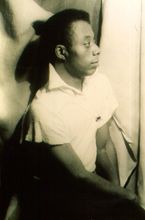
James Baldwin
Photograph by Carl Van Vechten
Portrait Photographer Richard Avedon
We are adding one more portrait photographer to this week toybox. His is another name, which surfaced during this project, because of his collaboration with James Baldwin on the book, NOTHING PERSONAL (1964),
His greatest achievement has been his stunning reinvention of the genre of photographic portraiture.

Roberto Lopez, oil field worker, Lyons, Texas
Photography by Richard_Avedon
|
