
Location: Rhodes, Greece
- Inscription on the Colossus
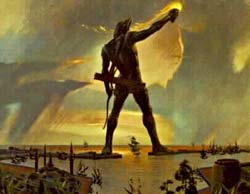
The construction of the Colossus took 12 years and was finished in 282 BC. For years, the statue stood at the harbor entrance, until a strong earthquake hit Rhodes about 226 BC. The city was badly damaged, and the Colossus was broken at its weakest point -- the knee. The Rhodians received an immediate offer from Ptolemy III Eurgetes of Egypt to cover all restoration costs for the toppled monument. However, an oracle was consulted and forbade the re-erection. Ptolemy's offer was declined. For almost a millennium, the statue lay broken in ruins. In AD 654, the Arabs invaded Rhodes. They disassembled the remains of the broken Colossus and sold them to a Jew from Syria. It is said that the fragments had to be transported to Syria on the backs of 900 camels.
Note: The picture may not be a accurate description. If the colossus had stradled the harbor, as seen in the picture, it would have completely shut down harbor traffic when it fell.
Location: Bahgdad, Iraq
- Diodorus Siculus
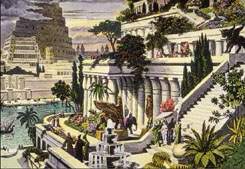
While the most descriptive accounts of the Gardens come from Greek historians such as Berossus and Diodorus Siculus, Babylonian records stay silent on the matter. Tablets from the time of Nebuchadnezzar do not have a single reference to the Hanging Gardens, although descriptions of his palace, the city of Babylon, and the walls are found. Even the historians who give detailed descriptions of the Hanging Gardens never saw them. Modern historians argue that when Alexander's soldiers reached the fertile land of Mesopotamia and saw Babylon, they were impressed. When they later returned to their rugged homeland, they had stories to tell about the amazing gardens and palm trees at Mesopotamia.. About the palace of Nebuchadnezzar.. About the Tower of Babel and the ziggurats. And it was the imagination of poets and ancient historians that blended all these elements together to produce one of the World Wonders.
It wasn't until the twentieth century that some of the mysteries surrounding the Hanging Gardens were revealed. Archaeologists are still struggling to gather enough evidence before reaching the final conclusions about the location of the Gardens, their irrigation system, and their true appearance. Some recent researchers even suggest that the Hanging Gardens were built by Senaherib, not by Nebuchadnezzar II (ca. 100 years earlier)
Location: Alexandria, Eqypt
- Inscription on the Lighthouse
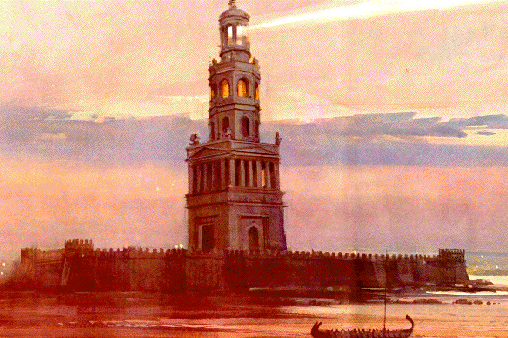
The project was conceived and initiated by Ptolemy Soter around 290 BC, but was completed after his death, during the reign of his son Ptolemy Philadelphus. Sostratus, a contemporary of Euclid, was the architect, but detailed calculations for the structure and its accessories were carried out at the Alexandria Library/Mouseion. The monument was dedicated to the Savior Gods: Ptolemy Soter (lit. savior) and his wife Berenice. For centuries, the Lighthouse of Alexandria (occasionally referred to as the Pharos Lighthouse) was used to mark the harbor, using fire at night and reflecting sun rays during the day. It was even shown on Roman coins, just as famous monuments are depicted on currency today.
When the Arabs conquered Egypt, they admired Alexandria and its wealth. The Lighthouse continues to be mentioned in their writings and travelers accounts. But the new rulers moved their capital to Cairo since they had no ties to the Mediterranean. When the mirror was brought down mistakenly, they did not restore it back into place. In AD 956, an earthquake shook Alexandria, and caused little damage to the Lighthouse. It was later in 1303 and in 1323 that two stronger earthquakes left a significant impression on the structure. When the famous Arab traveler Ibn Battuta visited Alexandria in 1349, he could not enter the ruinous monument or even climb to its doorway.
The final chapter in the history of the Lighthouse came in AD 1480 when the Egyptian Mamelouk Sultan, Qaitbay, decided to fortify Alexandria's defense. He built a medieval fort on the same spot where the Lighthouse once stood, using the fallen stone and marble.
Location: Southwest Turkey.
- King Maussollos
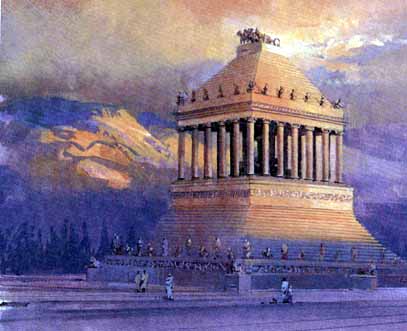
For 16 centuries, the Mausoleum remained in good condition until an earthquake caused some damage to the roof and colonnade. In the early fifteenth century, the Knights of St John of Malta invaded the region and built a massive crusader castle. When they decided to fortify it in 1494, they used the stones of the Mausoleum. By 1522, almost every block of the Mausoleum had been disassembled and used for construction.
Today, the massive castle still stands in Bodrum, and the polished stone and marble blocks of the Mausoleum can be spotted within the walls of the structure. Some of the sculptures survived and are today on display at the British Museum in London. These include fragment of statues and many slabs of the frieze showing the battle between the Greeks and the Amazons. At the site of the Mausoleum itself, only the foundation remains of the once magnificent Wonder.
Location: Greece.
- Pausanias the Greek
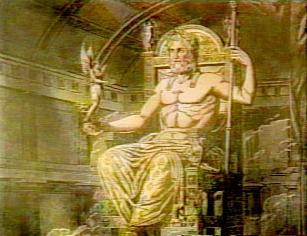
For the years that followed, the temple attracted visitors and worshippers from all over the world. In the second century BC repairs were skillfully made to the aging statue. In the first century AD, the Roman emperor Caligula attempted to transport the statue to Rome. However, his attempt failed when the scaffolding built by Caligula's workmen collapsed. After the Olympic games were banned in AD 391 by the emperor Theodosius I as Pagan practices, the temple of Zeus was ordered closed.
Olympia was further struck by earthquakes, landslides and floods, and the temple was damaged by fire in the fifth century AD. Earlier, the statue had been transported by wealthy Greeks to a palace in Constantinople. There, it survived until it was destroyed by a severe fire in AD 462. Today nothing remains at the site of the old temple except rocks and debris, the foundation of the buildings, and fallen columns.
Note: The Builer of statue was teased after completion, because when he buit the statue he failed to make the proper measurements. When the statue was erected, Zues's head almost touched the celing. It was said that if Zues were to stand up, he would unroof the temple.
Location: Izmir, Turkey
- Antipater of Sidon
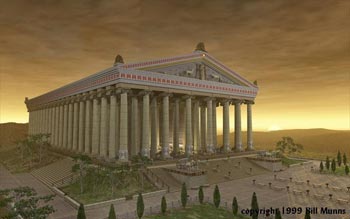
The temple served as both a marketplace and a religious institution. For years, the sanctuary was visited by merchants, tourists, artisans, and kings who paid homage to the goddess by sharing their profits with her. Recent archeological excavations at the site revealed gifts from pilgrims including statuettes of Artemis made of gold and ivory... earrings, bracelets, and necklaces... artifacts from as far as Persia and India.
On the night of 21 July 356 BC, a man named Herostratus burned the temple to ground in an attempt to immortalize his name. He did indeed. Strangely enough, Alexander the Great was born the same night. The historian Plutarch later wrote that the goddess was "too busy taking care of the birth of Alexander to send help to her threatened temple". Over the next two decades, the temple was restored and is labeled "temple E" by archeologists. And when Alexander the Great conquered Asia Minor, he helped rebuild the destroyed temple.
When St Paul visited Ephesus to preach Christianity in the first century AD, he was confronted by the Artemis' cult who had no plans to abandon their goddess. And when the temple was again destroyed by the Goths in AD 262, the Ephesians vowed to rebuild. By the fourth century AD, most Ephesians had converted to Christianity and the temple lost its religious glamor. The final chapter came when in AD 401 the Temple of Artemis was torn down by St John Chrysostom. Ephesus was later deserted, and only in the late nineteenth century has the site been excavated. The digging revealed the temple's foundation and the road to the now swampy site. Attempts were recently made to rebuilt the temple, but only a few columns have been re-erected.
Location: Cairo, Egypt
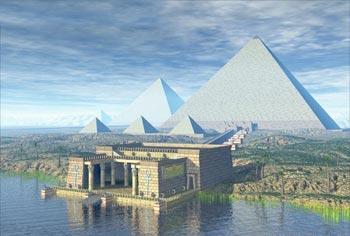
The great pyramid is believed to have been built over a 20 year period. The site was first prepared, and blocks of stone were transported and placed. An outer casing (which disappeared over the years) was then used to smooth the surface. Although it is not known how the blocks were put in place, several theories have been proposed. One theory involves the construction of a straight or spiral ramp that was raised as the construction proceeded. This ramp, coated with mud and water, eased the displacement of the blocks which were pushed (or pulled) into place. A second theory suggests that the blocks were placed using long levers with a short angled foot.
Throughout their history, the pyramids of Giza have stimulated human imagination. They were referred to as "The Granaries of Joseph" and "The Mountains of Pharaoh". When Napoleon invaded Egypt in 1798, his pride was expressed through his famous quote: "Soldats! Du haut de ces Pyramides, 40 si�cles nous contemplent". (Soldiers! From the top of these Pyramids, 40 centuries are looking at us)
Today, the Great Pyramid is enclosed, together with the other pyramids and the Sphinx, in the touristic region of the Giza Plateau. Also in the area is the museum housing the mysterious Sun Boat, only discovered in 1954 near the south side of the pyramid. The boat is believed to have been used to carry the body of Khufu in his last journey on earth before being buried inside the pyramid. It may also serve him as a means of transportation in his afterlife journey according to Ancient Egyptian beliefs.