Algebra II
Standard
|
| Skills (Note:
none listed for science standards)
|
Teacher
Strategy
|
Student
Tasks or Scientific Investigation/Experimentation
|
Assessment
or Scientific Application/Assessment
|
Resources
and Technology
|
|
The California Mathematics Content Standards -Grade8 9 10 11 12
Algebra II
Standard
6. Students add, subtract, multiply, and
divide complex numbers.
Skills (Note: none listed for science standards)
Teacher Strategy
Review old material by having students multiply monomials,monomials/binomials and two trinomials which are complex expressions.
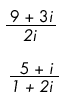
Explain rationalizing complex number expressions where the denominator might just be an imaginary number or a complex number.
Adding Complex Numbers
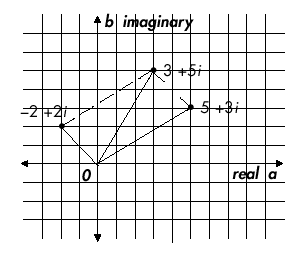
You can model the addition of complex numbers on a coordinate plane.The horizontal axis represents the real part a of the complex number and the vertical axis represents the coefficient b of the imaginary part.Use a coordinate plane to find (5 +3 i)+(–2 +2 i).
• Create a coordinate plane and label the axes appropriately.
• Graph 5 ++3i by drawing a segment from the origin to (5,3)on the coordinate plane.
• Graph –2 +2i by drawing a segment from the origin to (–2,2)on the coordinate plane.
• Draw a parallelogram that has the two segments you drew as sides.
• The diagonal of the parallelogram drawn from the origin represents the sum of the two complex numbers.The endpoint of the diagonal is (3,5),which represents 3 +5.So, (5 +3i)+(–2 +2i)=(3 +5i).
Student Tasks or Scientific Investigation/Experimentation
Determine whether the sum,difference,and product of complex numbers are real,imaginary or complex.
Model (–2 +3i)+(1 – 4i) on a coordinate plane.
Assessment or Scientific Application/Assessment
Have students multiply various binomials that incorporate i.Make them use rationalization of complex numbers.
(5 +2i)(5 – 2i) (a +bi)(a –bi)Simplify.
Resources and Technology
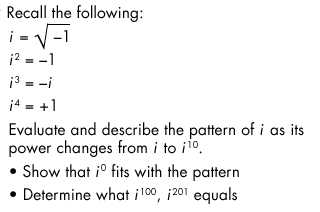
The Mathematics Teacher focuses on mathematics instruction in secondary schools, two-year colleges,and teacher education colleges.Highlights include practical ideas for more effective teaching and motivation of students,book reviews,technology tips,and research studies.Published monthly, September through May,and available as selected publication with $57 annual membership fee to National Council of Teachers of Mathematics (NCTM.)Additional publications are available.Contact (http://www.nctm.org/member.service/). Technology:Have students explore what i to various powers is using a calculator.
This page is taken from the Santa Clara Office of Education.