|
The Law of God
How did God proclaim His law of His people? "And the Lord speak unto you out of the midst of the fire; ye heard the voice of the worlds, but saw no similitude; only ye heard a voice. And he declared unto you his covenant, which he commanded you to perform, even ten commandments; and he wrote them upon two tables of stone." Deuteronomy 4:12, 13. (See also Nehemiah 9:13, 14. For the Ten Commandments see Exodus 20: 2 - 17.
NATURE OF GOD'S LAW What is the nature of God's law? "Wherefore the law is holy, and the commandments holy, and just, and good.: "For we know that the law is spiritual: but I am carnal, sold under sin." Romans 7:12, 14. Note.---In His comments on the sixth and seventh commandments (Matthew 5:21-28) Christ demonstrated the spiritual nature of the law, showing that it relates not merely to outward actins, but also to the thoughts and intents of the heart. (See Hebrew 4:12.) The tenth commandments forbids lust, or all unlawful desire. (Romans 7:7.) Obedience to this law, therefore, requires not merely an outward compliance but genuine heart service. This can be rendered only by a regenerated soul. "The law of the Lord is perfect, converting the soul." Psalm 19"7. "Is there such a thing as a perfect law? Everything that comes from God is perfect. The law of which we are thinking came from Him. It becomes sullied in our hands. e take from it and try to add to it, and in that way it becomes less than perfect. In a very real sense the law of God is the manifestation of the nature of the Lord. It could no more be imperfect than He is." The Augsburg Sunday School Teacher (Lutheran), August, 1937, Vol. 63, No. 8, p. 483, on the Sunday School lesson for August 15. How comprehensive are these commandments? "Fear God, and keep his commandments: for this is the whole duty of man." Ecclesiastes 12:13. Note.---"No human lawgiver could have given forth such a law as that which we find in the decalogue. It is a perfect law; for all human laws that are right are to be found in that brief compendium and epitome of all that is good and excellent toward God, or between man and man."---C. H. Spurgeon, Sermons, Series 2 (1857), p. 280. What is the essential principle of the low of God? "Love worketh no ill to his neighbor: therefore love is the fulfilling of the law." Romans 13: 10. What two commandments sum up the law of God? "Thou shalt love the Lord thy God with all thy heart, and with all thy soul, and with all they mind. This is the first and great commandment. And the second is like unto it. Thou shalt love thy neighbor as thyself. On these two commandments hang all the law and the prophets." Matthew 22: 37-40. Note.---If you love God with all your heart, you will keep the first table: if you love your neighbor as yourself, you will keep the second.
PURPOSE OF LAW
Why should we fear God and keep his commandments? "Fear God, and keep his commandments: for this is the whole duty of man. For God shall bring every work into judgment, with every secret thing, whether it be good, or whether it be evil.." Ecclesiastes 12:13. 14. What will be the standard in the judgment? "So speak ye, and so do, as they that shall be judged by the law f liberty." James 2:12. What is sin declared to be? "Whosever committeth sin transgresseth also the law: for sin is the transgression of the law." 1 John :4.
DISOBEDIENCE TO LAW
How many of the commandments is it necessary to break in order to be become a transgressor of the law? "For whosever shall keep the whole law, and yet offend in one point, he is guilty of all. For he that said, Do not commit adultery said also, Don not kill, Now if thou commit no adultery, yet if thou kill, thou art become a transgressor of the law." James 2:10, 11. Note.---"The ten commandments are not ten different laws; they are one law. If I am being held up in air by a chain with ten links and I break one of them, down I come, just as surely as if I break the whole ten. If I am forbidden to go out of the enclosure, it makes no difference at what point I break though."---D. L. Moody, Weighed and Wanting (1898 ed.), p. 119. "The ten words of Sinai were not ten separate commandments," said G. Campbell Morgan, "but ten sides separate commandments," G. Campbell Morgan, "but ten sides of the one law of God" --- The Ten Commandments (Revell, 1901 ed.) p.11 "As eh [a Methodist] loves God, so he keeps his commandments; not only some, or most of them, but all, form the least to the greatest. He is not content to keep the whole law, and offend in one point; but has, in all points, ' a conscience void of offence towards man' " -- John Wesley, "The Character of a Methodist," in Works, Vol. 8 (1830 ed.) p. 344. For what did Christ reprove the Pharisees? " 'Why do you , too, ' he retorted, 'transgress God's commandments for the sake of your tradition? God said, "Honor thy father and thy mother" (Exod. xx. 12); and "Let him who reviles father or mother be put to death" (Exod. xxi. 17); but you say; "If a man says to his father or mother, 'This is consecrated, otherwise you should have receive it from me,' he shall be absolved from honoring his father" ' and so you have rendered futile God's word for the sake of your tradition, ' Matthew 15: 3-6, Weymouth. Consequently, how did Christ value their worship? "But in vain they do worship me, teaching for doctrines the commandments of men." Verse 9, A. V. Can one know God and not keep His commandments? "He that saith, I know him, and keepeth not his commandments, is a liar, and the truth is not in him." 1 John 2:24.
NECESSITY OF OBEDIENCE
What was Christ's Christ's attitude toward God's will, or law? "Then said I, Lo, I come: in the volume of the book it is written of me, I delight to do they will, O my God: yea, thy law is within my heart." Psalm 40:7, 8. (See Hebrews 10:5, 7.) Who did He say would enter the kingdom of heaven? "Not every one that saith unto me, Lord, Lord, shall enter into the kingdom of heaven: but he that doeth the will of my Father which is in heaven." Matthew 7:21. How will men be rated in relation to God's commandments? "Whosoever therefore shall break one of these least commandments, and shall teach men so, he shall be called the least in the kingdom of heaven: but whoever shall do and teach them, the same shall be called great in the kingdom of heaven." Matthew 5:19. Note.---"The Ten commandments constitute a summary of the duties God requires of men. These commandments are the foundation which lies beneath the ethical life of humanity. They are as binding upon Christians today as they were upon the Hebrews who first received them." ---The Snowden Douglass Sunday School Lessons for 1946, p. 17. Copyright, 1945, by The Macmillan Company. Used by permission.
HOW CAN MAN OBEY?
Why is the carnal mind enmity against God? "The carnal mind is enmity against God: for it is not subject to the law of God, neither indeed can be." Romans 8:7. Can man of himself, unaided by Christ, keep the law? "I am the cine, ye are the branches: he that abideth in me, and I in him, the same bringeth forth much fruit: for without me ye can do nothing." John 15:5 . (See Romans 7:14-10.) What provision has been made by which we are enabled to keep God's law? "For what the law could not do, in that it was weak through the flesh, God sending his own Son in the likeness of sinful flesh, and for sin, condemned sin in the flesh; that the righteousness of the law might be fulfilled in us, who walk not after the flesh, but after the Spirit." Romans 9:3. 4. How does the renewed heart regard God's law? "For this is the love of God, that we keep his commandments: and his commandments are not grievous." 1 John 5:3.
BLESSINGS OF WILLING OBEDIENCE
What blessing attends those who keep God's commandments? "Moreover by them is they servant warned: and in keeping of them there is great reward." Psalm 19:11. What would obedience have ensured to ancient Israel? "O that thou hadst hearkened to my commandments! then had thy peace been as a river, and they righteousness as the waves of the sea." Isaiah 48:18.
What other blessing attends commandments keepings? "The fear of the Lord is the beginning of wisdom: a good understanding have all they that do his commandments." Psalm 111:10. What promise is made to the willing and obedient? "If ye be willing and obedient, ye shall eat the good of the land." Isaiah 1:19.
The law given at Sinai
How does Nehemiah describe the giving of the law at Sinai? "Thou camest down aslo upon mount Sinai, and spakest with them from heaven, and gavest them right judgments, and true laws, good statutes and commandments; and madest known unto them thy holy sabbath, and commandedts them precepts, stuatutes, and laws, by teh hand of Moses." Nehemiah 9:13, 14, What is the chief advantage possessed by the Jews? "What advantage them hath the Jew?... chiefly, because that unto them were committed the oracles of God." Romans 3:1,2. Note.---The law was not spoken at this time exclusively for the Hebrews. God honored them by making them the gurdians and keepers of His law, to be held by them as a sacred trust for the whole world. The precepts of the Decalogue are adapted to all manking, and they were given for the instruction and government of all. "We have already seen that, unlike the ceremonials and civil codes which were given to Israel as the chosen people and holy nation, the moral law is intended for all making, and it has never been abrogated nor repealed."--- William c. Procter, Moody Bible Institute Monthly (copyrighted). December 1933, p. 160. Used by permission.
|
||
|
|
THE MORAL LAW BEFORE SINAI
Before receiving the law at Sinai, how did Moses judge? "When they have a matter, they come unto me; and I judge between one and another, and I do make them know the statutes of God, and his laws." Exodus 18:16. In the wilderness, before Israel reached Sinai, how did Moses explain the absence of manna on the seventh day? "He said unto them, This is that which the Lord hat said, To morrow is the rest of the holy sabbath unto the Lord....Six days ye shall gather it; but on the seventh day, which is the sabbath, in it there shall be none." Exodus 16:23-36. When some went out to gather manna on the seventh day, what did her the Lord say to Moses? "And the Lord said unto Moses, How long refuse ye to keep my commandments and my laws?" Verse 29. Note.---It is evident therefore that the Sabbath and the law of God existed before the law was given at Sinai. What further evidence have we that the moral law existed prior to its proclamation at Mount Sinai? "By one man's disobedience many were made sinners." Romans 5:19. "Whosoever committeth sin transgresseth also the law; for sine is the transgression of the law." 1 John 3:4.
|
|
|
Note.---The one man through whom sin entered into this world was Adam. Since sin is the transgression of the law, it follows that the law existed in Eden, else there would have been no transgression, no sine. "26. How had God revealed this law? "In the creation He wrote it in men's hearts, and hence it is called the law of nature. Rom. 2:15. "27. Has not God revealed the Law in any other Way? "Yes, He gave it on Mount Sinai, written on two tables of stone."--- Epitome of Pontoppidan's Explanation of Martin Luther's Small Catechism. translated from the Norwegian by Edmund Belfour (1935), p.7.
TEN COMMANDMENTS AT SINAI
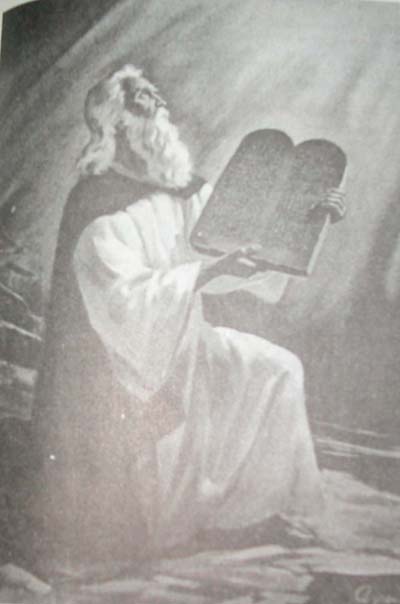
How was the Commandment law first given at Sinai? "God spake all these words, saying... Thou shalt have no other gods before me." Exodus 20:1-3. How did God present the law to Israel in permanent form? "He gave unto Moses, when he had made an end of communing with him upon mount Sinai two tables of testimony, tables of stone, written with the finger of God." Exodus 31:18. Note.---The law of God, as well as the knowledge for creation, the plan of redemption, and the experiences of the early patriarchs, had been handed down from father to son until this time, but not in written form. He wrote the Tin Commandments upon two tables of stone with His won finger. How did Moses show that the children of Israel had broken their covenant with God? "It came to pass, as soon as he came nigh unto the camp, that he saw the [golden] calf, and the dancing: and Moses' anger waxed hot, and he cast the tables out of his hands, and brake them beneath the mount." Exodus 32:19. With what exactness did the Lord write the law again? "He wrote on the tables, according to the first writing, the ten commandments, which the Lord spake unto you in the mount out of hte midst of the fire in the day of the assembly; and the Lord gave them unto me. Deuteronomy 10:4. Where did Moses place these two tables of stone? "I... put the tables in the ark which I had made; and there they be, as the Lord commanded me." Verse 5. What other law was given at this time? "When Moses had made an end of writing the words of this law in a book, until they were finished" Deuteronomy 31:24. Note.----Besides the Ten Commandments law, the Lord gave to Moses instruction concerning the sanctuary service, which was ceremonial, and certain civil laws regulating the subjects of the nation. These laws were written by Moses in a book, and are called the law of Moses, whereas the other law was written on tables of stone with the finger of God.
OBEDIENCE TO LAW
Why did the Lord take His people out of Egypt? "He brought forth his people with joy, and his chosen with gladness:...that they might observe his statutes, and keep his laws." Psalm 105: 43-45. How were they to teach the law to their children? "Thou shalt teach them diligently unto thy children, and shalt talk of them when thou sittest in thin house, and when thou walkest by the way, and when thou liest down, and when thou risest up." What promise to Israel hinged on keeping the instructions He gave them? "Now therefore, if ye will obey my voice indeed, and keep my covenant, they ye shall be a peculiar treasure unto me above all people: for all the earth is mine: and ye shall be unto me a kingdom of priests, and an holy nation." Exodus 19:5,6, Was this promise made to the Jews alone? "Now the Lord had said unto Abram, Get thee out of the country, and from the kindred, and from thy father's house, unto a land that I will shew thee: and I will make of thee a great nation, and I will bless thee, and make thy name great; and thou shalt be a blessing; and I will bless them that bless thee, and curse him that cursedth thee: and in thee shall all families of the earth be blessed." Genesis 12:1-3. " If ye be Christ's, then are ye Abraham's seed, and heirs according to the promise." Galatians 3:29. Note.---From these texts it will be readily seen the God not one provision of grace and none law for the Jew and another means of salvation and another law for the Gentile; but the plan was that through Abraham's seed all the families of the earth should be recipients for divine grace and should receive the blessing through obedience.
THE CHRISTIAN AND THE LAW
What shows that the Ten Commandment law, given at Sinai, is the law for the Christian? "Whosoever shall keep the, whole law, and yet offend in one point, he is guilty of all. For he that said, Do not commit adultery said also, Do not kill. Now if thou commit no adultery, ye if thou kill, thou are became a transgressor of the law. So speak ye, and so do, as they that shall be judged by the law of liberty." James 2: 10-12. Note.---James, years after the Christian era began, emphasizes the obligation of the Christian to keep the law of Ten Commandments, not merely one precept, but all, and sets forth this law as the standard by which man will be judged in the great day of God. To us, as Christians, God has committed the blessed law in writings, as He did to ancient Israel. This law points out sin to us, that we may confess it and find forgiveness. And when this law is written in our hearts in the new covenant experience. (Hebrews 8:10), it also becomes to us the law of life.
PENALTY FOR TRANSGRESSION
What is the wages of sin? "The wages of sin is death." Romans 6:23. "In the day that thou eatest therefore thou shalt surely die." Genesis 2:17. "The soul that sinneth, it shall die." Ezekiel 18:4. How did death enter the world? "Wherefore, as by one man sin entered into the world, and death by sin; and so death passed upon all men, for that all have sinned " Romans 5:12.
PROBLEM OF WILLFUL SIN
God is merciful, but does this clear the guilty? "The Lord is longsuffering, and of great mercy, forgiving iniquity and transgression, and by no means clearing the guilty." Numbers 14:18. (See Exodus 34: 5-7. "If we sin willfully after that we have received the knowledge of trough, there remaineth no more sarifice for sins, but a certain fearful looking for of judgment and fiery indignation, which shall devour the adversaries, He that despise Moses' law died without mercy under two or three witnesses. of how much sorer punishment, suppose ye, shall he be thought worthy, who hath trodden under foot the Son of God, and hath counted the blood of the covenant, wherewith he was sanctified, and unholy thing, and hath done despite unto the Spirit of grace?" Hebrew 10: 26-29. To whom is execution of judgment given? "Vengeance is mine; I will repay, saith the Lord," Romans 12:19. "The Father hath... given to the Son... authority to execute judgment also." John 5: 26, 27. (See Jude 14, 15.) What presumptuous course do many pursue? "Because sentence against an evil work is not executed speedily, therefore the heat of the sons of men is fully set in them to do evil." Ecclesiastes 8:11. What message has God sent by His ministers? "Say ye to the righteous, that it shall be well with him: for they shall eat the fruit of their doings. Woe unto the wicked! it shall be ill with him: for the reward of his hands shall be given him." Isaiah 3:10, 11. "We are ambassadors of Christ, as though God did beseech you by us." 2 Corinthians 5:20. ( See 2 Timothy 2: 24-26.) How can man escape the penalty of sin? "The wages of sin is death; but the gift of God is eternal life though Jesus Christ our Lord." Romans 6:23. Note.---"God threatens to punish all who transgress theses Commandments. But he promises grace and every blessing to all who keep them: we should, therefore, love and trust in him, and gladly obey his Commandments." Luther's Small Catechism, in Philip Scahaff, The Creeds of Christendom (Harper), Vol. 3. p. 77. "Through the atonement of Christ more honor is done to the law, and consequently the law is more established, than if the law had been literally executed, and all mankind had been condemned." ---Jonathan Edwards (Congregationalist), Works (1842 ed.), Vol. 2., p. 369. |
||
|
|
||