Discussion
document for individual country project proposal
(last
modified April 6, 2007)
RED EDUCATIVA
LATINOAMERICANA (EUROPA)
LATIN AMERICAN
EDUCATION NETWORK (EUROPE)
PERU / LATIN AMERICA
See also
Bolivian Education Network (Europe) www.geocities.com/rededucativa
Resumen - Red Educativa Latinoamericana (RELA) Europa
Summary - Latin American Education Network (RELA) Europe
5. Bolivian and Peruvian Networks. 5
7. Where the learning materials should be useable?
10. Family Groups or study groups with members in different countries
11. Basis for cost effective “open university”
13. Consultative council of the network
14. Role of embasies, consulates and cultural centres
15. Role of European schools in relation to this network
16. Language Circles. Languages of Latin America and Europe
18. Online access to study materials
23. Not a distance education network
25. Linking with Departmental and Provincial associations.
26. Trans-university network and exchange scheme.
27. Proposed Inter-Library Project.
28. Administration of Mentor Groups
30. Formation of group in Latin America / La Paz
32. Databases of Latin Americanist output.
34. Note: the infrastructure is for all to use
36. Current practicalities: Model 2
38. International infrastructure open to all
Philosophies behind the project, theory and concepts
39. Remigration cultural archipelago model
40. Multiculturalism and a multiple heritage society. Multiple identities. 14
41. Public libraries and infrastructures provided as a public good
43. Global capital, global labour, global knowledge
44. Urbanisation and the abandonment of the countryside
45. Extra education compatible with societal model
46. Self-esteem and knowledge, pre-travel courses
48. Annexe A. Ciberayni: joint production of materials
49. Annexe B. Peruvian comment on the exodus
50. Annexe C. Collections – Links to websites
51. Annexe D. Study scheme - Peru to the 1960´s
52. Annexe F. Historical origins of the project
53. Annexe G. Funding proposal
Further information and contact
Resumen - Red Educativa Latinoamericana (RELA) Europa
See below for summary in English
- El objetivo de la Red Educativa Latinoamericana (RELA-Europa) es ampliar las oportunidades educacionales de los latinoamericanos y sus familias en Europa. Los materiales de educación serían también para beneficio de los sistemas educativos latinoamericanos y serviría para el uso de europeos en América Latina y otros quienes estuvieren interesados, o tengan interés en América Latina: organizaciones voluntarias, latinoamericanistas, diplomáticos, gente de negocios, turistas, estudiantes y otros.
- La literatura, el cine, la música, la poesía, las visitas virtuales a sitios históricos, la televisión, la radio, la cátedras universitarias serían divulgadas vía RELA de una forma moderna (mp3, mp4, etc.).
- Los materiales serian preparados en América Latina, Europa y/o por latinoamericanistas en otras áreas, y podrían ser desarrollados y distribuidos de forma que fuesen usadas, por ejemplo, en el hogar, en asociaciones culturales, centros comunales, colegios, universidades (en casos donde, de momento, no existan estudios latinoamericanos), embajadas, consulados, lugares de trabajo, por individuos durante por ejemplo durante largos viajes en transporte público, y por otros grupos.
- Padres de familia y asociaciones de latinoamericanos en Europa jugarían un rol importante en el esquema RELA, como también la red de mentores voluntarios y/o tutores pagados.
- Bibliotecas nacionales y museos en la propuesta podrían actuar como fuentes principales de los recursos o como "backup" (respaldo) a los servidores de la red.
- Especiales redes de idiomas reforzarían los lenguajes tradicionales. (Redes en Europa entre por ejemplo Aymará-hablantes, Quechua-hablantes y lenguas habladas en el trópico (oriente) del país).
- Los grupos de aprendizaje del RELA tendrían entre sí miembros en el campo y en las ciudades de América Latina tanto como en Europa, lo que les permitiría un beneficio mutuo.
- Las asociaciones departamentales y provinciales en América Latina tendrían un distinto rol en el campo educativo. Universidades locales latinoamericanas podrían ofrecer cursos o cátedras en Europa a un costo razonable.
- En resumen, RELA no es un sistema de educación a larga distancia, más bien, es un sistema de acceso a materiales de aprendizaje en varios formas (media) a través de tutores locales.
For further
details, see the project proposal document on the following pages or click www.geocities.com/rededucativa
Summary
- Latin American Education Network (RELLAA) Europe
For Spanish see above
- The objective of the Latin
American Education Network (RELA-Europe) is to increase educational
opportunities for Latin Americans
and their families in Europe. The education materials will also be
of benefit to systems of education in Latin America and be of use to
Europeans in Latin America and others
who are interested, or have interests, in Latin America: voluntary
organisations, Latin Americanists, diplomats, business people, tourists,
students and so on.
- Film, narrative, music, poetry,
webcam visits to historic sites, TV and radio, university lectures would
be downloadable via RELA in
contemporary formats (mp3, mp4, etc).
- The materials are to be
prepared in Latin America, Europe and/or by Latin Americanists in other
areas, and should be so developed and distributed that they are useable in, for example: the home; cultural
associations; community centres; school and college (extra-curriculum);
embassies and consulates; university (in cases where currently there are
no Latin American studies); workplace; other groups or environments and by
individuals in otherwise “unused” time: e.g. on public transport.
- Parents
and cultural associations in Europe would play a vital role in the RELA scheme, as would a network of voluntary mentors
and/or paid tutors.
- National libraries and museums,
in the proposal, would act as a
principal source of media and as backup to the networks servers.
- Special language networks in Europe will reinforce Latin America’s
traditional languages: Aymara,
Quechua and the languages spoken in the eastern part of the country.
- “Family
and friends” learning groups will link RELA members in the countryside and cities of Latin
America with those who are currently living throughout Europe.
- There will be new educational
role for departmental and
provincial associations, who would
act as intermediaries and benefit from new low-cost learning
centres. Local universities in Latin America will be able to offer their
courses in Europe on a cost-effective basis.
- RELA is not distance education but distance access to learning materials in various media with local
mentoring (tutoring), plus a dynamic system for feeding back into the
network quality materials developed by study groups. In a nutshell RELA
will offer (a) connections
to collections and provide
(b) a system for organising
tutoring or mentoring (extra-curricular education).
For further
details, see the project proposal document on the following pages or click www.geocities.com/rededucativa.
The
basics of the network
1. For whom?
1)
The network will bring
together Latin American and European entities concerned with increasing
educational opportunity for Latin
Americans in Europe. Representatives
of these entities (institutions, associations, individuals, etc.) would form
the consultative council of the network.
2)
Would also have
beneficial feedback for Latin American education systems.
3)
Europeans in Latin America
and others interested
in Latin America (see 4), would also benefit.
2. Collections.
The
network, which is the subject of this proposal, would archive and make
accessible - in cooperation with authors, producers, national libraries,
universities, radio, TV, film and others – “collections of media” which will be
of use to the further, mainly extra-curricular education of Latin Americans in
Europe and others (see 1).
3. Connections to collections
The
network´s main job is to connect students to the collections and provide good
“educational communication” between the learner and the collections.
4. Interest to others.
The
documents / media / materials will be of further use to others who are
interested, or have interests, in Latin America: voluntary organisations, Latin
Americanists, diplomats, business people, tourists, students and so on.
Education materials would be ‘repurposed’ for education systems in Latin
America.
5. Bolivian and Peruvian Networks.
The network
(RELA-Europe) is being developed in parallel with Bolivian and Peruvian
Education Networks (Europe). RELA will help to link together the individual
country networks as well as handling materials at the Latin American level. It
is hoped that a network of bi-lingual volunteers in Latin America and Europe
will enable the network to prepare materials for most of the various language
areas / countries of Europe. Why just Europe? Other regions would be welcome to
make use of the networks.
 6. What would be developed?
The initial
developments, as proposed, are in the areas of: authors’ recordings (sound
files (mp3)) with associated text (htm) accessible through webpages; an
introduction to Latin America and / through its cinema (using mp4 film clips /
DVD movies); mp4 slide shows; downloadable music, radio and TV programmes;
links to education material on other sites, and so on. The collections of materials
will be open. They can be added to by anyone with access to internet. The
donation of text, film and audio-files will be gratefully acknowledged and the
materials (usually in digitised form) will be protected by – it is proposed –
deposit in a back-up library, such as the National Libraries of relevant
countries.
7. Where the learning materials should be useable?
The
materials are to be prepared in Latin America, Europe and/or by Latin
Americanists in other areas, and should be so developed and distributed that
they are useable in for example:
(1)
The home
(2)
Cultural associations
(3)
Community centres
(4)
School and college
(extra-curriculum)
(5)
Embassies and
consulates
(6)
University (in cases
where currently there are no Latin American studies)
(7)
Workplace
(8)
Other groups or
environments and by individuals in otherwise “blank” time: e.g. on public
transport, in the car.
8. Study Groups and Circles.
The
network, which is the subject of this proposal, would encourage the formation
of study groups guided by paid tutors or volunteer mentors. The study groups
would be set up, in the first instance,
by Latin Americans and their families, consulates, and Latin American
cultural association in Europe and could be extended to include relatives and
friends in both rural (where ever there is email) and urban Latin America.
Networks of tutors, mentors, librarians, rapporteurs would be developed to
service the study groups or circles.
9. Getting started
Whilst the
network – on a voluntary free-labour basis – is getting the webpages up and running
it would be feasible to start up, in parallel, some trial study groups.
(1)
Make up a small group
(2)
Choose a mentor if a
paid tutor is not available. The mentor leads the academic discussion / or just
chivvies it along. There could be one mentor for each topic (or group of
topics) or one for the whole course. Mentors would be sent more detailed study
and guidance materials than other group members.
(3)
Choose the “librarian”
(the only member who definitely needs good internet / broadband access to
RELA). In small groups the mentor and the librarian can be the same person,
though it is envisaged that the best person to act as mentor does not
necessarily have good or convenient access to internet.
(4)
Send email addresses of
group members to RELA. Where a group member does not have an email address – or
does not / cannot use it regularly – materials will be sent to the librarian.
(5)
The group agrees a
learning schedule with RELA and effectively becomes part of RELA.
(6)
RELA will send each
member the study materials for the next week - or the period between topics
agreed in (5). Extra support material will be sent to the librarian and mentor.
The librarian will be archiving this and materials generated by the group;
helping to sort out glitches in the distribution of materials to members;
helping to expand the collections of study materials for RELA.
(7)
Queries and responses
to interactive material can generally / may be answered by additional material
supplied to mentors or may have to be forwarded to a more specialized advisor.
Where these queries are of general interest they will be circulated to other
groups for their discussion or will be sent to a topic-specialist for
consideration.
(8)
Mentors and librarians
share materials generated by groups with others over the RELA website. This
will be more difficult to implement but is of the essence for knowledge
sharing.
(9)
New, specialist and
extra contributions can be recorded in multimedia format (mp3 or mp4 files, for
example). Rapporteurs for each group can help the mentor and the librarian to
get these important materials onto the RELA database.
10.Family Groups or study groups with members in different countries
Although it
is envisaged that most study groups will form around a theme or topic based on
the use of particular collections, there is scope for the formation of
“extended family” study groups. [See the concept of the “remigration cultural
archipelago” in the theoretical annexe. See also topics international ayllu and clan].
Depending on the availability of internet in rural locations (and only the
mentor or “librarian” of the group needs access), it should shortly be possible
to establish tutor groups with members in different countries, e.g.
grandparents in a rural village, parents in La Paz / Santa Cruz, children in
Spain. Another potential use for the mentor/ tutor system is in the creation of
Bolivia-Peru study circles, i.e between Latin American countries. See also
Peruvian Education network.
11.Basis for cost effective “open university”
The
tutorial and mentor group system would be incorporated into the proposals for a
Latin American Open University, based on the revised plans for the Universidad
Andina Internacional submitted to CONAFU-Peru (initially) in 1996 and revised
in 2000. The infrastructure of RELA and other collaborating Latin American
education networks would be used to support the dissemination of courses from
Latin American universities.
12.Summary so far
The scheme
is not distance education but distance access to learning materials in various
media with local mentoring (tutoring), plus a dynamic system for feeding back
into the network quality materials developed by study groups. The learning
scheme is designed for: (1) Latin Americans and Latin Americanists in Europe;
(2) Others in Europe interested (or with interests) in Latin America; (3) May
also be of interest to many in Latin America and particularly to the extended
families in Latin America of Euro-Latin Americans. In general The Latin
American(ist) Education Network (RELA), the subject of this proposal, seeks to
facilitate (1) access to (and the production and distribution of) learning
materials for different learning environments (situations) and provide (2) a
system for organising tutoring or mentoring
(extra-curricular education)
Developing
the network
13.Consultative council of the network
It is
proposed that the consultative council of the network include representatives
from the users and providers – universities*, libraries, community
associations, consular services and other groups / institutions concerned with
the education / well-being of Latin Americans and Latin Americanists in Europe.
(*teachers of Latin American and Latin American studies and teachers of
European studies in Latin America). The Council would initially meet
“virtually” but provision would be made for meeting in a place, using a system
of delegates. Each language area would probably need a sub-council.
The council
can be called on to advise the executive of the network which at present
consists of a programmer, a producer, a coordinator and (provision for) the
chair of the network council
14.Role of embasies, consulates and cultural centres
Under
discussion.
15.Role of European schools in relation to this network
Under
discussion.
16.Language Circles. Languages of Latin America and Europe
The
objective of the network would be to develop European learning groups in all
European languages (where the availability of voluntary translators permits)
and in Latin American languages including Aymara, Quechua and the languages of
Eastern Latin America. This document (English) focuses on the needs of Latin
Americans in English-speaking areas of Europe: Ireland, Malta, UK and other
areas where documents may not be available in the national or regional language
or in Spanish.
17.Infrastructure
The network
focuses on providing infrastructure (mainly software and databases) for members
(Latin American(ist)s, students and others . . ) in order that they may
(1) contribute to “collections” of documents,
sound & film archives and other learning materials for study groups
throughout Europe.
(2) draw up “a la carte” study schemes in
particular fields of Latin American and Euro-Latin American studies. Note
1. (mainly for tutors and mentors).
(3) join lists of qualified and experienced
tutors.
(4) join lists of voluntary mentors or
group-leaders.
(5) manage and administer their courses and
groups
Note 1.
Latin American history, literature, cultural studies, European-Latin American
heritage studies, Latin American development, Latin American languages,
European-Latin American technological studies
18.Online access to study materials
As users of
Internet and Google are aware online access in many areas has improved in
recent years. At the same time access to many learned journals is barred to
those without JStor and Athens passwords. These are difficult to obtain if you
are not in a subscribing university. Many* Latin American universities do not
have subscriptions. Some/many books out-of-copyright (>75 years old) are now
digitised and relevant extracts or the whole book can be downloaded. Almost
all* in-print and in-copyright books (in English) can now be bought online (at
a price). Out-of-print and in-copyright books are still a problem but there is
a project for their monetisation (down-loadable at a price).
* Check the
facts – let the network know your experience.
Catalogues
of relevant websites are available. Of
particular note is the Latin American section of Latin American Network
Information Centre (LANIC): http://www1.lanic.utexas.edu/la/sa/bolivia/
LAOAP: Providing Access to Latin American Grey Literature - will prove an
increasingly important resource: http://lanic.utexas.edu/project/laoap/
Catalogues of links: LANIC, the Latin American Network
Information Centre
*general page| REDIAL (Latin American documents) | LAB
(European gateway/search) | Copac (research libraries catalogue) | other libraries | Telnet | IHEAL |
list of useful sites re Latin America (French) | ILAS (note: not all links take you to real
content. Try open access journals if the sources you require are
locked up in a library you do not have access to or is the other side of Europe.)
19.Open collections
RELA is the
first attempt – it is believed – to provide collections, not selected
anthologies for each topic. As the collections are open, one book may appear in
many collections. Many collections will be expanding. As the network does not
set out a prescribed cannon (required list) it will be up to the tutors,
mentors and students to select from the collection for each topic. So for the
guidance of tutors, in the collection database it will be desireable to include
links to critical reviews, associated webpages, and data on whether the
document is peer reviewed, its status (draft, published, etc), its academic
level, etc. The network cannot do this itself for all entries but will set up a
webpage for users to contribute the knowledge they have. Authors are encouraged
to contribute documents to collections. Documents will remain on the network
server and (once drafts have been corrected) will also be deposited in the
National Library and/or backup library for safe keeping.
20.Courses
RELA does
not do courses. RELA is there to help you (as mentors and students) design and set-up
your own course. RELA would supply a “reading list” topic by topic and indicate
whether a document is available online. Once you or your tutor / mentor have
indicated to RELA which topics and documents / sound files you would like to
study, the centre will send you the materials according to a schedule which,
again, you dictate. If you prefer to study as an individual student that is
also fine.
See Annexe D - Peruvian Education Network (PEN): Peru to
the 1960´s: Selection of writers and brief historical background.
Software
infrastructure
21.For consultation
This
document includes proposals for the development for an education network,
directed, in the first instance, towards the children of Latin Americans in Europe.
The network also may be of interest to many other groups, for example those
visiting Latin America for the first time. The proposals are divided into two
parts. The first deals with “infrastructure of the network” and the second part
deals with “use of the infrastructure”. For those not used to networks an
analogy for infrastructure might be a public highway, which then might be used
for delivery services, tourist trips, private motoring and so on.
Other
examples of the use to which the infrastructure of an education network might
be put – developed further in the second part - is an interuniversity programme
for staff and student exchanges and a tutoring – mentoring system for Latin
Americans / Latin Americanists in Europe making use of a multimedia “public
library” of education materials.
22.Wider context
The “Latin
Americanist” network is seen as part of a wider context: a Latin American
network and as facilitating regional, decentralised networks e.g. a RELAi
education network or a Pando education network. It is hoped that experience in
developing the Latin American network will be useful to those developing the
wider and also the more focused networks.
Latin American Education Network
LATIN AMERICAN EDUCATION NETWORK (EUROPE)
Peruvian
Education Network
RELAi Education Network
Pando
Education Network . . . . . .
23.Not a distance education network
The Latin Americanist
Education Network (RELA), the subject of this proposal, seeks to provide (1)
access to learning materials for different learning environments (situations)
and (2) a system for organising tutoring or mentoring. For example in See
section “Where the learning materials should be useable” The evidence is that –
except for some individuals – “distance education” is a poor alternative to
that of having a knowledgeable tutor relating well to a reasonably small group
of students. So an education scheme worth its salt must include a system for
“mentoring” or providing tutors. The broad infrastructure for the network is
considered first, followed by a sample “module”.
24.Infrastructure
(notes to
guide the construction of the RELA website)
Consultation
list and forum webpage.
[Webpages
for the management of various lists: the consultation list (this list); plenary
membership; membership and distribution lists for mentors and tutors; threaded
discussion sites and/or forum webpages; segments within the overall European
site with respect to each of the operating languages]
The
infrastructure we have at the moment is an Emailed consultation list. The list is presently on a yahoo
server. The development of this
(English language) document uses Ireland, UK and Malta categories. At the same
time it is hoped to provide French and Italian documents, with translations,
where necessary, into Spanish / English (the European common languages for the
purpose of the net). If you would like your institution to be added to the list
please do so via the consultation – forum webpage / pending implementation
write to the coordinator.
All Latin
American associations in “English language countries” of Europe are/ should be
included in this subnet (again please write in with details of “missing”
associations).
25.Linking with Departmental and Provincial associations.
[Interactive
webpages to link diaspora groups, the “root” districts and relevant provincial
associations. The concept views the migration from a particular zone of root
culture - towards a capital city and then internationally - as a process of formation of “archipiélagos culturales” ]
Subnet to
link local university courses in the provinces of Latin America to students in
Europe using the existing network of departmental, provincial and (even)
district. New legislation might be needed to upgrade the role of these
associations in the development of their root territories. RELA could
collaborate in this process. Technically webpages would facilitate direct links
between diaspora groups, the “root” districts and relevant provincial
associations.
26.Trans-university network and exchange scheme.
[Webpages
to facilitate exchanges and visits by students and academic staff; joint
research projects; consultation on curriculum development].
A trans- or
inter- university network is seen as the “academic backbone” of RELA. On the
“exchange webpages” universities in Latin America and Europe would list details
of courses open to overseas students together with costs, entrance and visa
requirements. The software would attempt to “mate” courses with student
demand. Faculty staff exchanges would
be facilitated by virtual faculties covering academic subject areas (fields) of
mutual interest. The project would develop faculty and then student cooperation
Latin America-Europe, particularly in the elaboration of anthologies for the
purposes of RELA.
27.Proposed Inter-Library Project.
The
operation of RELA would encourage the development of technical and academic
cooperation between the national libraries of Latin America and those of
European countries. An initial project is proposed to extend (1) mutual backup
in relevant areas, starting with those most directly relevant. For example in
the areas of Euro-Latin American / Latin America-European studies, relations
and development and studies of the diaspora. (2) secure inter-generational
archiving of digital materials, again in relevant areas. For example for the
collections which are essential to the RELA. (3) the concept of deposit
libraries for diasporic groups (what is the national deposit library for Latin
Americans in London?). The future concept of a national library with a ‘back
server’ holding digitized and archived copies of collections and a ‘front
server’ providing rapid internet access to the collections would restore one of
the principles of the public library movement. The scheme could be linked to a
‘public lending rights account’ which would reward authors whose works are
accessed and used.
28.Administration of Mentor Groups
If you have
experience of education software for the administration of courses and tutorial
groups which might be applicable to our types of courses and materials (for
example, the problem of disemination over a wide geographical area, in this
case Europe) please let the network know.
29.Ownership.
RELA
currently is a network not a legal association (persona juridica). It has no
property other than a domain name and website held effectively in trust for the
network. Academic materials generated, once published, are in the public domain
and deposited in an online public library (see #2 in proposed inter-library
project above). Most members of the consultative network of RELA are “persona
juridical”.
Other
points
30.Formation of group in Latin America / La Paz
A group
with Euro/Latin American representatives from each of the language areas in
Europe is being formed in La Paz, with the objective of advising on the
construction of the network and collaborating in the development of study
materials of use to Latin Americans and Euro/Latin Americans in each of the
countries of the European Union and Switzerland.
31.Same language networks.
The design
of the website and constituent pages should be such as to encourage the use,
where feasible, of the “lesser used” languages of Latin America and Europe.
RELA offers the real possibility of linking, for example, Aymara and Quechua,. . . . speakers throughout
Europe.
32.Databases of Latin Americanist output.
It should
be feasible now to build a joint database of the academic output of European
Latin Americanists, but on a country by country basis. For this and other
purposes we need an online database facility (input and output) fit for the
purpose.
33.Other key webpages.
Other
important web pages that we should be designing shortly would include those
for: membership access including all categories of “Latin Americanists”; mentor
administration for the organization of mentor/tutor groups; mobilizing
volunteer interpreters and visiting-specialists hosting; iterative
knowledge-relay administration to encourage cultural associations to contribute
to the provision of learning materials; a basic-knowledge base / reference
grid; a public “grid” for advanced knowledge materials and courses; a page for
access to language glossaries and other learning tools.
34.Note: the infrastructure is for all to use
The
infrastructure is for any individual or organization – for example, authors,
universities or cultural associations - to use as a platform for disseminating
their work or as a means for organising tutorial and/or mentor groups. Sample
module: See Annexe.
Although
RELA is a platform, archiving and mentoring organisation for others to use (in
order, for example, to develop content), it is envisaged that it could itself
elaborate certain foundation or “pre-requisite” courses (necessary to
understand the “more advanced” courses). The following is included so that we
have some course material to trial the “voluntary” mentoring system.
35.Long-term ideal: Model 1
The long-term
objective of the network is to provide extensive collections, accessible by
topic / subject / author etc. and available on line from secure servers. There
should also be some guidance as to the level of difficulty of the contents and
the degree of peer-reviewing, etc. Mentors and group members could then decide
their own syllabuses, reading, viewing and schedules.
Alternatively
perhaps there is some advantage in having a core number of topics (as in the
schedule below) which can be followed and discussed by mentor groups, wherever
– and effectively whenever – they are participating. Or the two methods or
models can be mixed.
36.Current practicalities: Model 2
Where
possible and after obtaining copyright permission, educational materials will
be distributed via internet.
Where
printed anthologies / collections are available most students prefer reading
from the printed page than from the screen, so we recommend that mentor groups
purchase the published book, even if online sources are available.
37.Proposed schedule
Proposed
schedule - for joint study across Europe (materials in Spanish and English +
national or regional language when available) - of a selection of Latin
American writers and a “sampling” of Latin American history from the first
urban civilisations.
The Latin
American Education Network (RELA) proposes to disseminate:
a)
Narrative - recordings
of Latin American authors reaading from their works; dissemination via mp3
audio files; archiving of associated text.
b)
Film – introduction to
the most acclaimed Latin American cinema; dissemination of clips via mp4 video
and *.avi files and feature films via local lending of DVDs.
c)
Music – distribution of
annotated music files from Latin American composers and performers via mp3
audio files.
38.International infrastructure open to all
The Latin
American Education Network is not designed as a new or separate association but
as “international infrastructure” (a public highway) open to all. The network
welcomes the closest possible cooperation and collaboration with other Latin
Americanist and Latin Americanist organisations (see, for example, proposals
for a Peruvian Education Network). Although prepared
for Latin America/Europe, it is thought that the infrastructure (the internet
webpages) and the content (the archives) will be of interest to many worldwide.
Philosophies behind the project, theory and concepts
39.Remigration cultural archipelago model
Latin
American remigration model – allows for possibility of retorno. With
thanks to the GZ multiple migration model. Add possibility of remigration – if
not of the person then of remesas and of knowledge.
40.Multiculturalism and a multiple heritage society. Multiple identities.
The
emergence of multiple heritage societies (as if they were not there all the
time) produces a new buzz phrase: multiple heritage education. The history of
the French is no longer just the history of France, but also of the various
populations which make up the French. Franco-bolivian history should now figure
in French history texts!
41.Public libraries and infrastructures provided as a public good
An old
chestnut from developmentalist theory. Lay down the road and development will
follow. It happened with the railways and the roads (Sometimes /usually?). Will
it happen with Internet. On line libraries and international learning and
research groups are the infrastructures of knowledge sharing.
42.Spiritual dimension
The search
for a spirtual equilibrium and that for knowledge frequently become
intertwined, especially as churches take over schools and universities. In Peru
previous catholic monopolies are being challenged by secular authorities and by
newer protestant churches.
43.Global capital, global labour, global knowledge
Some
theorists maintain that in a world system with fleet-footed capital, which is
world-fluid seeking the highest rent, labour and knowledge should be similarly
fluid. Any migration barriers are counter-productive. Knowledge locked-up in
local or national libraries (and static labour) is simply not fit-for-purpose,
not up to performance. Barriers to knowledge sharing and education attainment
such as racial or gender based glass-walls should be smashed away.
44.Urbanisation and the abandonment of the countryside
The problem
with the urban-rural surplus model (e.g A.Lewis) was that often the the surplus
was not invested locally – the Miami drain – and, secondly, the rural loss was
underestimated. An so it was with international migration which incurs a
cultural loss, particularly if there is a double langage shift (Quechua to
Spanish to English). See also archipiélago cultural..
45.Extra education compatible with societal model
(See second
internet version)
46.Self-esteem and knowledge, pre-travel courses
47.Progression through time
Patrimonialism,
Positivism, Marginality, Developmentalism (temporal), Mestizaje, Multicultural
A, Multicultural B, Multiheritage. Future-isms.
ANNEXES
48.Annexe A. Ciberayni: joint production of materials
Users of
the network (readers / viewers) are invited to contribute any of their works to
the network, to write new materials or help edit or upgrade existing pages.
Text and multimedia input on the following topics are particularly welcome at
this stage of the infrastructure’s development.
(1)
Introductory topics
(2)
Tailored introduction
for different profiles
a)
Latin American
students/ participants in Europe, the introduction would vary dependent on the
learning environment: the home, cultural associations, community centres,
school and college, university, workplace or other groups or environments.
b)
Members of Latin
America support organisations in Europe (not necessarily Latin American).
c)
Other groups on demand.
The network also invites contributions on the
following themes or topics (Please add any you feel should be included in the Introduction):
(1) Who and/or what are Latin
Americanists?
(2) Language, writing and communications
prior to 1532.
(3) Why the network favours original
works.
(4) Caveat Lector - evaluating online
materials.
(5) The beginnings of urban
civilisation?
(6) The first regional expansion?
(7) European-Latin American Heritage as
education for a multi-heritage society.
(8) The Languages of Latin America
(9) Micro-regional history and
development, linked to the Departmental and Provincial “virtual associations”.
49.Annexe B. Peruvian comment on the exodus
If no image presented, click on http://www.geocities.com/rededucativa/pen_archivos/image002.jpg
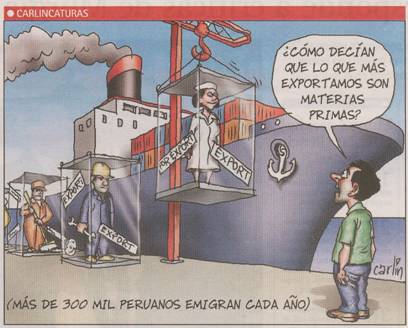
“How can they say that our main exports are
raw materials (minerals etc)? (More than 300 thousand Peruvians emigrate each
year)”. By the Peruvian cartoonist Carlin in La Republica newspaper. Lima. Saturday 13 January 2007. More valuable than
the “materias primas” are our “primas” and “primos” (cousins) who live outside
Peru. Opening up education opportunity in Europe for “our cousins” is one of
the main objectives of RELA (the Latin Americanist Education Network).
50.Annexe C. Collections – Links to websites
·
Asociación de Estudios Latin Americanos
·
Centro Latin Americano de Estudios
Multidisciplinarios
·
La Coca en la Historia de Latin America By Magdalena Cajias
de la Vega, Revista Latin Americana de Cultura
·
Historia de Latin America Solo Latin America
·
Lista de Institutos y Centros de
Investigación por Sistema Universitario Latin Americano Universidad Católica Latin Americana San Pablo Carrera de
Filosofía y Letras
51.Annexe
D. Study scheme - Peru to the 1960´s
See table
below.
52.Annexe F. Historical origins of the project
Not included
in this document but available during the April 2007 Santiago Conference of
Peruvianists
53.Annexe G. Funding proposal
Short term:
No external funding. Preparation using volunteer specialists.
Long term:
Under discussion with potential funding agencies.
|
Peruvian
Education Network (PEN) Europe
|
|||
|
Title
/ Topic |
Author |
|
Reference |
PERU
Introduction
to PEN and this schedule. |
Introductory
team. |
|
Emailed
(Tailored to student profile – see below) |
|
The
Huarochirí Manuscript |
Anonymous
|
|
PR
29 + Email |
|
Officials
and Messengers |
Guamán Poma de Ayala |
|
PR
75+ Email |
|
The
origins of the Incas |
Garcilaso de la Vega |
|
PR
49+ Email |
|
In
defense of the Indians |
Bartolomé de las Casas |
|
PR
107+ Email |
|
Friar
Martin´s Mice |
Ricardo Palma |
|
PR 142+ Email |
|
The
rebellion of Tupac Amaru |
Alberto Flores Galindo |
|
PR
147+ Email |
|
Priests,
Indians, Soldiers and Heroes |
Manuel González Prada |
|
PR
187+ Email |
|
Women
of Lima |
Flora Tristán |
|
PR 195+ Email |
|
Tempest
in the Andes |
Luis Valcárcel |
|
PR 219+ Email |
|
Reflections |
José Carlos Mariátegui |
|
PR
228+ Email |
|
Human
Poems |
César Vallejo |
|
PR 234+ Email |
|
The
Pongo´s Dream |
José María Arguedas |
|
PR
258+ Email |
|
Liberation
Theology |
Gustavo Gutiérrez |
|
PR 293+ Email |
|
Featherless
Vultures |
Julio
Ramón Ribeyro |
|
PR
281+ Email |
|
A
World for Julius |
Alfredo Bryce
Echenique |
|
PR
297+ Email |
|
Conversation
in the Cathedral |
Mario Vargas Llosa |
|
PR
487+ Email |
|
To
be inserted by mentor / group |
Additional
reference |
|
|
|
To
be inserted by mentor / group |
Additional
reference |
|
|
|
To
be inserted by mentor / group |
Additional
reference |
|
|
|
To
be inserted by mentor / group |
Additional
reference |
|
|
|
To
be inserted by mentor / group |
Additional
reference |
|
|
|
To
be inserted by mentor / group |
Additional
reference |
|
|
|
To
be inserted by mentor / group |
Additional
reference |
|
|
|
PR:
The Peru Reader. See Peru Education Network for details of this scheme |
|||
Further
information and contact
See www.geocities.com/rededucativa
http://www.geocities.com/rededucativa/coordinator.htm
__________________________________________________________________________

