http://robtshepherd.tripod.com/redding.html
Redding's oldest house of worship
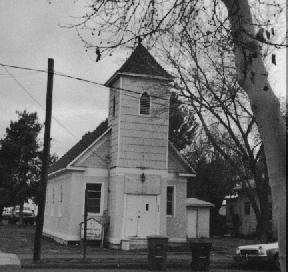
was this little Negro gospel church
History plays a trick
What a turn-around history has performed on the two cities of Shasta (now known as Old Shasta) and Redding (then known as Poverty Flats).
The first city in then-Shasta County, back when it stretched from the Pacific Ocean to the stateline touching the Nevada territory -- was the boom town of Shasta. This gold town actually sprung into existence while still under Mexican rule, and its premier official was the alcalde (Benjamin Shurtleff), an office the Spanish had inherited from their Moorish past.
Shasta was the product of gold fever, and the dominant men of that day and age, in their wisdom decided that for the sake of racial harmony, Shasta should be a wholly "white" town. Accordingly, non-whites were left to fend for themselves. And so, a settlement -- scarcely a camp or shanty-town at first -- began to form on the south bank at the curve of the Sacramento River, nicknamed "Poverty Flats." In the spring it was subject to flooding, which did not occur every year. The population was a motley crew of Indians, African-Americans, and a mushrooming contingent of Chinese.
Shasta was the launching point for prospectors setting out by mule train or on foot into the gold fields of the Trinity's to the west, the Siskiyou's and Cascades to the north. It's hustle and bustle were fueled by gold fever, and an excess of youthful males from the eastern states (and even over seas). Those who had come by wagon from Red Bluff, the terminus for river travel from San Francisco, found that wagons could not be taken further into the mountains. Shasta was as far as wagon travel took you.
It was not until the coming of the railroad in 1872 that "Poverty Flats" came into its own. Previously Shasta boomed as the Queen City of the north. By the 1870's the years of "gold mania" had by and large passed and Shasta was in decline. More than just a settlement, "Poverty Flats" was now going by the name of Reading (pronounced Redding).
With the C&O Railroad, suddenly the town was deserving of a name more becoming its newfound dignity. The young "Reading" was the new nexus for surrounding towns and villages, a hub for the growing logging industry.
Similarly, the multiracial population of the earliest (Poverty Flats) days began to fade (or whiten). The somewhat rigid segregationism was relieved, as history so often shows, by inevitable gaps. Simple economic self-interest demanded that the races cooperate, where cooperation was not only unavoidable, but in the mutual interests of all concerned.
Moreover there were always romantic liaisons. The early day predominance of males had the inevitable consequence that women made themselves available for short-term or longer term companionship. Many of these connections were inter-racial. The history of gold rush California abounds with the instances of relationships that would have raised eyebrows in more decent and "civilized" cities of the East.
Redding's coming of age would have to be associated with the advent of the California and Oregon Railroad, in 1872. It was then that the spelling first began to change from Reading to Redding (though the pronunciation remained the same). The earlier days of the Poverty Flats encampment gave way to an up-and-coming town, with all the modern (for the times) accoutrements. Obviously, the river town of Red Bluff had an elegance and affluence that the upstart Redding could only envy -- and laboriously strive to emulate. If the Sacramento River had "made" Red Bluff, it was the railroad that made Redding.
Historians grant to Chancey Carroll Bush (CC Bush) the accolade of Father of Redding. (Cf. Edward Petersen; Cf. John Lawson). The 1870s were a bustling decade. There was disagreement whether the spelling of the town would be Reading or Redding, but the older name (Poverty Flats) was disdained by all. In 1887 the voters decided to incorporate and the next year, 1888, the county seat was moved from Shasta to Redding. Incidentally, the town's newspaper, the Independent, was still referring to the town as "Reading" as late as 1880.
The first mining attraction (gold) -- so responsible for the prompt statehood of the former Mexican province of California -- gave way to other mineral boons. Redding's attraction was copper.
The smelting of copper was an involved operation, or series of operations, involving substantial investment before there was any hope of return. But the foothills were rich in the suflides (ore) from which the copper could be produced. The copper boom lasted for three decades, the 1890s to 1919 roughly.
Five mines and smelters flourished during part or all of those years. Keswick (Iron Mountain) was first in point of time. Coram (Balaklala) and Kennett (Mammoth Mine) produced the most in terms of output. Bully Hill was located on the Pit River. And fifth, the Ingot mine also went by the name of Afterthought.
Lumber and paper and forest products generally were also a source of livelihood right from the start. It was to Major Reading's business partner Samuel Hensley that credit belongs for the first timber cutting operation in northern California. Rafting the logs down Battle Creek, then down the Sacramento River, Hensley found himself a profitable niche in the development of early day California.
|
Shasta Historical Society
The Jedediah Smith Story The Chinese Role Gazelle School History Hayfork Valley (History) Weaverville Whitmore History Red Bluff History Cottonwood, bygone days |