|
The wake and funeral were several days later. I didn’t speak to Roger until then, for he didn’t come to school and I didn’t have the heart to call him. My parents and I went to wake and funeral, dressed in stiff dark clothing we hadn’t worn for ages that smelled faintly of mothballs. I felt much like my clothing, tired and sick and sad. I’d cried for days straight, and now I felt like a wrung out, red-eyed rag, and more weary than I could ever remember. Deep down, I didn’t want to go to the services, and I hated myself for it. I was scared to see Roger, poor, poor Roger, and I felt completely sick just imagining the pain he was in. But that was why I had to go. Howard O’Donnell had been my adored coach, and he was my best friend’s father. I owed it to a wonderful man to pay last respects, and I needed to be there for the best friend I loved. Not to mention for poor Mrs. O’Donnell. The services took place on the most miserable day imaginable, a day where the sky and air was gray, the wind was slow and mournful, and the sky spit tears every now and then, rolling in and out of composure much like the mourners. This was perhaps better than a cruel sunny day; the earth was in mourning with us. Mr. O’Donnell had been killed in a car accident as he was trying to drive home, or to the game—no one really wanted to say. He’d been struck by a drunk driver, some reckless stupid kid. Both cars had gone off the road, and both had been killed instantly. I could not fathom how much Roger was hurting. The funeral home was dim, with dark red velvet and smoking lamps glowing in the corners. There were several rooms, and there was another small wake going on at the same time. I followed my parents into a larger room, where rows of chairs were set up. The casket was off to the side, wreathed in flowers, and Roger, his mother, and his aunt and uncle stood abreast to the side of it. People mulled about, but not too many, for we had come early. I’d never been to a wake before, so I mimicked what my parents did, following them as they knelt by the coffin and prayed. I held my cross in my fingers and said a quick Our Father and Hail Mary, but I couldn’t concentrate. I stared at the casket, so large and dark, with shining stripes stretching down its polished sides. The accident had been so gruesome that there was nothing the morticians could do to make Mr. O’Donnell’s body presentable. The casket was closed. My parents moved down the line of family members, shaking hands and hugging and offering condolences. Mrs. O’Donnell’s entire face was red, and tears glistened on her cheeks as she embraced my mother, father, and I. I looked to Roger, ready to comfort him, and was shocked by his visage. Roger was staring, dry-eyed, off into space. His face was a sickly, pale shade of gray, and there were dark circles around his eyes. Mourners spoke to him, and he blinked and nodded slightly, scarcely acknowledging their presence and never once focusing his eyes, never once showing a tear. My parents touched him and told him they were sorry for his loss, but he didn’t see or hear them; he stared past them and nodded automatically, not making a sound. My heart was pounding when I approached him, and I felt as if there were glass shards stabbing deeper and deeper into it with each pulse. “I’m so sorry, Roger,” I whispered to him, my hand on his arm. “This must be so hard for you.” What a stupid thing to say, I chided myself. Of course it was hard for him! And how could I be sorry for something I didn’t do? But what else could I possibly say? What on earth could possibly make him feel better now? Nothing, I knew, for nothing would bring back his father. Or take back the last words he’d spoken to him. I stood in front of him for an extra moment, feeling my tears come back just seeing Roger’s miserable corpse standing there, as motionless as his father’s. He didn’t pay any more attention to me than he had anyone else—he just stared with unfocused eyes at absolutely nothing, with no acknowledgment whatsoever that he had even heard me. Feeling my composure slip away, I turned and started to move on. And then, suddenly, surprising everyone around us greatly, Roger’s hand shot out like a bullet and snatched my wrist in a tight grip. For the first time, his eyes focused, and he met mine—and they were so pained and sorrowful that I nearly screamed. “Roger!” I gasped, and I threw my arms around his shoulders. His body remained tense under my arms. One hand touched my waist, but he couldn’t find the strength to hug me back. When I pulled away, his eyes were dead and unseeing again. I bit my tongue and tore away, rejoining my parents with some other mourners in time to break into sobs on my mother’s shoulder. The wake lasted several hours. More and more people filtered in to pay their respects. Mr. O’Donnell had been a popular, well-liked man, and his grievers were all in a state of shock at his sudden death. The only dry eyes in the room were Roger’s. Our entire team came, including those who had been coached by him, and those who were there to support Roger. Mr. O’Donnell had coached many boys in his long soccer career, and it seemed that each and every one came. Most of Roger’s teachers, many classmates, and a good deal of Mr. and Mrs. O’Donnell’s coworkers and colleagues filtered through. Roger didn’t stay next to his mother the whole time, but disappeared from sight from time to time. I wondered how he could move around with all his senses dead to the world. The boys from my team clumped together in the corner, talking in low voices, and I joined them. They looked strange in neat clothes and stiff suits, being boys I usually saw in cleats and shorts. Pete had the grace to look solemn and upset. His eyes were red and glassy. He may not have cared much for Roger, but he’d loved Mr. O’Donnell as a coach. The group of us commented gravely about how many people were attending, how many we knew, and how good a coach and man Roger’s father had been. We stood by a sign someone had put together quickly, a collage of photographs that showed him in full coaching garb or fishing with his buddies—but mostly with his arms around a redheaded woman and a tall dark-haired boy. One photo showed Mr. O’Donnell holding a tiny, tousle-haired Roger in his arms who couldn’t be more than six years old. Roger was asleep in the picture, and Mr. O’Donnell was looking at him with a warm, protective love that glowed through the film paper. “I can’t believe he’s gone, just like that,” Pete remarked, gnawing on a joint of his finger. “I feel so bad for Roger and his mom,” McKellen agreed, a strange thing to come out of McKellen’s sharp mouth on a normal basis, but then, nothing about this situation was normal. The funeral took place right after the wake. The O’Donnells got into a black car, and all the mourners who were going to the funeral climbed in their own cars to follow in a procession to the church. I don’t remember much from the mass. The priest and the alter servers performed most of the usual acts around the alter. Roger did a short reading, and hearing such a steady, if heavy voice emanating from a corpse of a boy was unsettling. There was no question of him losing his composure, for it was apparent that any stumbling was due to dyslexia and strange Biblical mouthfuls. He was completely gone to the world, functioning mindlessly, and the church may as well have been empty, the mass for someone he didn’t know. His uncle went to the podium and read a eulogy he’d written about his brother that was so heartfelt and heartbreaking that the entire church bawled. Howard O’Donnell was a father, he said. He was a father, a brother, a son, a coach; he was a good man taken too soon from Earth. I clung to my father’s side, leaning against him and unable to bear the thought of losing him. As much as I feared and sometimes resented him, as much as I suffered trying to gain his pride and acceptance, he was my father, and I loved him more than life itself. How could a boy like Roger or me go on without his father? There was the typical funeral possession to the cemetery after everyone shuffled out of the church and into their cars. The cemetery wasn’t far, for Mr. O’Donnell was being buried in a local, small graveyard near Roger’s house. The rain had let up, but it made little difference regardless, for the air was so heavy and wet that it saturated everyone’s hair and clothing, and I kept trying to wipe my wet face with moist hands. I don’t remember much from the cemetery either, other than the wetness that made us all cry more. Mist floated around the casket and the preacher and the remaining O’Donnell’s, and tears ran freely down my face. The entire world seemed so wet and sad, I wasn’t sure if my eyes would ever be dry again.
Suddenly it was all over. The casket was gone from sight, any remains of Mr. O’Donnell were gone forever, buried under six feet of wet earth, and everyone got in their cars and went home. My father lit a fire in the woodstove, and after changing out of our clothes, we sat around it, staring into the crackling flames and silently musing on how fleeting life truly was. By now had it finally sunk in that Roger’s father was dead—never again would he give me a loud “Hallo, Arik!” or scold Roger and I for fooling around instead of studying. I would only see his wide grin and flyaway hair in my memory and in photographs and only hear his voice on the answering machine message. I thought of Roger and all the times they’d quarreled, all the times he’d called me up late in the evening needing to rant because of some injustice his father had dealt him. I thought of Roger embracing me on his front porch and sobbing, “He hates me!” The last time they’d spoken was that cell phone argument before the game. How could any of us have known it would be the last time? What would he have said if he knew if was the last time? How could someone be gone, so quickly, so suddenly, with no warning? I leaned affectionately against my father, not caring if I was too old to do so. Maybe my father would be gone, too, by the next morning. No one could say if he’d still be there the next time I looked for him. In the grand scheme of things, I would rather have my father know that I love him than that I obeyed the unwritten codes of manliness. I told him I loved him. He put his arm around me. “I love you, too,” he said, for the first time in a long time. We watched the fire snap and writhe, casting warm orange heat onto my wet cheeks. Eventually, I fell asleep on the couch and awoke alone several hours later when the phone rang by my head. I was shocked to hear Mrs. O’Donnell’s soft voice whisper over the receiver. “Hello, Arik? I-Is Roger there?” I blinked and rubbed my eyes, disoriented from sleep. “N-no, not that I know of—I haven’t seen him since the funeral.” Mrs. O’Donnell made a worried noise. “Arik, he-he went out several hours ago with his car and I haven’t seen him since. I-I was sure he’d be at your house… I don’t know where he went—he’s taking this so hard—I’m beginning to worry. I don’t know if I should call the police…” I rubbed my forehead. Roger was missing. Oh, hell. “Don’t worry, Mrs. O’Donnell, I’ll go look for him. I have a few ideas where he might be,” I said. Mrs. O’Donnell sighed, lightly relieved. “Oh, God bless you, Arik, God bless you. I really don’t know what he’d do without you.” “I’ll find him,” I replied, and we hung up. I told my parents the situation and left immediately on my bike. I’d lied—I had no idea where Roger could be. With his car and several hours head start, he could have gone anywhere. In his current state, where would he go? As I checked some country roads between our two houses, I brainstormed a list. The school, maybe? The beach? The church? Someone else’s house?—unlikely, though, for if he was to go to any friend’s house, he’d go to mine. Would he ever go to Marisa’s? Maybe, with the pain he was in now, he was just crazy enough to go to her. To bitch her out, maybe. Would he go…for ice cream? To New Hampshire, to his father’s spot? To a bar to drink? I could only go so far on my bike. I checked the beach and some places in the woods where we’d hung out from time to time or where we’d gone jogging. I rode to the school and surveyed all the fields where Mr. O’Donnell had stood on the sidelines for years, but to no avail. Pedaling as fast as I physically could through the misty fog, I checked several other spots. Darkness was falling already, and my search had been fruitless. What was more, it had begun drizzling again. Worried, I started home. And an idea came to me as I came to an intersection. I turned my bike down an unusual route and sped up. A tiny, sleek black car was parked outside the gate of the cemetery: an MGB roadster, looking humble and melancholy with its top snapped on. I parked my bike, took off my helmet, and pulled out the cell phone my parents had given me. I called Mrs. O’Donnell. “I found him,” I told her quietly, and she let all the breath in her body out in one long, relieved sigh. “He’s at the cemetery. I’ll talk to him. This may take a little while.” He was standing in the center of the cemetery in his sports jacket, hands in the pockets of his khakis, water dripping from his black hair, and his pale skin glowing in the darkness. He was staring with half-lidded eyes at the new dirt beneath which his father lay. He seemed to have been standing there for hours on end, a tall, dark, dripping statue over a new grave. What could I possibly say to him? I stood by the gate, at a complete and utter loss for words. I watched him as he stood motionless and silent, spellbound. Was he still as dead to the world as he’d been this morning? Still unseeing and unhearing, as if he had no consciousness at all? “I can’t believe the bastard’s dead,” came Roger’s voice, quite normal, the only solid thing past the iron fence I was leaning on, the only proof that a person was standing there, and not a specter. “How’d you know I was here?” I asked, for he hadn’t once turned his eyes to me. “You always are, aren’t you?” he replied cryptically. “You always are eventually.” I wasn’t sure how to take that comment. Slowly, quietly, I slipped through the gate and entered the cemetery. Wet grass and mud squished under my sneakers. “Why do they bury people, Arik?” he asked me, and he sounded so normal that it was more unsettling than before. He turned to face me for the first time, his arms gesturing to the soggy earth beneath him. “Wh-why would they lock you in a box and drop you in a hole and-and trap you down there? Why would they do that?” “I think it’s just a cultural thing,” I replied, not knowing. “A convention. It’s just the way it is.” “Why would anyone want that?” he asked me, his voice low. “Why would anyone want to spend eternity in a box in the ground? When I die, I want to be cremated until there’s nothing left of me—I don’t want to stay on this Goddamn earth any longer than I have to. I want to leave this awful place forever, not be tied down by so many tons of dirt and worms and shit! Why would they waste all this land just to trap people underneath it in wooden boxes? People could live here; it’s nice land, they could build a house. Why would they make dead people rot under it instead?” He laughed, a high, shuddering, wailing laugh, and something glinted in his eye, something like madness. “For God’s sake, Arik, what is this?” he asked me, throwing a hand to the ground and smiling widely while tears gathered in his crazed eyes. “They took my dad away and gave him a new home here. But why would they bother?” He looked to the ground, laughing and wailing at the same time, throwing his hands in the air in query. He howled, “Arik, why would they bother putting him here? Everyone says this is where he is now, but how can he be here? I can’t talk to him! I can’t touch him! I can’t tell him I love him or that I’m sorry! He’s fucking dead—he’s gone FOREVER! So what are graveyards for? “In a few days his headstone will be ready, and they’ll put it here, right in this spot! And that will be his new address, his new existence—the only thing left of him!” He turned to face me, tears rolling down his face, completely bawling now. “Arik, how is this my father?!” His balance faltered, and I ran to him, wrapping my arms around him, blinded and shaking with tears. He clung to me weakly. Frantically, he shrieked, “I want to dig him up!—I want to take him out of there and bring him back—but if I can’t, I want to burn him up so that he doesn’t have to stay there forever—I don’t want this place—this dirt—to be my father!” “Roger, shh,” I whispered desperately, “shh..” “I want him back! I want him back!” he raved, his entire body shaking violently. “Even if they take him away again, I just want to tell him I’m sorry first—I just want to tell him I’m sorry! I just want to see him one more time!” His legs gave out on him, and he hung against me, clinging desperately to me and gasping. My own legs buckled under the weight, and we sank to our knees, arms around each other, his head on my shoulder. All the emotion he didn’t show this morning flooded to his body now, and he exploded into wild, shuddering sobs. His body shook, and he wailed more violently than I could have thought humanly possible—he had to be crying blood, not tears! He wailed as if the world was ending, and perhaps for him, it was. He cried and cried, and my body began shaking, too—I looked up to the dark gray ceiling through my own tears and implored God, Please help him, please, God, don’t make him cry anymore, please just help him! 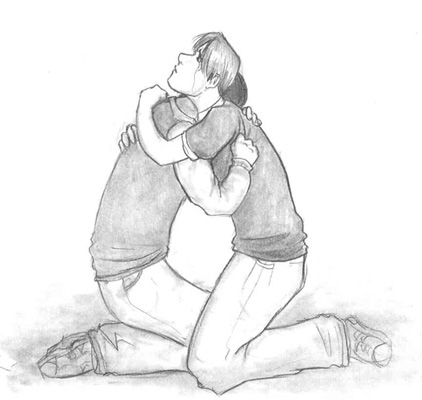 “I killed him, you know!” he wailed, his words barely audible through the sobs. “It’s my fault he’s dead! I killed him!” “Roger, what are you talking about?!” I gasped. “He’s dead because of me! I killed him and now he’s dead!” I wrenched away from him and held his shoulders at arm’s length, looking him in the face. “Roger, you didn’t kill him! You weren’t even there! You were with me, at the game, don’t you remember?” There was a hysterical, irrational fear in his eyes as he stared at me, shaking his head slowly. “I killed him,” he repeated. “It’s my fault. If it weren’t for me, he’d be alive!” “ROGER, NO!” I screamed. “YES!” he yelled back. “WE HAD A FIGHT AND I YELLED AT HIM AND HE DIED AND IT’S ALL MY FAULT! I TOLD HIM I HATED HIM AND HE DIED! NOW HE’S GONE FOREVER AND I CAN’T TELL HIM THAT I DIDN’T MEAN IT BECAUSE I CAN NEVER GET HIM BACK!” His nails dug into my sides, and I screamed. He pulled away from me and collapsed backwards. His face screwed up, and he rolled to his side and retched violently. His body shuddered, but there was little in his stomach—I don’t think he’d eaten more than a few bites since the game. I crawled over to him and rubbed his back. He spit repeatedly, trying to get the horrid taste from his mouth, and wiped his face with a handkerchief I gave him. He panted heavily, his back heaving up and down, his spine protruding through his wet shirt like a sharp ridge down his body. He blew his nose into the handkerchief and breathed deeply, trying to calm himself down. “Please help me, Arik,” he whispered, the insanity gone from his voice. “I’m so scared, and I don’t know what to do. I’ve never been so scared in my life. How can he be gone forever so suddenly? I never knew he wouldn’t be there when I got home, and I never got to say goodbye. If I’d known, I would never have said those things I did, never in a million years. But how can people just disappear like that? What if someday I wake up and you’re gone?” He looked me in the eyes, tears in his. He opened his mouth to continue, but couldn’t, unable to fathom a notion so painful to him, and he closed his eyes. I wanted to tell him that I’d never leave him, that I would never, ever make him cry, but I couldn’t. I’d learned the same lesson. Who was I to guarantee I would be alive to see tomorrow? What could I possibly tell him to comfort him that would be true, that I could guarantee, that I knew? “I love you,” I whispered. His eyelids flicked open, and he stared at me again. “…Really?” he asked, as if that was such an unbelievable concept. Tears came back to my eyes. “I love you with all my heart!” He smiled, and he said, “I love you, too.” He leaned against my shoulder, affectionate and clingy. He means it differently than I do, I thought, but he doesn’t know that and that’s not important right now. —And are there ever really different types of love? “Please don’t leave me, Arik,” he breathed. “If I ever lost you, I don’t think I’d be able to live anymore. Having you as my friend is the only reason I get out of bed anymore—I just feel like everything else is falling apart. You’re the only one who’s always there no matter what.” I put my nose into his hair, my arm around his shoulders, unable to reply. “I-I want you to do something for me… When you die, can you tell my dad that I’m sorry for what I said—for everything I ever said—and that I love him? Because I know you’re going to heaven, I know you are, and I know my dad did, too.” “Roger,” I whispered back, “you can tell him yourself you know—if you tell him, he’ll hear it! And you’ll see him when you die, too, you’re a good person!” He lifted off my shoulder and shook his head. “No,” he disagreed, “no, I can’t, I can’t. I-I’m never going to heaven—I-I-I don’t believe in God.” “W-what?” I gasped. “Y-you’re atheist?” He shook his head again. “N-no, I’m not anything. I don’t know… I believe that you have a God, and my mom does… but I don’t.” “I don’t understand,” I said. “Neither do I,” he confessed. “I just truly can’t believe that there’s some invisible deity that would want my-my soul, or whatever it is—I just don’t believe that I have anything like that. Everything about me is just chemicals and shit that doesn’t work right—there’s nothing to send to God or to hell. I don’t even know if I have a soul… “I think… I think when I die, I’ll just die. No soul to heaven or hell, I’ll just die.” “Roger, that’s not true!” I cried. “Why not?” he yelled back, pulling away from me. “And what’s wrong with that? I can’t think of anything better than just ending, just ceasing to exist in any form or consciousness. I hate this place so much, I think that a real heaven would be that we really do end when our bodies do. And don’t tell me that I can talk to my dad after he died—that’s bull—he’s dead. I can’t talk to someone who’s in heaven.” He paused for a long while, looking sadly at the muddy ground around him. “I still wish they wouldn’t lock them in boxes underground, though,” he said. |