
The Advanced Guard /Out-guard Camp.
"The safety of the army depends, in a great measure, upon the vigilance of the out-guards…."
-General Orders Quebec, July 5, 1759.
At some events the 55th regiment’s company of light infantry sets up as an advanced guard or out-guard camp. The two terms are synonymous. These camps were set up on the perimeter of larger encampments to provide for the security of the army. Period documents such as journals, orderly books, treatises, &c. give us an idea of how the camp was set up.
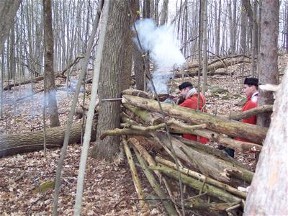
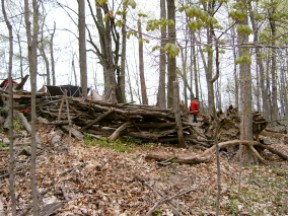
The out-guard camp is a fortified camp. "All our detachments and outposts, that are placed for the security of the camp, are to fortify themselves in the best manner they can, either by intrenching, planting palisadoes, or by cutting down trees, and making a breast-work of their trunks, with the branches thrown forwards. In this situation a small party will be able to defend itself until succour arrives, or, at least, will give time for the troops to get under arms."1 "All our advanced posts are ordered to intrench, to prevent a surprize…."2 General orders given on June 20, 1759 by General Jeffery Amherst; "Whatsoever post an Officer may be sent to take, the General expects he will first visit the ground round him, and post his centinels as he judges best, to make it impossible for the enemy to surprise him; centinels must not be out of sight, or hearing of the guard, or of each other; the Officer will throw up logs, or strengthen his post by the best means he can, so that the enemy shall not force it…."3 As John Bradstreet led an army to Detroit in 1764 to help quell the uprising of Native Americans, John Montressor noted in his journal that the encampments of the troops were "defended by Fleches & Redoubts.4 A simple fleche or a few connected fleches can easily serve the needs of an Out-Guard / Advanced Guard camp. A fleche " (pronounced flash) is a small "V"-shaped work constructed with the pointed end facing the enemy. These small, temporary works provided protection for the forward positions and outer pickets."5
Various manners in which the out-guard camp can be fortified:
The shelter at the Out-Guard camp, was minimal. Mostly we sleep under the stars. However, if materials are available we build makeshift shelters. Often times if bad weather is expected or if shade from the sun is needed we build these. Makeshift shelters or "brush hutts" can add to the appearance of the camp. We typically build lean-tos. "The out Guards to make Bark Shades for themselves."11 Though, not an out-guard detail, Anne Grant noted that a party of soldiers set out from Fort Ontario did not bring tents, but were expected to build wigwams.12 "During the gruelling Cherokee campaign of 1761, when only officers slept under canvas, Grant’s footsore soldiers proved adept at constructing "wigwams" for themselves."13 While, I have yet to find an example of soldiers using oilcloth for shelter, it was used quite frequently for provisions and goods that were being transported, a soldier may have gotten his hands upon the such article and possibly used it for protection. "The oil cloaths &c. be constantly employed in covering the provisions ashore and afloat and to be appropriated to no other purposes."14 "All oyl cloths belonging to the King in the Possession of the Regts to be deliver’d in immediately…."15 During the siege of Fort Niagara a similar order was recorded in a orderly book; Sir William Johnson is surprized that the others [sic. orders] relating delivering up the oil cloths to the King’s Commissary it [sic. is] being not complied with…." Another viable option is the use of a spare blanket, evidenced by the following excerpt from the Order Book of Captain Simon Ecuyer, of the 60th while he was defending Fort Pitt in 1763.
"Fort Pitt July 31 1763. G.O. Parole Aberdeen (leave a section out not dealing with shade in the beginning of the Order.)
" The Officers commanding at bastions are desired not to allow on any account the men to raise fixed shades against the parapet in the night time as it would not only very much prevent the men from doing their duty in case of attack, but also stop the passage from sending orders back and forwards when required."
"In the Daytime the men may be allowed loose shades, made with their blankets only, which are to be taken down at night."16
At events where we provide an out-guard camp, we set up a schedule to do short shifts of sentry duty at various times throughout the day. Often, early in the morning for an hour, during the afternoon for an hour, and at evening for an hour. It is nice to do both day time and night time sentry duty because the procedures for each differed slightly. "All the out-posts are to place double centries in the night, and they are to be so near the guard, that they can retire to it, if attacked."17 We enlist the help of other units to practice parole procedures.
Footnotes:
1
Knox, John. An Historical Account of the Campaigns in North America, Vol. I. p. 383.2
Knox, John. An Historical Account of the Campaigns in North America, Vol. II. P. 532.3
Knox, John. Vol. I. P. 476-477.4
Montressor, John. P. 295.5
NWTA website.6
Smith, William. Reflections on the War with the Savages of North America. P.74.7
Dunnigan, Brian Leigh. Siege 1759. P. 888
LaCointe, M. The Science of Military Posts. P. 53.9
Knox. Vol. I. P.401.10
Montressor, John. Page 211.11
Bouquet, Henry. The Papers of Henry Bouquet Vol. 2. P. 663.12
Grant, Anne. Memoirs of an American Lady. P. 129.13
Brumwell, Stephen. Redcoats. P.189-190.14
(BFTM "Moneypenny Orderly Book." P. 354)15
(Ibid. P.114)16
Redmon, Barton. Correspondance via e-mail on the Duncan’s Company egroup.17
Knox. John. Vol. I. P. 427.
55th of Foot Light Infantry Company Website Menu

