Drill &
Exercise
“The regiment daily out at exercise….”
-Captain John Knox, 43rd regiment
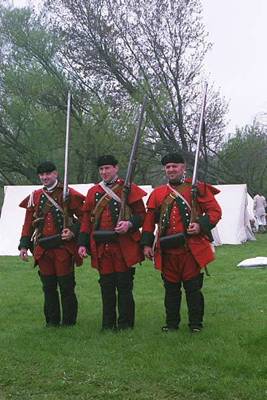
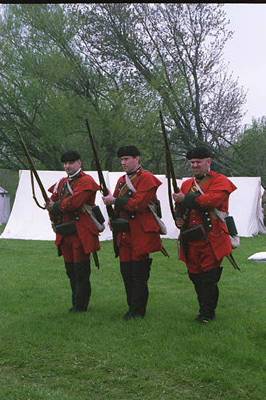
A common sight at events is that
of units drilling, we are no exception.
We can be seen practicing the New Exercise of 1757, the evolutions set
forth in the 1759 version of Bland’s, Wolfe’s alternate system of firing, as
well as the tactics employed by light infantry and rangers. It is our goal to continually research and
work at these in order to master them.
Victory on the field of battle depends upon good training.
Drilling or going through
their motions, target practice or “firing ball,” “bush fighting,” and mock battles were among
the more military duties of the soldier.
Alexander Moneypenny of the 55th Regiment recorded the orders
given on July
28, 1758; “The Regts to be under arms for Exercise,
three times a week. Choosing their own
Days, from six in the morning till eight, in the front of their own encampment,
to practice their men in loading & firing quick, the Recruits & awkward
men of each Regt. to be out twice a Day.” During the winter of 1759 John Knox wrote
that his “regiment daily out at exercise….” In the summer of 1760 General Amherst
reviewed his army to see how they performed the drill, he remarked; “I saw the
1st & 2nd Battn of Royal Highlanders, Montgomerys
& Oughton’s fire two rounds by Platoons three deep, two rounds by Platoons
two deep, the whole loaded with ball.”
They practiced firing
ball at targets. Officers whose men were
good marksmen had a distinct advantage in North
America where fighting took place with men
dispersed, hidden behind trees and rocks.
Henry Skinner recorded in his journal that General Amherst ordered his
regimental commanders “to practice their men at firing at marks, whenever the
weather permitted.” There are several entries in order books and
journals during the 1759 campaign on Forts Ticonderoga and Crown
Point with orders for regiments to practice
firing at marks. At
Fort
Ontario
in 1760, the troops had “stuffed gabions” to shoot at, “that the shot may be
recovered, when ordered to be sought for.” A year earlier the when the Royal Highland
Regiment was ordered to practice musketry, “all the shooting boards [were] to
be covered with paper and a black spot made in the middle.” By the end of the war the British soldier was
indeed very good marksmen, General Amherst boasted; “in general all the men are
so good marksmen that it requires only little practice to keep their hands in.”
Light infantrymen were particularly expected to be good marksmen. Lt.-Col. Roger Townshend wrote in a letter to
Major Robert Rogers that the new light infantry companies “have what ammunition
they want, so I don’t doubt but they will be excellent marksmen.”
John Knox recorded in his journal the qualifications for light
infantrymen, which included that they must be “good marksmen” and “expert at
firing ball.”
“Bush fighting” as it was
called in North America
was practiced quite often by the troops.
Capt. Hugh Arnot of the 80th regiment (Gage’s Light Infantry)
wrote in his journal that in the spring of 1758, the army was “Exercising a new
Method of fighting, forming, and marching, in the Woods.”
One provincial officer wrote in his journal on June 25, 1758; “In the
forenoon we were allarmed by the fireing of several small Arms in the Woods
which was the English Light Infantry….” Later at the battle of Lord Howe’s Landing on
July 5th, he noted how during the skirmish Gage’s men were joined by
“some of the Provincials & a few of the Regulars who acted as Lt Infantry
in the Army’s new Manuvers.” On August 24, 1758, it was ordered that;
“the Regular Regts are to practice marching & forming in the Wood; also
forming & charging in columns of different Depths.”
During the 1760 campaign, troops under General Amherst “were instructed
in the regular and irregular…method of fighting, and exercised in firing ball;
in fine, they were trained up in every particular that prudence, with
experience, could dictate, to render the troops expert in an open or covered country….” William Amherst, commander of a
battalion of light infantry companies wrote on August 13, 1760; “I took the
opportunity of laying here to practise my Corps to march and form in the
woods.”
Every once and a while
the soldier could expect to participate in mock battle to prepare for upcoming
campaigns or expected attacks by the enemy.
John Knox recorded that soon after arrival in Nova
Scotia they were having mock
battles. On July 17, 1757 he wrote;
“Some intrenchments are erecting on the left of the camp, in order to
discipline and instruct the troops, in the methods of attack and defence; and this is to be continued during our stay
here….”
On July 24th he wrote; “This morning the picquets of the
line, with a working party from the army marched to the left of the camp, where
the intrenchments were thrown up; they were formed into distinct bodies; one
half carried on approaches, while the other defended; frequently sallying out
to obstruct the workmen, when the covering parties attacked, repulsed, and
pursued them, making many prisoners; which afforded much mirth to a numerous
crowd of spectators.” Five days later, he again noted the mock
battles; “the troops continue every morning, for several hours, their
counterfeit attacks on the trenches, and are greatly pleased with this kind of
exercise.” Major Moneypenny recorded orders for a mock
battle in preparation for a possible attack by the French after General
Abercromby’s defeat at Ticonderoga
in 1758.
Moneypenny,
Alexander. “The Moneypenny Orderly Book” The Bulletin of the
Fort Ticonderoga
Knox,
John. An Historical Journal of the Campaigns in North America For the Years 1757, 1758, 1759,
Knox,
John. An Historical Journal of the Campaigns in North America For the Years 1757, 1758, 1759,
Stewart,
James. Royal Highland Regiment Copy of
the Order Book of Capt. James Stewart’s Coy, 1759.
Knox. An Historical Journal of the Campaigns in North America For the Years 1757, 1758, 1759,
Moneypenny. “The Moneypenny Orderly
Book” The Bulletin of the Fort
Ticonderoga
Moneypenny. “The Moneypenny Orderly
Book” The Bulletin of the Fort
Ticonderoga
