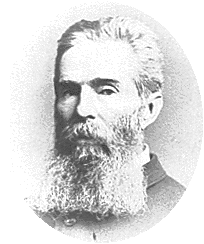
Where do I begin? Aside from Moby Dick and "Bartleby the Scrivener", the works of Herman Melville are largely ignored. This, I feel, is a tragedy. He was probably the most profound fiction writer of the American Romantics. His writing career began with the bestselling adventure novels Typee, Omoo, and Mardi. After the huge success of these, he began to delve deeper into philosophical treatments of American ideals, policies, and lifestyles through a series of young initiate protagonists. Of his first three "deep" novels, Redburn, White-Jacket, and Moby-Dick, only the latter remains widely studied outside of literary circles, a true shame, because the other two, aside from being more readable, are equally valuable as literary texts. Ironically, while we remember Melville most as the author of Moby-Dick, it was a miserable failure in his lifetime.
Moby-Dick was followed by Pierre, by all accounts one of the most brilliant failures in literature. His final published novel was The Confidence-Man (1857), another financial failure, one that some scholars labeled "unfinished" until the mid 1950s; however, by any standard, it is as brilliant as any other work. He continued to publish short stories and poetry throughout his lifetime, as his fame dwindled to obscurity. A fan of Melville's work from Great Britain who visited the aging author in the 1870s was shocked to learn that the author had no complete collection of his own novels. Further evidence of his obscurity arises from mistaken obituaries in the 1880s. Melville died in 1890; but his final published work did not come until 1920, when the manuscript for Billy-Budd, Sailor was discovered among his papers, sparking a Melville revival.
Melville was an excellent poet; however, his poetry - much like the rest of his work - is frequently overlooked. The religious doubt and questioning for which he is known is evident in many. Below is a selection of some of his greatest poems. Scroll down freely, or use the Table of Contents below.
The College Colonel - from Battle-Pieces
Aurora-Borealis - from same
The Mound by the Lake - from same
Far Off-Shore - from Sea Pieces
The Figure-Head - from same
The Maldive Shark - from same
Lone Founts - from Timoleon, etc.
In a Church of Padua - from same
The College Colonel
He rides at their head;
A crutch by his saddle just slants in view,
One slung arm is in splints, you see,
Yet he guides his strong steed - how coldly too.
He brings his regiment home -
Not as they filed two years before,
But a remnant half-tattered, and battered, and worn,
Like castaway sailors, who - stunned
By the surf´s loud roar,
Their mates dragged back and seen no more -
Again and again breast the surge,
And at last crawl, spent, to shore.
A still rigidity and pale-
An Indian aloofness lones his brow;
He has lived a thousand years
Compressed in battle´s pains and prayers,
Marches and watches slow.
There are welcoming shouts, and flags;
Old men off hat to the Boy,
Wreaths from gay balconies fall at his feet,
But to him - there comes alloy.
It is not that a leg is lost,
It is not that an arm is maimed,
It is not that the fever has racked -
Self he has long disclaimed.
But all through the Seven Days´ Fight,
And deep in the Wilderness grim,
And in the field-hospital tent,
And Petersburg crater, and dim
Lean brooding in Libby, there came -
Ah heaven! - what truth to him.
Return to Table of Contents.
Aurora-Borealis (1865)
What power disbands the Northern Lights
After their steely play?
The lonely watcher feels an awe
Of Nature´s sway,
As when appearing,
He marked their flashed uprearing
In the cold gloom -
Retreatings and advancings,
(Like dallyings of doom),
Transitions and enhancings,
And bloody ray.
The phantom-host has failed quite,
Splendor and Terror gone -
Portent or promise - and gives way
To pale, meek Dawn;
The coming, going,
Alike in wonder showing -
Alike the God,
Decreeing and commanding
The million blades that glowed,
The muster and disbanding -
Midnight and Morn.
Return to Table of Contents.
The Mound by the Lake
The grass shall never forget this grave.
When homeward footing it in the sun
After the weary ride by rail
The stripling soldiers passed her door,
Wounded perchance, or wan and pale,
She left her household work undone -
Duly the wayside table spread,
With evergreens shaded, to regale
Each travel-spent and grateful one,
So warm her heart - childless - unwed,
Who like a mother comforted.
Return to Table of Contents.
Far Off-Shore
Look, the raft, a signal flying,
Thin - a shred;
None upon the lashed spars lying,
Quick or dead.
Cries the sea-fowl, hovering over,
"Crew, the crew?"
And the billow, reckless, rover
Sweeps anew!
Return to Table of Contents.
The Figure-Head
The Charles and Emma seaward sped,
(Named from the carven pair at prow)
He so smart, and a curly head,
She tricked forth as a bride knows how:
Pretty stem for the port, I trow!
But iron-rust and alum-spray
And chafing gear, and sun and dew
Vexed this lad and lassie gay,
Tears in their eyes, salt tears nor few;
And the hug relaxed with the failing glue.
But came in end a dismal night,
With creaking beams and ribs that groan,
A black lee-shore and waters white:
Dropped on the reef, the pair lie prone:
O, the breakers dance, but the winds they moan!
Return to Table of Contents.
The Maldive Shark
About the Shark, phlegmatical one,
Pale sot of the Maldive sea,
The sleek little pilot-fish, azure and slim,
How alert in attendance be.
From his saw-pit of mouth, from his charnel of maw
They have nothing of harm to dread,
But liquidly glide on his ghostly flank
Or before his Gorgonian head;
Or lurk in the port of serrated teeth
In white triple tiers of glittering gates,
And there find a leaven when peril´s abroad,
An asylum in jaws of the Fates!
They are friends; and friendly they guide him to prey,
Yet never partake of the treat -
Eyes and brains to the dotard lethargic and dull,
Pale ravener of horrible meat.
Return to Table of Contents.
Lone Founts
Though fast youth´s glorious fable flies,
View not the world with worldling´s eyes;
Nor turn with weather of the time.
Foreclose the coming of surprise:
Stand where Posterity shall stand;
Stand where the Ancients stood before,
And, dipping in lone founts thy hand,
Drink of the never-varying lore:
Wise, once, and wise thence evermore.
Return to Table of Contents.
In a Church of Padua
In vaulted place where shadows flit,
An upright sombre box you see:
A door, but fast, and lattice none,
But punctured holes minutely small
In lateral silver panel square
Above a kneeling-board without,
Suggest an aim if not declare
Who bendeth here the tremulous knee
No glimpse may get of him within,
And he immured may hardly see
The soul confessing there the sin;
Nor yields the low-sieved voice a tone
Whereby the murmurer may be known.
Dread diving-bell! In thee inurned
What hollows the priest must sound,
Descending into consciences
Where more is hid than found
Return to Table of Contents.
Source:
Robillard, Douglas, ed. The Poems of Herman Melville. Kent: Kent State UP, 2000.
As always, if you have any questions, comments, or suggestions, please E-mail me. If you want to learn more about Herman Melville´s life and works, I suggest the following links:
A good, short biography and list of works may be found here.
A more extensive biography and information database may be found here.
There is much more poetry in my Poetry Archive.